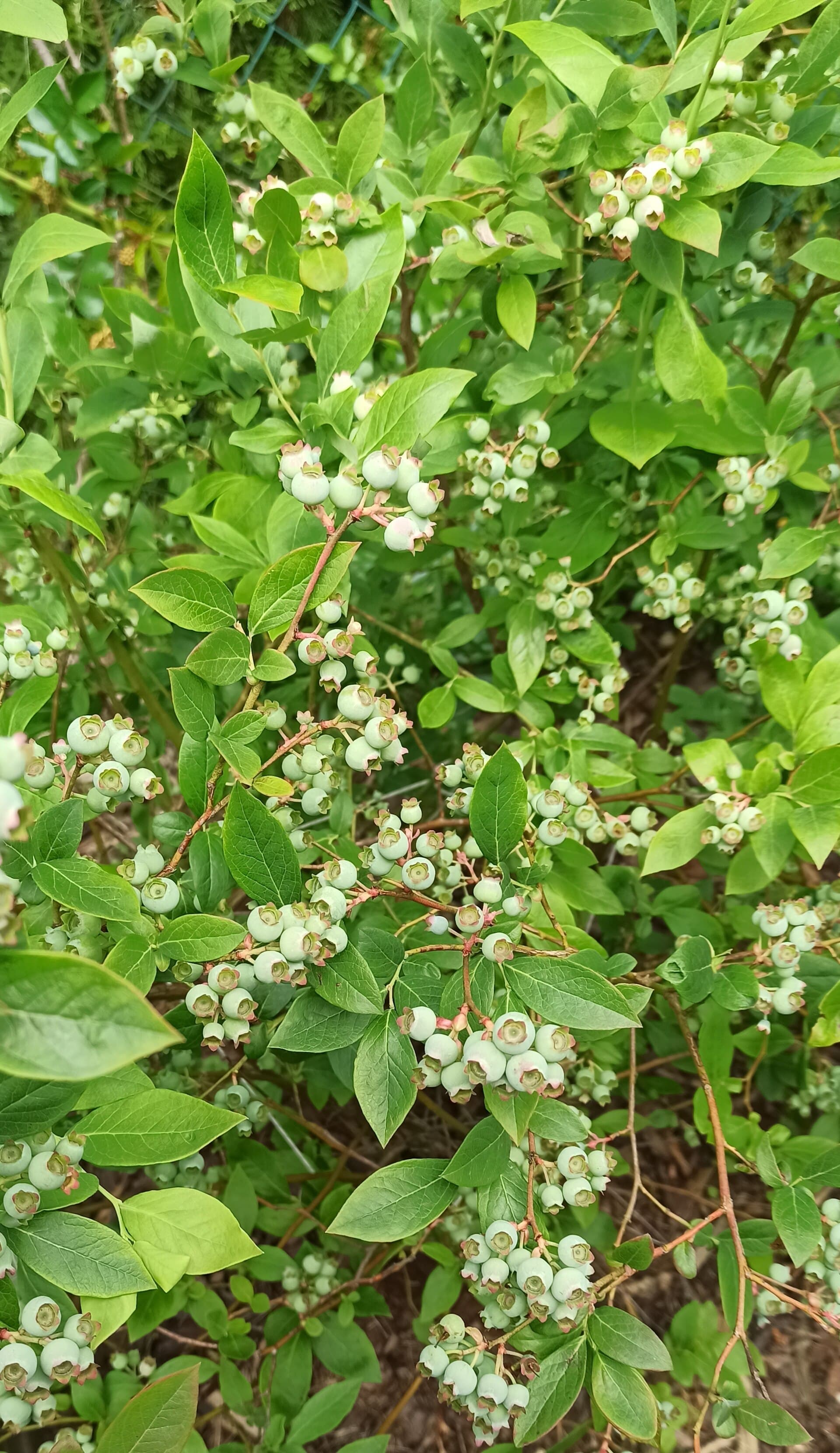
Growing guide
How to grow blueberries
The only fruit here that no nineteenth-century book can help you with, because it had not been invented yet. It is also the one crop where getting the soil wrong cannot be fixed by anything else you do.
Vaccinium corymbosum · Ericaceae, with rhododendron, azalea, heather and cranberry
Above: Aw58 · CC BY 4.0

moderate. Trouble-free for decades once the soil is right, and impossible if it is not. Almost all blueberry difficulty is one problem, pH, showing up as half a dozen different symptoms.
At a glance
- Family
- Ericaceae, rhododendrons and heathers
- Life cycle
- Perennial shrub, productive 20+ years
- Soil pH
- 4.5 to 5.5. This is the whole crop
- Hardiness
- Very hardy; needs winter chill
- Planting
- Autumn or early spring
- Roots
- Shallow, fine, no root hairs, mulch always
- Sun
- Full sun for the heaviest crop
- First real crop
- Third year
- Pollination
- Plant two varieties for a better set
- Biggest single risk
- Ordinary garden soil
The soil is the whole crop
A blueberry is an ericaceous plant, the family that contains rhododendrons, azaleas and heathers, and like its relatives it needs distinctly acid soil, pH 4.5 to 5.5. That is more acid than almost any vegetable wants, and well below ordinary garden soil.
Above about pH 6 the plant cannot take up iron, and the symptom is unmistakable once you know it: new leaves turn yellow while their veins stay green, then redden and scorch at the edges. The bush does not die quickly. It sits, makes a little growth, fruits poorly, and declines over years, which is why the problem so often goes unrecognised.
Test before you plant, not after. A cheap soil test is the single most useful thing you can do for this crop, and it is the only crop on this site where we would say that.
If your soil is not acid, do not fight it in open ground. Amending a bed downward by a full point of pH is a losing battle against the surrounding soil and the water you irrigate with. Grow in containers or a dedicated raised bed filled with ericaceous compost instead, where you control the whole volume.
The maritime Northwest is unusually well placed here: much of the region's soil is naturally on the acid side, which is a substantial part of why Oregon and Washington grow so many blueberries commercially.
Water matters too. Hard tap water is alkaline and will raise the pH of a container over a season. Rainwater is free, soft, and exactly what this plant evolved in.
- pH 4.5–5.5, which is more acid than any vegetable wants.
- Yellow leaves with green veins means the pH is too high, not hunger.
- In non-acid ground, use containers or a dedicated bed. Water with rain.
Planting, roots and mulch
Blueberry roots are fine, shallow and, unusually, have no root hairs, relying instead on a fungal partnership to take up nutrients. Three practical consequences follow, and they explain most of the crop's care.
They dry out fast. A blueberry needs steady moisture through the growing season and suffers quickly in drought, particularly while fruit is sizing.
They cannot be dug around. Never hoe or fork near a blueberry, you will destroy the feeding roots, which are in the top few inches. Weed by hand or, better, by mulching so thoroughly that nothing germinates.
And they want an organic, open rooting medium. Mulch with pine bark, pine needles, sawdust or leaf mould, two to four inches deep, topped up annually. That mulch is not optional decoration; it is doing the job the plant's roots cannot do alone.
Plant in autumn or early spring, at the depth the plant was already growing, and tease the roots out if it is pot-bound, blueberries left in a spiral rarely establish.
Feed only with an ericaceous or acidifying fertiliser. Ordinary balanced feeds and anything containing lime will push the pH the wrong way, and bone meal is a particularly common mistake.
- Fine surface roots with no root hairs: never hoe, always mulch.
- Mulch 2–4″ with pine bark, needles or leaf mould, topped up yearly.
- Ericaceous feed only. Never lime, never bone meal.
Pruning for young wood
Blueberries fruit best on wood that is two to four years old. Older wood keeps living and keeps producing less, so the object of pruning is a bush that is continually renewing itself rather than one that is merely tidy.
For the first two or three years, prune almost nothing, just remove damaged or crossing shoots, and strip off the flowers in the first year so the plant establishes rather than fruits. It costs you one small crop and repays it for twenty years.
From about year four, in late winter, take out one to three of the oldest stems each year, cutting right down to the base. Old wood is recognisable: thicker, greyer, flakier, and carrying twiggy unproductive side shoots. Removing it prompts strong new stems from the crown.
Also take out anything dead, anything crossing through the centre, and any thin twiggy growth at the tips that will make only tiny berries.
The aim is roughly six to eight strong stems of mixed ages on a mature bush, open enough that light and air reach the middle. Beyond that, blueberries need less intervention than almost any other fruit.
- Fruit comes on two- to four-year-old wood. Renewal is the whole point.
- First two years: prune nothing, and remove year-one flowers.
- Then take one to three of the oldest stems to the base each winter.
Two varieties, and getting the fruit before the birds
Most blueberry varieties will set some fruit alone, but nearly all set a heavier crop of larger berries when a second variety flowers alongside them. Two bushes of different varieties is the single cheapest yield improvement available, and choosing ones that overlap in flowering season is the only subtlety.
Picking is the pleasant part and has one rule people routinely get wrong: a blueberry that has turned blue is not necessarily ripe. Give it several more days after colouring, until it drops into your hand at the lightest touch. A berry you have to tug is a berry that will taste sharp.
They ripen in clusters over several weeks, so pick every few days rather than stripping the bush.
Spotted-wing drosophila is the pest that changed soft fruit growing here, and it is worth understanding rather than just spraying at. The ordinary vinegar flies a gardener knows only bother fruit that is already damaged or going over. This one has a saw-edged ovipositor, so the female cuts into sound ripening fruit and lays inside it, and the berry looks perfect until it collapses a day later. The two measures that work in a garden cost nothing: pick every day or two rather than letting fruit hang, since hanging ripe fruit is what it wants, and chill what you pick straight away, because cold slows or kills the eggs already in there. Spinosad is the home treatment the handbook lists, and some formulations of it are approved for organic growing.
Birds will take every berry, and unlike with strawberries they will do it in a morning. Netting on a frame is the only reliable answer, held clear of the bush, secured at ground level, and taken down after harvest so nothing gets caught in it.
Blueberries freeze better than any other fruit here: spread them on a tray, freeze loose, then bag them. They keep their shape and go straight from the freezer into baking.
Sources
- Two varieties flowering together gives more and bigger fruit.
- Blue does not mean ripe. Wait until they release at a touch.
- Net on a frame before they colour, birds strip a bush in hours.
The fruit that did not exist in 1881
There is a book on our shelf called Success with Small Fruits, published in 1881 by a commercial grower who covers strawberries, raspberries, blackberries, currants and gooseberries in exhaustive detail. It does not cover blueberries. Neither does Fearing Burr's 1863 catalogue of American vegetables, and neither does our 1912 planting table.
The reason is simple: there was no such thing as a cultivated blueberry. People gathered wild ones, and repeatedly failed to bring them into gardens, because nobody understood that the plant required acid soil and a fungal root partnership.
That changed in the 1910s at Whitesbog, New Jersey. Frederick Coville, a USDA botanist, worked out the soil chemistry; Elizabeth Coleman White, whose family farmed cranberries there, paid local pickers to find outstanding wild bushes in the Pine Barrens and bring them in. Between them they selected and crossed the first named highbush varieties, and every blueberry in every supermarket descends from that work.
The watercolour below is from that lineage. Brooks, painted for the USDA in 1940 by J. Marion Shull, from a specimen at Whitesbog itself, the place the crop was made.
It is the youngest domesticated fruit most people grow, and it is worth knowing that when a guide tells you blueberries are fussy. They are not fussy. They are wild, and only just.
- No 19th-century book covers blueberries. There were none to cover.
- Domesticated in the 1910s at Whitesbog by Coville and White.
- The youngest fruit in most gardens, wild within living memory.
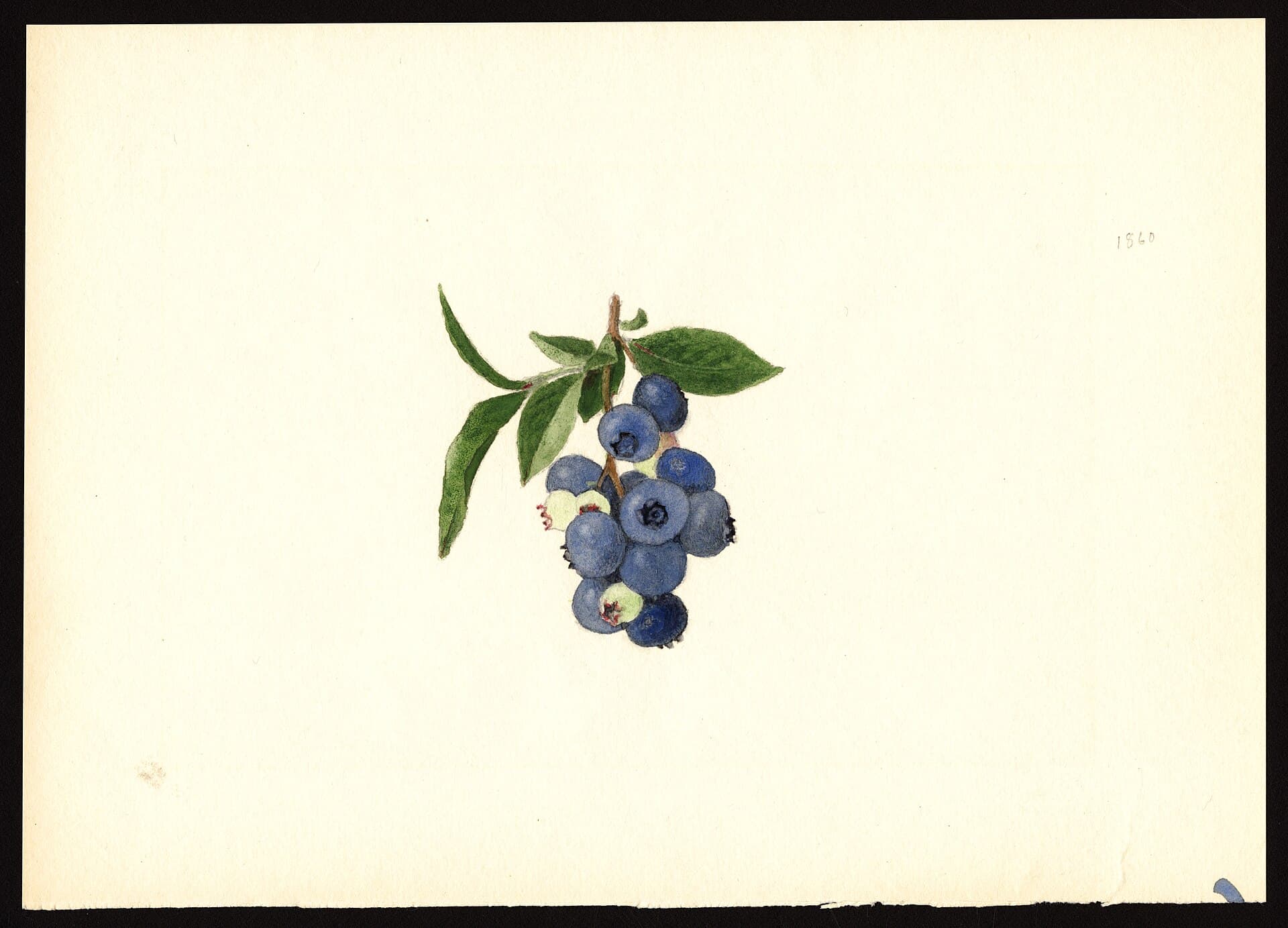
The Brooks blueberry, painted for the USDA in 1940 by J. Marion Shull, from a specimen at Whitesbog, New Jersey, the farm where the highbush blueberry was domesticated barely two decades earlier. The pencilled number at the top right is the collection's accession number, not a date.
Specimen from Whitesbog, Burlington County, New Jersey, 1940 · National Agricultural Library
J. Marion Shull, USDA Pomological Watercolor Collection · Public domain

Which type to grow
Grouped by what each is for rather than by catalogue order, because the useful question is which one suits your ground.
Northern highbush
Upright bush, 4–6ftBest for: Most temperate gardens, including the PNW
The standard type and what nearly every named variety belongs to. Needs real winter chill, which the Northwest supplies. Bluecrop, Duke and Chandler are the varieties most people meet.
Half-high
Compact, 2–4ftBest for: Cold winters and small gardens
Crosses between highbush and the wild lowbush blueberry, bred for hardiness and size. Useful where snow cover is reliable and in containers.
Rabbiteye
Large vigorous bush, 6–10ftBest for: Warmer regions with mild winters
A different species, Vaccinium virgatum, from the American southeast. Needs far less winter chill and tolerates heat, and it is genuinely self-incompatible, so two varieties are required rather than merely helpful.
Lowbush
Spreading mat, under 18″Best for: Ground cover, and the wild flavour
Vaccinium angustifolium, the wild Maine blueberry. Tiny, intensely flavoured fruit on a plant that spreads by rhizome. The closest thing to what people were gathering before the crop was domesticated.
What went wrong
Listed by what you can see, not by what the plant has, you arrive here holding the evidence and without the vocabulary. Where the answer is that nothing can be done this year, it says so.
Yellow leaves with green veins, edges reddening
Fixable nowWhy: Iron deficiency caused by soil that is not acid enough, the classic blueberry failure.
What to do: Test the pH. Mulch with pine bark or needles, feed with an acidifying fertiliser, and water with rainwater. If the ground itself is alkaline, move the plant into a container or a dedicated ericaceous bed; amending open ground rarely holds.
Bush sits and does nothing for years
Next seasonWhy: Same problem, further along, a starved plant rather than a diseased one.
What to do: As above. A blueberry in wrong soil does not fail dramatically, it stalls, and people treat it as a poor variety when it is a pH reading.
Small crop of small berries on a healthy bush
Next seasonWhy: Only one variety, or a bush that has not been pruned for renewal.
What to do: Plant a second variety that flowers at the same time. On bushes over four years old, start taking out one to three of the oldest stems each winter.
Fruit disappears just before you were going to pick it
Fixable nowWhy: Birds. Blueberries are taken faster than any other fruit here.
What to do: Net on a frame before the fruit colours, secured at ground level. Remove it after harvest so birds do not get trapped.
Berries turn blue but taste sharp
Fixable nowWhy: Picked too early. Colour arrives several days before flavour.
What to do: Leave them until they detach at the lightest touch. If you have to pull, it is not ready.
Leaves scorch and fruit shrivels in summer
Fixable nowWhy: Drought. The roots are shallow, fine, and lack root hairs.
What to do: Water deeply and consistently while fruit is sizing, and mulch two to four inches deep. Never hoe near the plant, the feeding roots are in the top few inches.
Growth is weak after feeding
Fixable nowWhy: The wrong fertiliser. Balanced feeds, bone meal and anything with lime push the pH up.
What to do: Use only ericaceous or acidifying feed. This is one of the few crops where the ordinary all-purpose product does active harm.
What’s in blueberries
Per 100 grams raw, from USDA FoodData Central. The range is what USDA actually measured across its samples — it is usually wide, and your own crop sits somewhere in it rather than on the headline number.
| Nutrient | Per 100 g | % daily | Range measured |
|---|---|---|---|
| Vitamin C | 8.059 mg | 9% | 4.295–11.1 (n=8) |
| Iron | 0.3398 mg | 2% | 0–0.603 (n=8) |
| Potassium | 85.64 mg | 2% | 74.2–109.5 (n=8) |
| Magnesium | 6.179 mg | 1% | 4.99–7.82 (n=8) |
| Protein | 0.703125 g | 1% | 0.5–1 |
| Calcium | 11.69 mg | 1% | 6.46–23.5 (n=8) |
| Water | 84.19 g | , | 81.08–87.48 (n=8) |
Source: USDA FoodData Central, “Blueberries, raw” (Foundation, published 10/28/2022). Percentages are of the FDA adult Daily Value, a labelling reference rather than a personal requirement. Raw values; boiling leaches water-soluble vitamins and some carotene, so a cooked serving is not the same figure.
Saving your own seed
Not worth doing, for the usual reason: named blueberry varieties are clones, and seedlings from them are highly variable, mostly smaller-fruited and later, occasionally interesting, never the parent.
Propagation is by cuttings, and it is slow rather than difficult. Hardwood cuttings taken in late winter from one-year-old wood will root in a moist acidic medium over a season, given patience and humidity.
Bear in mind the timescale. A rooted cutting takes three or four years to crop meaningfully, so buying a two-year-old plant is usually the better trade for a household.
The genuinely interesting exception is the historical one. Every cultivated blueberry descends from wild bushes selected in the New Jersey Pine Barrens barely a century ago, so selecting outstanding wild plants and propagating them is not a quaint idea, it is precisely how this crop came to exist, and it happened recently enough that the paperwork survives.
Farm rooted clothing · Est. 2005
The guides are free. The shop is the business.
Sun & Rain Works is a small apparel outfit in Eugene, Oregon, with agricultural roots and a slow path toward farming. The blueberries guide you just read comes from the same place as the shirts.
More growing guides
We're working through the vegetables one at a time, with dates counted from your own frost station and the old books read properly. Occasional notes from Eugene, Oregon, an art business with agricultural roots, working its way toward farming.
We'll email you to confirm before sending anything. After that, occasional seasonal notes from Sun & Rain Works, we won't share your address, and every email has an unsubscribe link.
Growing advice here is current horticultural practice, drafted with AI assistance and checked against the sources this page names. Where it quotes a book, the book is named and linked. Where practice is genuinely contested, or local enough that we would be guessing, the text says so, your county extension service beats any national guide, including this one, on pest timing.
The photographs are not AI-generated. Every one is our own work, public domain, or licensed, and carries its author and licence beneath it.