From the library
The one book written about our summer
Steve Solomon founded Territorial Seed Company, lost his well one June in Lorane, and wrote the only book on our shelf that names our valley. He put it in the public domain himself.
Gardening Without Irrigation: or without much, anyway · Steve Solomon
Gardening Without Irrigation: or without much, anyway, by Steve Solomon, subtitled the Cascadia Gardening Series. Project Gutenberg ebook 4512, released October 2003; the transcription credits Solomon himself as its producer, and Gutenberg records the work as not in copyright.
The title page carries no year, which is why our shelf lists the year as unknown rather than guessing. The internal evidence dates it: the seed-company directory lists Territorial Seed Company at Cottage Grove, and the trial results Solomon reports run to 1992.
Quotes below are verbatim from that transcription. The plain-text file encodes a degree sign as [de] and fractions as [f], and we have printed the characters the book meant rather than reproducing the encoding.
Read the whole book free at Project Gutenberg → We host none of it. Everything in a quoted block below is the book's; everything beneath it is ours.
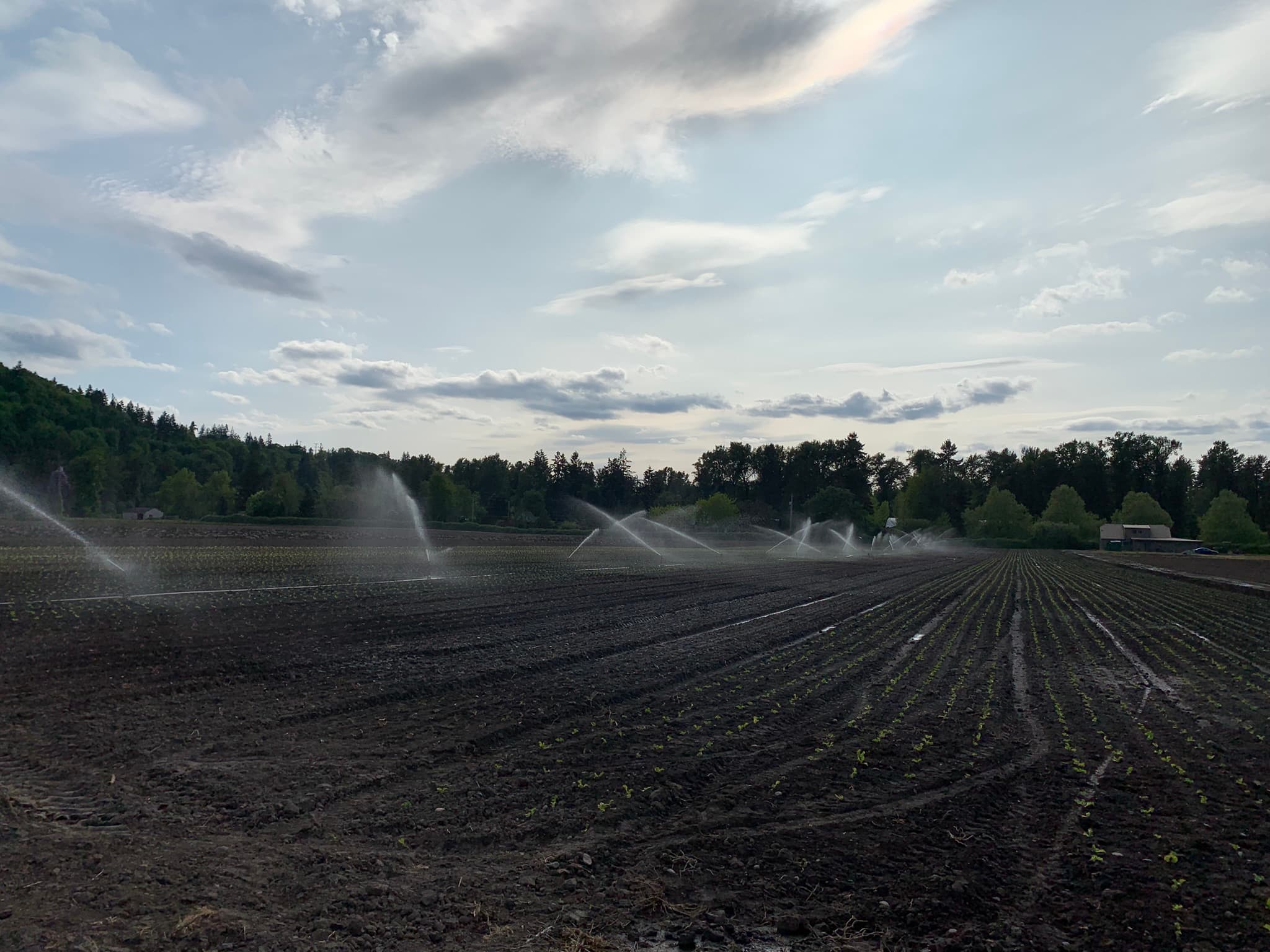
Almost every gardening book sold in the Pacific Northwest was written somewhere else. It tells you to water an inch a week, which is sound advice in Ohio and meaningless here, where it does not rain at all from late June to September and then rains for eight months without stopping.
This is the exception. Solomon homesteaded at Lorane, about twenty miles from where we work in Eugene, and started asking his question when his well fell from fifteen gallons a minute to three. The book that came out of it is not about saving water. It is about whether you could grow food here if you had none to save.
It is also the only book on the shelf that its own author placed in the public domain, which is why we can quote it at length rather than gesturing at it.
- 01
Why the book exists at all
Still holdsWest of the Cascades we go into the summer growing season certain we must water regularly.
Thirty-odd years on this is still the one fact that separates growing here from growing almost anywhere else in the country, and still the fact that general gardening advice is written as though were not true. Everything else in the book follows from it.
- 02
What drought actually is
Still holdsDefined scientifically, drought is not lack of rain. It is a dry soil condition in which plant growth slows or stops and plant survival may be threatened.
The distinction does real work. It means the question is not how much rain fell but how much water your particular soil is holding and how fast your particular planting is drawing it down, which is why the same July kills one garden and not the one next door.
- 03
The argument against raised beds
Mostly holdsOld-fashioned gardens used low plant densities to survive inevitable spells of rainlessness. Looked at this way, widely separated vegetables in widely separated rows may be considered the more efficient users of water because they consume soil moisture that nature freely puts there.
This is the book's central heresy and it is aimed squarely at the intensive-bed orthodoxy that Solomon himself had been teaching. It holds where irrigation is genuinely scarce. It is not an argument that close spacing is wrong in general, if you have water, a tight bed still yields more per square foot, and Solomon keeps one for summer lettuce for exactly that reason.
- 04
The instruction addressed to us
Still holdsInland gardeners farther south or in the Willamette Valley may want to spread their plants out a little farther.
Solomon is writing from Elkton, which he notes is twenty-five miles inland and several degrees cooler in summer than the Willamette Valley. Eugene is the valley he means. It is the rare case of a book telling this brand's own city, by name, to do something differently from the author.
- 05
Why modern seed makes this harder
Mostly holdsMost American vegetables are now bred for irrigation-dependent California. Like raised-bed gardeners, vegetable farmers have discovered that they can make a bigger profit by growing smaller, quick-maturing plants in high-density spacings.
The breeding pressure he describes is real and has not reversed. What has changed since he wrote is the supply side: the seed-saving and regional-breeding networks that barely existed in the early nineties now make the sprawling, deep-rooting older varieties he wanted far easier to find than they were for him.
- 06
A claim we could not check
Mostly holdsYou may be surprised to learn that kale produces more complete protein per area occupied per time involved than any legume, including alfalfa.
Flagged rather than repeated. Kale is genuinely protein-dense for a leaf crop and its amino acid profile is unusually complete, but Solomon gives no source for the comparison against alfalfa and we have not found one. Treat it as the strongest version of a defensible point, not as a figure to quote onward.
- 07
How to tell the book's age
Of its timeTerritorial Seed Company: P.O. Box 20, Cottage Grove, OR 97424
Solomon founded Territorial and then sold it, and the directory of seed houses is the part of the book that has aged hardest, post-office boxes, no web addresses, and several of the companies gone. Check any variety recommendation against a current catalogue. The spacing and soil chapters need no such caution.
- 08
A spacing you can act on tonight
Still holdsSpring-sown lettuce will go to large sizes, remaining sweet and tender without irrigation if spaced 1 foot apart in a single row with 2 feet of elbow room on each side.
Worth reading against our own sowing calendar, which gives lettuce eight inches in the row and fourteen between rows. Both are right for their assumptions. Ours assumes you will water; this one assumes you will not, and buys that with roughly four times the ground per plant.
Summertime rainfall west of the Cascades, in inches
Reproduced from chapter 1, “Predictably Rainless Summers”. Solomon's own source line reads: Van der Leeden et al., The Water Encyclopedia, 2nd ed. (Chelsea, Mich.: Lewis Publishers, 1990).
| Location | April | May | June | July | Aug. | Sept. | Oct. |
|---|---|---|---|---|---|---|---|
| Eureka, CA | 3.0 | 2.1 | 0.7 | 0.1 | 0.3 | 0.7 | 3.2 |
| Medford, OR | 1.0 | 1.4 | 0.98 | 0.3 | 0.3 | 0.6 | 2.1 |
| Eugene, OR | 2.3 | 2.1 | 1.3 | 0.3 | 0.6 | 1.3 | 4.0 |
| Portland, OR | 2.2 | 2.1 | 1.6 | 0.5 | 0.8 | 1.6 | 3.6 |
| Astoria, OR | 4.6 | 2.7 | 2.5 | 1.0 | 1.5 | 2.8 | 6.8 |
| Olympia, WA | 3.1 | 1.9 | 1.6 | 0.7 | 1.2 | 2.1 | 5.3 |
| Seattle, WA | 2.4 | 1.7 | 1.6 | 0.8 | 1.0 | 2.1 | 4.0 |
| Bellingham, WA | 2.3 | 1.8 | 1.9 | 1.0 | 1.1 | 2.0 | 3.7 |
| Vancouver, BC | 3.3 | 2.8 | 2.5 | 1.2 | 1.7 | 3.6 | 5.8 |
| Victoria, BC | 1.2 | 1.0 | 0.9 | 0.4 | 0.6 | 1.5 | 2.8 |
These are the figures as the book prints them, from a 1990 reference. They are not our numbers and are not the NOAA normals behind the growing-season tool, read them as the evidence Solomon was arguing from, not as a current forecast.
What the book cannot tell you
Every date in it is written for a region, because that is the finest grain a printed book can manage. Your frost dates are not a region, they belong to the weather station nearest you, and the same government that published half this shelf has thirty years of records for it.
More from the library
We're working through the public-domain growing literature and marking what still holds. Occasional notes from Eugene, Oregon, an art business with agricultural roots, working its way toward farming.
We'll email you to confirm before sending anything. After that, occasional seasonal notes from Sun & Rain Works, we won't share your address, and every email has an unsubscribe link.
Source: Steve Solomon, “Gardening Without Irrigation: or without much, anyway”. Project Gutenberg ebook 4512, confirmed by Gutenberg as not in copyright. Quotations are verbatim from that transcription. Annotations are our own and are not endorsed by Project Gutenberg or by the transcribers.
Farm rooted clothing · Est. 2005
The guides are free. The shop is the business.
Sun & Rain Works is a small apparel outfit in Eugene, Oregon, with agricultural roots and a slow path toward farming. The annotated reading you just read comes from the same place as the shirts.