Growing guide
How to grow currants
Ordinary in Britain, almost unknown in American gardens, and for a reason that has nothing to do with how it grows: currants were federally banned for half a century to protect the white pine.
Ribes rubrum and Ribes nigrum · Grossulariaceae, with gooseberry and jostaberry
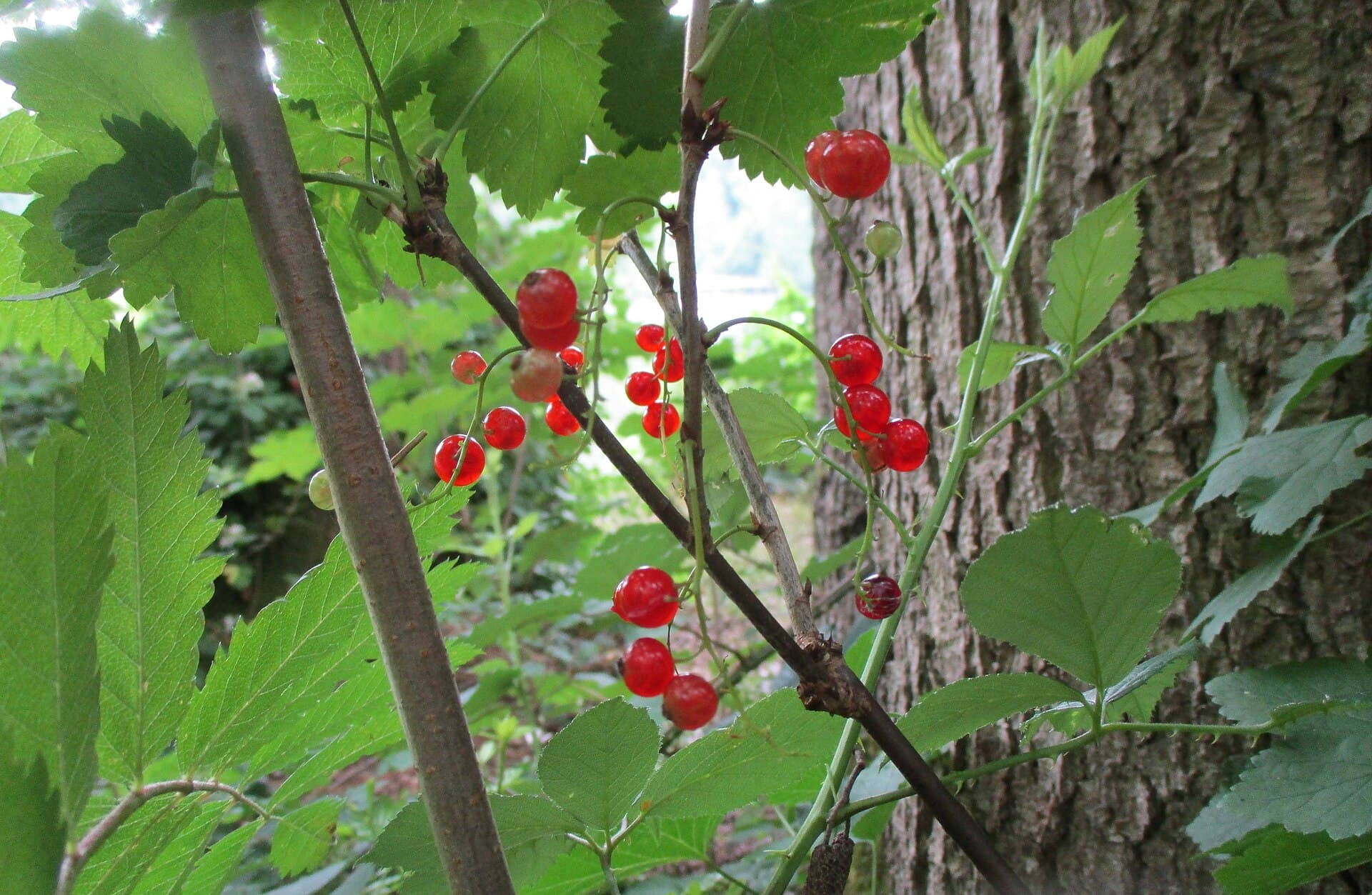
Above: AnRo0002 · CC0

easy. One of the least demanding fruits there is, hardy, shade-tolerant, long-lived and largely untroubled. The only genuine complication is legal rather than horticultural, and it is worth checking before you buy.
At a glance
- Family
- Grossulariaceae, with gooseberries
- Life cycle
- Perennial bush, productive 15+ years
- Hardiness
- Very hardy; wants winter chill
- Planting
- Bare-root in winter dormancy
- Sun
- Full sun to genuine part shade
- Soil
- Most soils; dislikes waterlogging
- First crop
- Second year, full crop by year four
- Pollination
- Self-fertile, one bush is enough
- Spacing
- 4–5ft apart
- Before you buy
- Check your state's Ribes rules
The fruit that was made illegal
There is a reason currants are everywhere in British gardens and almost nowhere in American ones, and it is not climate or taste. It is white pine blister rust.
The fungus needs two hosts to complete its life cycle: a five-needled pine, and a Ribes, a currant or gooseberry. It arrived in North America early in the twentieth century and threatened the eastern white pine, then one of the most valuable timber trees on the continent.
The federal response was drastic. From 1911 onwards, programmes to eradicate Ribes were organised across the pine states, and a federal ban on growing currants followed. Crews pulled wild and cultivated bushes out by hand across whole regions. An ordinary garden fruit was removed from American life by policy.
The federal prohibition was lifted in 1966 and control passed to the states. Some lifted their restrictions entirely; others kept them, and several still restrict or prohibit planting Ribes, sometimes only for blackcurrants, sometimes county by county.
So this is the one crop on this site where the first question is legal rather than horticultural. Check your state's current rules before you buy, and if there is a restriction, look for certified rust-immune cultivars, several were bred precisely to satisfy it.
The lasting effect is a whole generation of American gardeners who have never tasted a blackcurrant, growing up in a country that removed it deliberately. Read Roe's 1881 chapters on currants against that: he is writing about a completely standard fruit, thirty years before it became contraband.
Sources
- Ribes host white pine blister rust, so currants were federally banned.
- The federal ban ended in 1966; some states still restrict planting.
- Check your state before buying, and look for rust-immune cultivars.
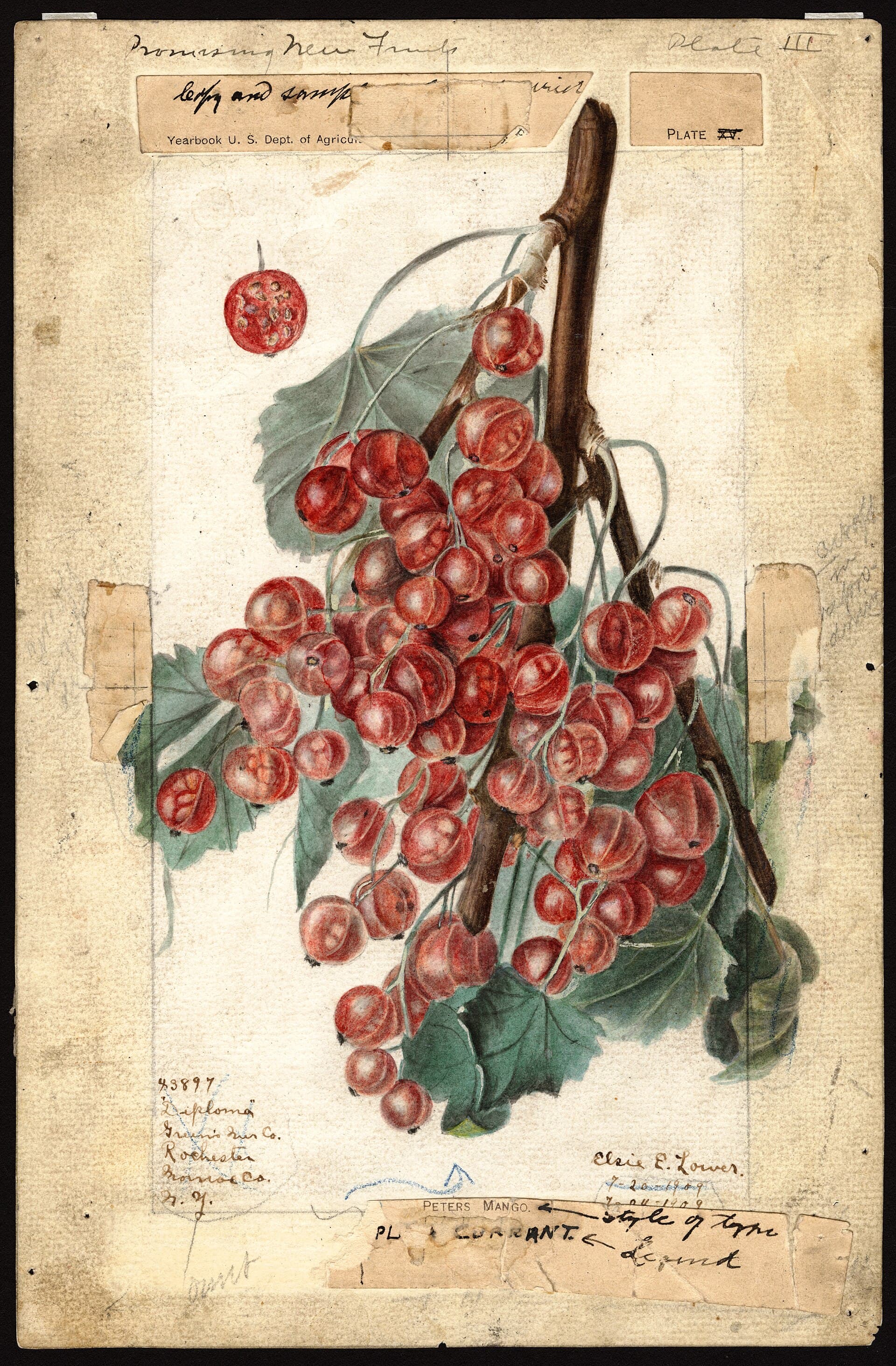
The Diploma redcurrant, painted for a USDA Yearbook plate headed “Promising New Fruits” and dated 1909, two years before the blister rust programme began. A nursery in Rochester, New York had sent in a variety it expected to sell. Wikimedia files this sheet under gooseberries; the plate itself is annotated CURRANT, and the fruit is unmistakably one.
Specimen from Green's Nursery Co., Rochester, Monroe County, New York, 24 July 1909 · National Agricultural Library
Elsie Lower Pomeroy, USDA Pomological Watercolor Collection · Public domain

Red and black are pruned in opposite ways
They look like the same plant and they are not. Redcurrants and whitecurrants fruit on old wood, at the base of last year's shoots and on short permanent spurs. Blackcurrants fruit on young wood, shoots produced the previous season.
That single difference reverses the pruning entirely, and it is the mistake that costs people a crop.
Redcurrants and whitecurrants are pruned like a miniature apple tree. Build a permanent framework of eight to ten main branches on a short leg, then each winter shorten the side shoots back to one or two buds. The structure persists for years and the fruit comes off it.
Blackcurrants are pruned like a raspberry. Cut roughly a quarter to a third of the oldest stems right down to the ground each winter and leave the young ones alone. There is no permanent framework; the bush is continually replacing itself from the base.
Prune a blackcurrant like a redcurrant, trimming the tips and keeping the old wood, and you get a thicket of ageing stems and very little fruit. It is the same class of error as pruning an autumn raspberry as though it were a summer one, and it fails just as quietly.
- Red and white fruit on old wood; black fruits on young wood.
- Red: build a permanent framework, spur-prune side shoots each winter.
- Black: cut a quarter to a third of the oldest stems to the ground.
The crop for the difficult corner
Currants are among the very few fruits that give a real crop in part shade. A redcurrant will fruit usefully on a north-facing wall or under the edge of a tree canopy, where a strawberry or an apple would sulk.
That makes them the answer to a specific garden problem: the shaded corner nothing wants. They will crop more heavily in sun, but unlike most fruit the shaded version is still worth having, and the fruit hangs longer without going over.
They are hardy well beyond anything the maritime Northwest offers, tolerate a wide range of soils, and want only reasonable drainage and a mulch. They are also self-fertile, one bush crops perfectly well alone, which none of the tree fruit does.
The one thing to plan around is birds. Redcurrants in particular are taken the moment they colour, and they colour weeks before they are sweet. A fruit cage or netting on a frame is the difference between a crop and a nice display for the blackbirds.
Pick whole strigs rather than individual berries, and strip them from the stalk afterwards, a table fork run down the strig does it in seconds.
- Real crops in part shade, where almost no other fruit obliges.
- Self-fertile: one bush is a crop, no pollination partner required.
- Pick whole strigs, then strip with a fork. Net before they colour.
What they are actually for
Currants are high in pectin and high in acid, which is precisely why they are a preserving fruit rather than a dessert one. Redcurrant jelly sets without help from anything, and a handful of redcurrants thrown into a low-pectin jam will set that too.
Blackcurrants are the strongest-flavoured fruit most gardens can grow, and unusually high in vitamin C, the reason Britain planted them intensively during the Second World War when citrus imports stopped, and the origin of the cordial that is still sold there.
Whitecurrants are a redcurrant without the pigment: milder, sweeter, and the one currant genuinely pleasant to eat raw off the bush.
All of them freeze well without any preparation beyond removing the stalks, and all of them are better cooked than they are fresh, which is the opposite of every other fruit on this site and worth knowing before you plant six bushes.
- High pectin and high acid: a preserving fruit, not a dessert one.
- Redcurrants will set a low-pectin jam without added pectin.
- Whitecurrants are the one worth eating straight off the bush.
Which type to grow
Grouped by what each is for rather than by catalogue order, because the useful question is which one suits your ground.
Redcurrant
Translucent red berries in hanging strigsBest for: Jelly, and cropping in shade
The most ornamental of the three and the highest in pectin. Fruits on old wood, so it is spur-pruned onto a permanent framework, and it trains beautifully as a cordon or fan against a shaded wall.
Blackcurrant
Matt black berries, aromatic leavesBest for: Flavour and vitamin C
The strongest-tasting fruit in most gardens, and the one most often restricted by state Ribes rules, check before buying. Fruits on young wood, so it is stooled hard each winter like a raspberry.
Whitecurrant
Pale translucent berriesBest for: Eating fresh
A redcurrant without the red pigment, and sweeter for it. Grown and pruned identically. Birds notice them slightly less, which is a real advantage.
Jostaberry
Vigorous thornless bush, large dark berriesBest for: Vigour, and no thorns
A blackcurrant–gooseberry hybrid. Bigger and tougher than either parent, thornless, and generally resistant to blister rust, which in a restricted state can make it the practical substitute.
What went wrong
Listed by what you can see, not by what the plant has, you arrive here holding the evidence and without the vocabulary. Where the answer is that nothing can be done this year, it says so.
You cannot legally buy or plant them
Next seasonWhy: State restrictions on Ribes, left over from the white pine blister rust programme.
What to do: Check current state rules, they have changed repeatedly and vary by species and sometimes by county. Where restricted, look for certified rust-immune cultivars, or grow a jostaberry.
Blackcurrant makes plenty of growth and little fruit
Next seasonWhy: Pruned like a redcurrant, old wood kept, tips trimmed.
What to do: Cut a quarter to a third of the oldest stems to ground level this winter and repeat annually. Blackcurrants fruit on young wood and need to keep replacing themselves.
Redcurrant is a thicket of shoots with fruit only at the edges
Next seasonWhy: Pruned like a blackcurrant, the permanent framework was removed.
What to do: Rebuild a framework of eight to ten well-placed branches over a season or two, then spur-prune side shoots back to one or two buds each winter.
Fruit gone as soon as it colours
Fixable nowWhy: Birds, which find redcurrants long before they are ripe.
What to do: Net on a frame or use a fruit cage, in place before the fruit begins to colour rather than after.
Orange or yellow pustules on the undersides of leaves
Fixable nowWhy: A rust, possibly white pine blister rust, which is the reason for the restrictions.
What to do: Remove and destroy affected leaves and improve airflow. If white pines grow nearby, this matters beyond your garden; check local guidance rather than treating it as a cosmetic problem.
Buds swell abnormally round in winter and fail to open
Fixable nowWhy: Big bud mite, which also transmits reversion virus in blackcurrants.
What to do: Pick off and destroy swollen buds in winter. A bush that has lost its aroma and stopped cropping has reversion and should be removed, there is no cure.
Leaves scorch and drop in a dry summer
Fixable nowWhy: Shallow roots drying out.
What to do: Mulch thickly each spring and water in prolonged dry spells. Currants are surface-rooted, which is also why you should never dig around them.
What’s in currants
Per 100 grams raw, from USDA FoodData Central. The range is what USDA actually measured across its samples — it is usually wide, and your own crop sits somewhere in it rather than on the headline number.
| Nutrient | Per 100 g | % daily | Range measured |
|---|---|---|---|
| Vitamin C | 41 mg | 46% | , |
| Fibre | 4.3 g | 15% | , |
| Vitamin K | 11 µg | 9% | , |
| Potassium | 275 mg | 6% | , |
| Iron | 1 mg | 6% | , |
| Magnesium | 13 mg | 3% | , |
| Protein | 1.4 g | 3% | , |
| Calcium | 33 mg | 3% | , |
| Folate | 8 µg | 2% | , |
| Vitamin A | 2 µg | 0% | , |
| Water | 83.95 g | , | , |
| Energy | 56 kcal | , | , |
Source: USDA FoodData Central, “Currants, red and white, raw” (SR Legacy, published 4/1/2019). Percentages are of the FDA adult Daily Value, a labelling reference rather than a personal requirement. Raw values; boiling leaches water-soluble vitamins and some carotene, so a cooked serving is not the same figure.
What the wartime archive says about currants
2 passages from the USDA’s 1943–46 victory garden material, with our note on whether each still holds. Pulled from the annotations themselves rather than listed here by hand.
- The jelly that would not jellStill holds
NANCY: (SOBBING) Look at it, look at it! It didn't jell!... It's done for, and so's my valuable sugar! ... FREYMAN: But that is bad, Johnny — wasting valuable sugar experimenting with jelly recipes, if you aren't exactly sure how to do it.
Consumer Time · July 7, 1945
- Fruit at homeStill holds
Strawberries, bush fruits and grapes can be grown fairly easily in many, many areas. Cherries, plums and perhaps other stone fruits, likewise, are adapted to many areas. Apple and pears, because of insects and disease are more difficult to…
A Victory Garden Program for 1945
Saving your own seed
Not done, for the usual reason: named varieties are clones and seedlings are variable, mostly inferior, and take years to show what they are.
Propagation is by hardwood cuttings and it is among the easiest of any fruit. In late autumn, cut a pencil-thick length of this year's wood about eight inches long, push two thirds of it into a slit trench of gritty soil, and leave it alone for a year. A very high proportion root.
For blackcurrants, leave all the buds on and bury two thirds, you want multiple shoots from below ground, because the bush is meant to keep renewing from the base. For redcurrants and whitecurrants, rub off the lower buds so the plant makes a short clear leg with a framework above it. The pruning logic starts at the cutting.
One caution specific to this crop: do not propagate a blackcurrant that has lost its strong aroma or stopped cropping well. Reversion virus travels with the cutting, and you would be multiplying an infected plant.
And check your state's rules before moving Ribes material about. This is the one fruit where propagation can be a regulatory question as well as a horticultural one.
Farm rooted clothing · Est. 2005
The guides are free. The shop is the business.
Sun & Rain Works is a small apparel outfit in Eugene, Oregon, with agricultural roots and a slow path toward farming. The currants guide you just read comes from the same place as the shirts.
More growing guides
We're working through the vegetables one at a time, with dates counted from your own frost station and the old books read properly. Occasional notes from Eugene, Oregon, an art business with agricultural roots, working its way toward farming.
We'll email you to confirm before sending anything. After that, occasional seasonal notes from Sun & Rain Works, we won't share your address, and every email has an unsubscribe link.
Growing advice here is current horticultural practice, drafted with AI assistance and checked against the sources this page names. Where it quotes a book, the book is named and linked. Where practice is genuinely contested, or local enough that we would be guessing, the text says so, your county extension service beats any national guide, including this one, on pest timing.
The photographs are not AI-generated. Every one is our own work, public domain, or licensed, and carries its author and licence beneath it.