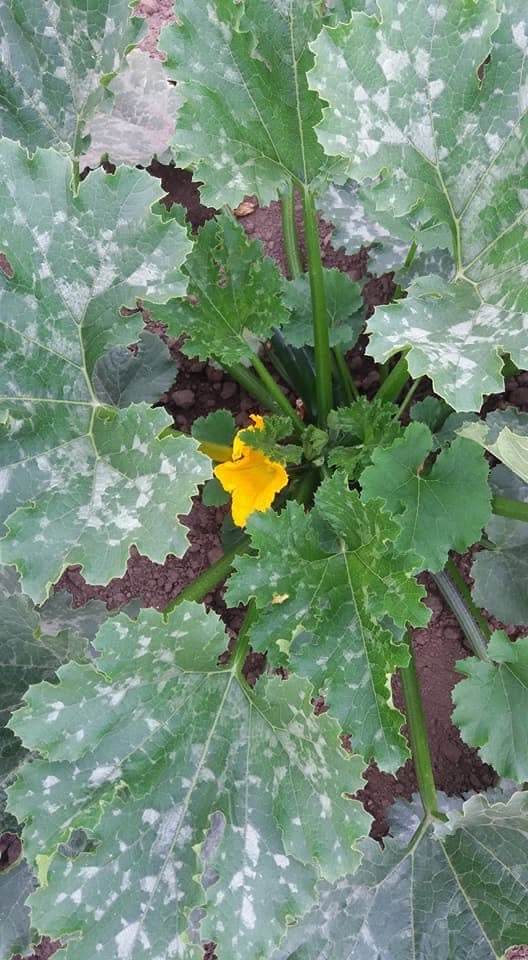
When things go wrong
Drought, flood, insects, damping-off and tomato disorders, the half of growing that most instruction skips. Plus the broadcast where the Department admits the exception to its own advice about seed.
What this is. 8 USDA radio scripts from 1942 to 1945, grouped by subject rather than by series, the second themed group drawn from the archive's 44 loose broadcasts. We read all 8 and quote 7. Scanned by the National Agricultural Library; every script is listed and linked at the foot of this page.
The split, confirmed. The 1944 insect guide divides cleanly: every mechanical and cultural control in it is still recommended, and nearly every chemical has been withdrawn. These six further documents show the same division holding, the diagnostic reasoning is almost all current, and the one insecticide recommendation has since reversed.
A dating problem, declared. Two 1945 spot announcements went out “on receipt” and their release stamps did not survive the scan. Those are cited by title rather than by a date we would have had to guess at.
How we transcribed them. Two of these scans are worse than the archive average; one carries most of a page of noise the scanner read as text, which is not quoted. “Tomotoes”, “snail” for “small”, “bare seed” for “bear seed”, repaired. “Wreck havoc” and “bienniel” are the typist's own and stand. Everything in a quoted block is the USDA's; everything beneath it is ours.
Diagnosis aged better than treatment
Sort tomato troubles into parasitic and non-parasitic before reaching for anything. Water once a week until the moisture is seven or eight inches down, rather than sprinkling daily and training the roots to live at the surface. Don't pick beans when the leaves are wet. Find out what the insect is before you treat it. Every one of those is current, and the last is the founding principle of integrated pest management stated in a four-hundred-word supply announcement.
The one recommendation that has reversed is a substitution forced by the war: use rotenone, since pyrethrum is unobtainable. Eighty years on, pyrethrins are still permitted and rotenone is not.
- 01
How much water counts as watering
Still holdsIf there are no rains for seven or eight days, you'd better do something about it. Don't just sprinkle a bit each day. That just brings the roots up near the surface. Do a real job of pinch-hitting for the rain. If you use a sprinkler, leave it on about three hours... remember that advice about soaking the soil. And that means getting the moisture down seven or eight inches.
The most useful watering advice in the whole archive, and the mistake it names is the one nearly everybody makes. A daily light sprinkle wets the top inch, the plant responds by rooting in the top inch, and the garden is then permanently a day from disaster. A long soak once a week sends roots down after it and buys drought tolerance the plant builds itself. Seven or eight inches is still the target, and the way to know you have hit it is to push a trowel in and look, not to time it.
- 02
Mulch, and how thick is too thick
Mostly holdsYou'll find a mulch helps conserve the water. Grass clippings make a good mulch, or any vegetation that has no weed seeds in it. Put it between the rows and around the plants. But don't spread it on too thick. A good depth for the mulch, after it settles down, is about two inches. If it were too deep, it would absorb the water from any light rain that might come.
The caution is real and almost never given: a deep loose mulch intercepts light rain and holds it where no root will reach, so the ground under a six-inch layer of dry clippings can be drier than bare soil. Two settled inches is a fair figure for grass clippings and straw. The caveat is that thickness depends on the material, a coarse bark or wood chip mulch is mostly air and can go deeper, and the fine-material warning here is specifically about what a 1944 gardener had to hand. The weed-seed clause matters too, which is why clippings from a lawn gone to seed are a bad idea.
- 03
Parasitic and non-parasitic
Still holdsTomatoes, the plant pathologists say, are subject to two different classes of diseases. They may suffer from either non-parasitic ailments, or from parasitic ailments. The non-parasitic troubles that may beset your tomatoes come from too little or too much water, and from too little or too much of certain mineral elements in the soil.
The single most useful distinction anyone can hold when a plant looks wrong, and it is the one people skip on the way to buying a spray. Half of what goes wrong with a tomato is not an organism at all, blossom-end rot, cracking, catfacing, leaf roll, sunscald, and no fungicide or insecticide touches any of it, because there is nothing alive to kill. The modern vocabulary says abiotic and biotic. The 1944 words are clearer.
- 04
Blossom-end rot, diagnosed by weather
Still holdsThis is caused by having very good growing weather while the fruit is small, then a severe drought. Well, the remedy for that ailment is to get busy with the hose before the drought has caused serious damage. Give the plants a good soaking about once a week and be sure to leave the hose running until the moisture has gone down seven or eight inches.
Sharper than the 1943 tomato broadcast, which said only that blossom-end rot comes from uneven watering. This one names the actual sequence: fast growth while the fruit is expanding, then a check. That is precisely when calcium delivery fails, because calcium moves only in the transpiration stream and a fruit growing at speed in dry soil cannot pull enough of it to the far end. The fix is the same one the same broadcast gives for everything, a real soaking, weekly, rather than a daily sprinkle.
- 05
The flood worm
Still holdsMany of the insect pests that you had to look out for in your early garden were carried away by the flood. But one insect to guard against in your after-flood garden is the cutworm. For odd as it may seem, one kind of cutworm seems to follow floods, so much so that it often goes by the name of “flood worm” or “overflow worm”.
A genuinely obscure and genuinely real observation. Several cutworm species are associated with river bottoms and flood-deposited ground, and the common name survives in the entomological literature. The mechanism is prosaic: high water strips out the resident insect population and the ground that dries afterwards is bare, warm and freshly silted, ideal for a moth looking for somewhere to lay. The instruction that follows is the archive's standard one, paper collars, which is the fourth document here to land on it.
- 06
Replanting a flooded garden
Still holdsSnap beans need a fairly rich soil, but too much fertilizer makes snap beans grow more to leaves than beans. On the other hand, for lima beans you can hardly have soil too rich... Lima beans are warm weather beans. They suffer from cold and too much wet. Be sure the ground has dried out enough when you plant them.
Two beans, opposite feeding requirements, in consecutive sentences, and it is still the thing people get wrong, because “beans” reads as one crop. Snap beans fix their own nitrogen and respond to a rich bed by making foliage; limas are hungrier and slower and want both the richness and the heat. The instruction to wait for the ground to dry is doing double duty in a broadcast about flooding: sowing into cold wet soil is how seed rots rather than germinates.
- 07
Don't work among wet beans
Still holdsRemember not to gather beans or work around beans when the leaves are wet with dew or rain. This tends to spread disease.
One line, no explanation, and completely correct. Bean rust, anthracnose and bacterial blight all move in a film of water, and the most efficient vector in any garden is the gardener, a sleeve brushing down a wet row carries spores the length of it. The rule is simple enough to keep: pick beans in the afternoon. It applies to peas and tomatoes for the same reason.
- 08
Identify before you treat
Still holdsWhat is being ready for them? Well, we need to know what insect is causing the trouble, and the treatment for it... if some insect you don't recognize or know the treatment for starts working on your plants, you'll want to get in touch with the local victory garden leader or your county agricultural agent immediately.
The first principle of integrated pest management, stated plainly in a four-hundred-word spot about supply logistics. Identify, then treat, then only the thing identified, and where you cannot identify it, ask somebody who can. The county extension office named here still exists in every state and still answers this exact question, which makes this the rare piece of 1945 advice whose recommended institution is unchanged.
- 09
Seed treatment against damping-off
Mostly holdsMany of the diseases that hurt our vegetable crops are caused by bacteria or fungi carried on, in or with the seed. For example, many plants are nipped in the sprout, so to speak, by seed decay and “damping off”... it's a term used to describe the effects of a fungus growth. Damping off attacks seedlings when they've barely poked through the earth and makes them wilt away.
The description of damping-off is exact, including the part that makes it so demoralising, the seedling emerges looking perfectly well and then topples at soil level. The practice has since split in two. Commercial seed of many crops now arrives already treated, usually dyed a warning colour, so the shaking-in-a-jar step the broadcast describes has moved up the supply chain. For untreated or saved seed the home answer is cultural rather than chemical: sterile starting mix, air movement, bottom watering, and not sowing into a cold wet tray, because the fungi involved are always present and it is the conditions that decide.
- 10
The false economy of saving seed
Mostly holdsIt's false economy for gardeners to save seed of many vegetables from this year's garden to plant next year. Producing high grade vegetable seed is one of the most difficult jobs in the agricultural field. Experts at it work under controlled conditions. They guard against plant disease. They get a high percent of germination. They take care to avoid cross pollination between different varieties. A home gardener is not prepared to do this.
The same position the Department gave a listener on Question Box in August 1943, restated two years on with the same six biennial crops named. Every individual claim is true, seed growing is a specialist trade and commercial seed is cleaner, more uniform and better tested than anything a garden produces. What does not follow is the leap from “many vegetables” to a general rule, which is how most people came to believe that saving seed is beyond them. It is beyond them for cabbage. It is not beyond them for beans.
- 11
Hybrid sweet corn, the one that is simply right
Still holdsThe experienced gardeners warn us particularly against putting aside any hybrid sweet corn to plant next year. The puppies from a mongrel litter have nothing, when it comes to variety, on the assortment of corn plants that come from such seed.
Correct, and it is the clearest statement of the hybrid problem in the archive. An F1 hybrid is uniform because both its parents were inbred; save its seed and the next generation segregates, so a row that was one plant last year becomes a dozen different plants of assorted height, timing and sweetness. This is why hybrid and open-pollinated is the distinction that actually matters when you are deciding what to save, not old versus new, and not the word heirloom.
- 12
“Of course, there's always an exception”
Mostly holdsThe wise Victory gardener won't bother to save seed of most crops. Of course, there's always an exception. Tomatoes and a few other crops come under that heading. But even with these, which are fairly safe, a gardener will want to get expert advice before trying to save them at home.
The sentence the 1943 answer never contained, and it changes the shape of the whole position. Tomatoes are self-pollinating, so they come true without isolation and are about as difficult to save as remembering which fruit you liked, and beans, peas and lettuce are in the same category. Having admitted the exception the broadcast immediately retreats from it, advising expert consultation and then suggesting the listener leave it to the professionals anyway. But it is on the record, in 1945, in the campaign usually blamed for teaching a generation that seed comes from a shop.
- 13
The love apple and the Supreme Court
Still holdsIt took the highest court in the land — the Supreme Court of the United States — to designate it as fruit or vegetable... Once this fruit, which we commonly consider a vegetable, was thought to be poisonous to eat, so it was used merely as a decoration and called the “love apple”.
Both stories are true and both are usually told wrong. The case is Nix v. Hedden, 1893, and it turned on a tariff that taxed imported vegetables and not fruit; the Court held that a tomato is botanically a fruit but a vegetable in ordinary speech, and taxed it accordingly. The poison reputation was not simple superstition either, the tomato is a nightshade, its leaves and stems really are toxic, and the family it belongs to contains genuinely dangerous plants. Guilt by association, and it took the better part of two centuries to shake off.
“Of course, there's always an exception”
In August 1943 the Department told a listener not to save her own seed and gave no exceptions. In August 1945 it made the same argument, and then admitted one. Tomatoes, and a few others. It retreats in the very next sentence, but it is on the record: the campaign usually blamed for teaching a generation that seed comes from a shop knew perfectly well where the line fell.
All 8 broadcasts
In order, each linked to its scan. Marked scripts are quoted above; the rest we read and took nothing from, which is worth saying rather than leaving them off the list.
- June 29, 1942Quoted
A marketing broadcast on the week's Victory Food Special, given over largely to the tomato's reputation, the love apple, the poison scare, and the Supreme Court.
- Release immediateQuoted
What to do with a garden after a flood: what can still be sown, and the cutworm that follows high water so reliably it has a name for it.
Tomato history and marketing rather than growing, the 1893 tariff case, the love-apple years, and why gardeners planted extra that summer.
- July 19, 1944Quoted
July's two enemies: drought and insects. How much water counts as watering, and how to mulch, including how thick is too thick.
- July 25, 1944Quoted
Tomato disorders sorted into parasitic and non-parasitic, with blossom-end rot as the worked example and a general watering rule.
- May 18, 1945Quoted
Insecticide supply for the 1945 season, and the instruction to identify the insect before treating it.
Seed treatment against damping-off and seed-borne disease, a practice that has since split in two directions.
- August 2, 1945Quoted
Why not to save seed, the 1943 Question Box answer restated, extended to hybrid sweet corn, and then quietly qualified in a way the 1943 version never was.
More from the archive
We're working through the USDA's victory garden material and marking what still holds. Occasional notes from Eugene, Oregon, an art business with agricultural roots, working its way toward farming.
We'll email you to confirm before sending anything. After that, occasional seasonal notes from Sun & Rain Works, we won't share your address, and every email has an unsubscribe link.
Sources: U.S. Department of Agriculture, Office of Information, 8 radio scripts 1942–1945. Digitised by the National Agricultural Library; archive identifiers are linked above. Public domain as works of the U.S. federal government. Annotations are our own and are not endorsed by the USDA. Nothing on this page is pesticide guidance, for current recommendations consult your state extension service.
Farm rooted clothing · Est. 2005
The guides are free. The shop is the business.
Sun & Rain Works is a small apparel outfit in Eugene, Oregon, with agricultural roots and a slow path toward farming. The wartime radio broadcast you just read comes from the same place as the shirts.