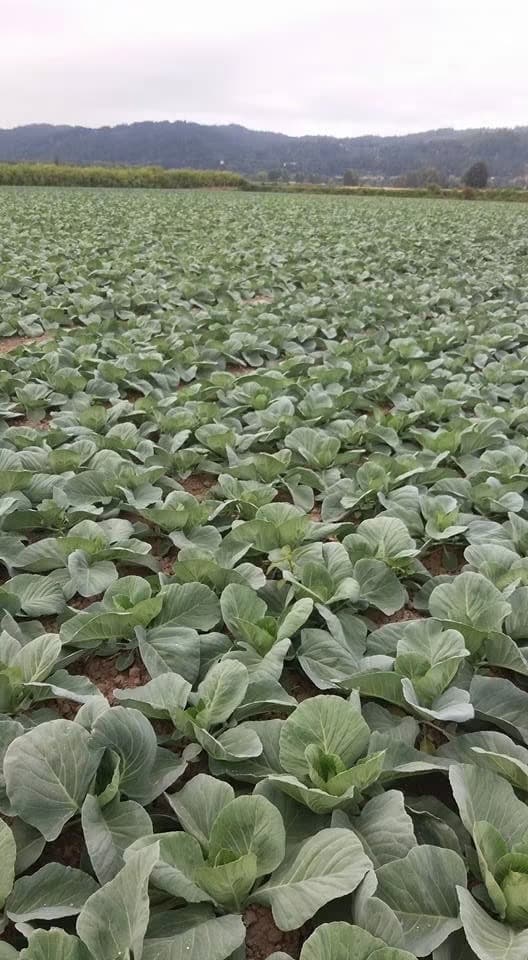
Pests and diseases
Three short leaflets alongside the 1944 insect guide. One of them explains, in a paragraph about black rot, why the world's cabbage seed is grown an hour from here.
What this is. 3 USDA bulletins from 1943 and 1944, sitting alongside the 1944 Victory Garden Insect Guide, which has its own page. We read all 3 and quote 3. Scanned by the National Agricultural Library; each is listed and linked at the foot of this page.
What these add to the guide. Disease, which the guide barely covers, resistant varieties by name, and where seed is grown. And the explanation the guide never gives for why the campaign's chemistry was in the state it was in.
On chemicals. These leaflets name arsenicals and fluorine compounds, and one gives a bait recipe. As on the insect guide page, no dose or mixing ratio for a withdrawn chemical is reproduced here, recording that a bait used paris green is history; repeating how much to use would be a recipe. The insect guide carries the full safety notice.
A table we did not reproduce. “Prevent Vegetable Diseases” prints a two-column list of resistant varieties, and the scanner has interleaved the columns, variety names survive but their headings often do not. Only pairings we could verify from the surrounding text are quoted, and the table itself is left alone. Recurring faults elsewhere: “Jane” for “done”, “mosojaitoes” for “mosquitoes”, “sten” for “stem”. Repaired.
A disease leaflet that turns out to be about Oregon
The 1944 leaflet mentions, as routine housekeeping, that American brassica seed had just stopped coming from Europe and started coming from the Pacific Northwest, and that this made it cleaner, because black rot and black leg do not occur here.
That is the Willamette Valley's seed industry being described at the moment it formed. Dry summers suppress the seed-borne bacterial diseases that ruin a seed crop in a wet climate; winters mild enough for biennials to stand in the field supply the rest. Eighty years on this valley is one of the world's principal sources of brassica, beet and chard seed, and a wartime disease leaflet is where we found the reason set down plainly.
The rest is exclusion, hand picking and timing, all still recommended, plus the one document in the archive that says why pyrethrum could not be bought in 1944.
- 01
Why your seed comes from Oregon
Still holdsBefore the war, most seed of cabbage, kale and related crops came from Europe, where black rot and black leg are common. Now this seed is grown in the Pacific Northwest where these diseases do not occur, and so it is free from them. Beans are often a failure because of seed-borne anthracnose and bacterial blights. Seed grown west of the Rocky Mountains is usually free from anthracnose, and seed grown in California is usually also free from the bacterial blights.
Written as a routine disease note, and it is the founding document of the industry down the road from us. Seed-borne bacterial diseases are spread by splash and survive on wet plant surfaces, so a seed crop ripening through a wet summer picks them up and a seed crop ripening through a dry one does not. The Willamette Valley has dry summers and winters mild enough for biennials to stand in the field and flower in their second year, which is the other half of what a brassica seed crop needs. The war cut the European supply, production moved here, and it never went back, this valley is now one of the world's principal sources of brassica, beet and chard seed. If you have bought cabbage seed anywhere in the English-speaking world, this paragraph is why it was probably grown within an hour of Eugene.
- 02
Resistance, named
Still holdsSeed catalogs indicate the resistance of a variety after the name. Example: “Marglobe (wilt resistant).” If that is not done, the resistance is usually mentioned in the description of the variety.
The convention is unchanged; only the notation got shorter. A modern packet says VFN or PM or DM where this one spelled it out, which is a compression that costs a beginner something, the letters mean nothing until somebody explains them. The varieties named in the leaflet's table are a genuine cross-section of what mid-century American breeding had achieved: Marglobe and Rutgers tomatoes against fusarium wilt, Golden Acre cabbage against yellows, Great Lakes lettuce against tip-burn, rust-resistant strains of Kentucky Wonder pole bean. Several are still sold, which makes them among the oldest disease-resistant varieties a gardener can still buy.
- 03
Spade in the autumn
Still holdsMany Victory Gardens will be planted on land that was in grass or weeds the year before, and such soil is likely to be infested with cutworms, white grubs, and wireworms. Where possible, therefore, spade or plow the ground during the fall or winter. By thus working the soil you will expose many of these pests to the fatal effects of the weather.
The warning is the useful half and it is the one nobody gives a first-time gardener. Ground that was lawn or rough grass last year is wireworm and white grub country, those larvae live on grass roots for two or three years, and when the grass goes they move to whatever is planted instead, which is why a brand-new plot on turf so often loses its potatoes and carrots to tunnelling in year one. The control offered is real if partial: turning the soil in autumn exposes larvae to frost and to birds. Modern practice would add that the problem largely solves itself by the third season.
- 04
The cutworm collar, to specification
Still holdsUse for this collar a piece of lightweight cardboard about the size and stiffness of the penny postcard. The opening in the rolled paper should be about four times the size of the main stem of the plant, to permit the entrance of air and light. The collar, when in place, should extend about 1 inch below and 2 inches above the surface of the ground.
The sixth document in this archive to recommend a paper collar and the only one to specify it properly, which is why it is worth quoting despite the repetition. Three numbers matter and all three are still right. An inch below ground, because a cutworm arrives from underneath. Two inches above, because it will climb. And an opening four times the stem diameter, the detail everyone gets wrong, since a collar fitted snugly around a stem strangles the plant it was meant to save as the stem thickens.
- 05
A row cover, in 1943
Still holdsSmall seedlings may be protected from insects by covering them with an inverted glass jar or by completely covering them with a light paper or muslin hood. Such hoods are usually about 8 inches in diameter and are supported by wire or wooden hoops and sealed to the ground by covering the edge of the hood with soil.
This is a floating row cover described forty years before the fabric existed, and the two details that make it work are both here: hoops so the covering does not rest on the plant, and soil over the edges so nothing walks in underneath. Exclusion remains the most effective non-chemical control there is for flea beetle, cabbage root fly, leaf miner and carrot fly, because it does not kill anything, it simply prevents the adult from reaching the crop to lay. The one thing the leaflet cannot know is that anything requiring insect pollination has to be uncovered at flowering.
- 06
Hand picking, started early
Still holdsHand picking of the larger beetles, bugs, and caterpillars, if done consistently, will often give satisfactory control and eliminate the need for applying insecticides. This practice is most effective if started early enough to catch the first few insects attracted to the vegetables.
The second sentence is the whole technique. Picking off twenty beetles in July is tiring and largely pointless; picking off the first three in May removes a founding population before it lays, and the arithmetic of that is the difference between an afternoon's nuisance and an infestation. Squash bugs, Colorado potato beetle, Mexican bean beetle and cabbage worms are all controllable this way in a garden-sized planting, and the same early-intervention logic is what modern integrated pest management calls acting at threshold.
- 07
Where the pyrethrum went
Of its timeYou probably know that some chemicals we commonly use to fight garden pests are hard to get now, due to the war. For instance, pyrethrum, one of the most popular spraying chemicals, is being used by the armed forces to control malaria-bearing mosquitoes. Manufacturers report that we will have a good supply of rotenone — one of the most useful insecticides.
The missing explanation. Two other pages here record the Department telling gardeners to substitute rotenone for pyrethrum, and note that the substitution has since reversed, pyrethrins are still permitted, rotenone is not. Neither says why the shortage existed. It was malaria: pyrethrum is extracted from chrysanthemum flowers, the supply was cut when Japan entered the war, and what remained went to the Pacific and to Army camps. A gardener in 1944 was told to use the more persistent chemical because the safer one was keeping soldiers alive.
- 08
Preparedness is half the battle
Still holdsSo draw up the battle plans, line up your fighting equipment, and get ready for the invasion of the insects. Preparedness is half the battle — get the early comers, and there won't be so many later on.
The invasion language is April 1944 and lands where you would expect, six weeks before Normandy, the campaign borrowing the war's vocabulary for a broadcast about aphids. Underneath it is the same point the 1943 leaflet makes about hand picking, and it is the one piece of pest advice that costs nothing: most garden insect populations are founded by a small number of arrivals and then compound. What you do in the first fortnight decides August.
“Seed grown west of the Rocky Mountains”
The same climate that makes this a seed-growing valley is the climate the crop guides are written for. Which crops cross with which, and which you can save at home, turns on the same botany that decides where seed can be grown cleanly at all.
All 3 bulletins
In order, each linked to its scan. Every one of them is quoted above.
A six-page leaflet of physical controls: winter spading against soil pests, exact specifications for a cutworm collar, tar-paper disks, muslin hoods, and hand picking.
- April 26, 1944Quoted
A broadcast in invasion language, and the one document that says why pyrethrum could not be bought: the armed forces had it, for malaria control.
Three ways to avoid trouble: resistant varieties by name, disease-free seed, and where seed is grown, which is where the Pacific Northwest enters the story.
More from the archive
We're working through the USDA's victory garden material and marking what still holds. Occasional notes from Eugene, Oregon, an art business with agricultural roots, working its way toward farming.
We'll email you to confirm before sending anything. After that, occasional seasonal notes from Sun & Rain Works, we won't share your address, and every email has an unsubscribe link.
Sources: U.S. Department of Agriculture, 3 bulletins 1943–1944; “Prevent Vegetable Diseases” prepared by R. J. Haskell, Senior Extension Plant Pathologist, Extension Service, War Food Administration. Digitised by the National Agricultural Library; archive identifiers are linked above. Public domain as works of the U.S. federal government. Annotations are our own and are not endorsed by the USDA. Nothing on this page is pesticide guidance, for current recommendations consult your state extension service.
Farm rooted clothing · Est. 2005
The guides are free. The shop is the business.
Sun & Rain Works is a small apparel outfit in Eugene, Oregon, with agricultural roots and a slow path toward farming. The wartime garden bulletin you just read comes from the same place as the shirts.