Growing guide
How to grow raspberries
Arguably the best fruit a wet-summer climate can grow, and the one most often ruined with secateurs. Everything depends on knowing which of two kinds you planted.
Rubus idaeus · Rosaceae, with strawberry, blackberry, apple and plum
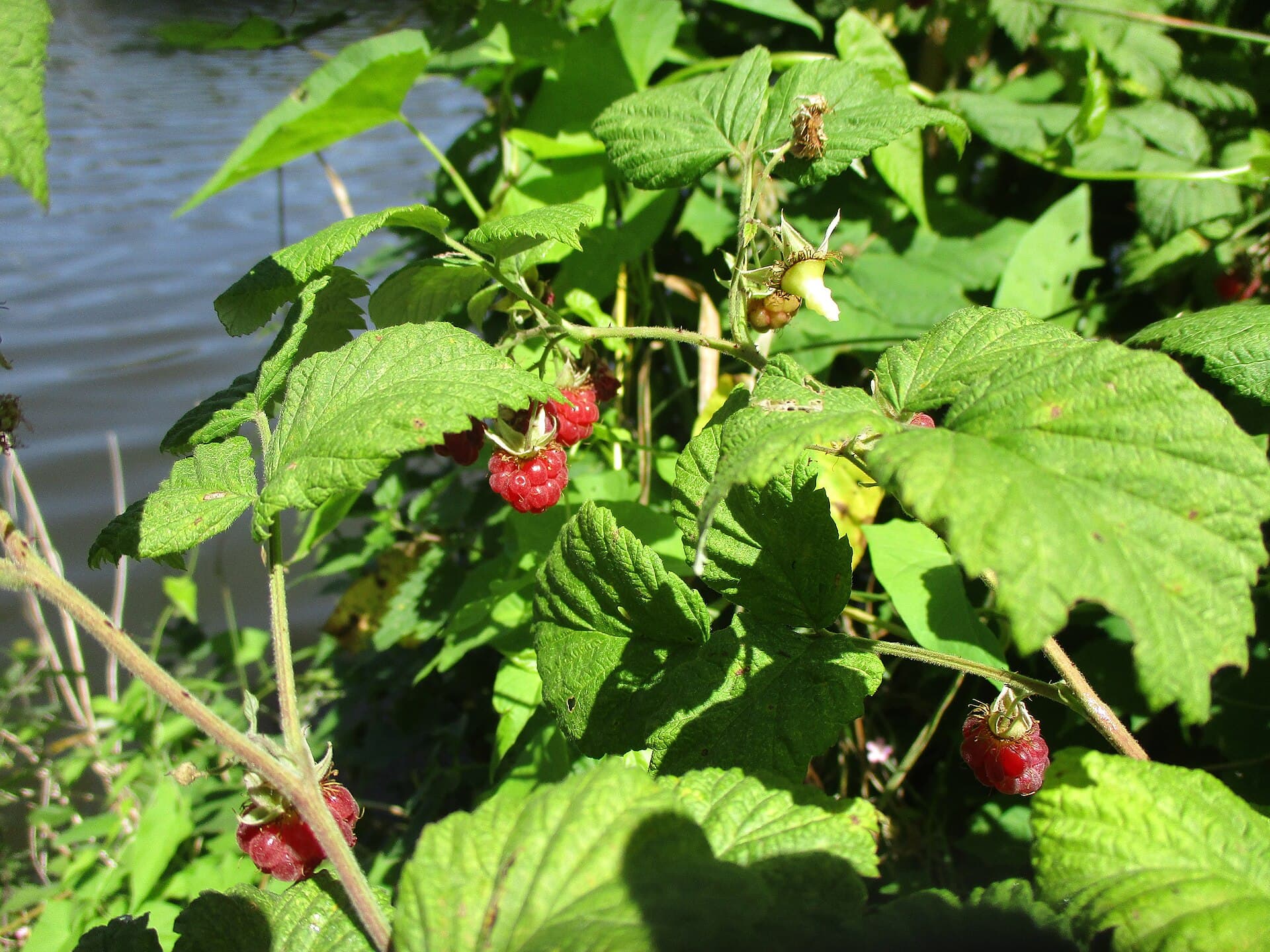
Above: AnRo0002 · CC0

easy. Undemanding, hardy, and productive for a decade or more from one planting, with a single genuine trap. Prune the wrong type the wrong way and you get no fruit at all, with no other symptom to warn you.
At a glance
- Family
- Rosaceae (rose family)
- Life cycle
- Perennial crown, biennial canes
- Grown from
- Bare-root canes, planted dormant
- Hardiness
- Very hardy
- Planting
- Late autumn to early spring, while dormant
- Soil
- Rich, moist, free-draining, slightly acid
- Sun
- Full sun; tolerates some shade
- First crop
- Second summer, or first autumn
- Spacing
- 18″ apart in rows 6ft apart
- Biggest single risk
- Pruning as if it were the other type
Summer-bearing or autumn-bearing?
A raspberry crown is perennial and lives for years. Its canes are biennial: they grow one season and fruit the next, then die. What differs between the two types is *when* a cane fruits, and that single fact decides how you prune.
Summer-bearing raspberries fruit in early summer on canes grown the previous year, the old wood. You are always carrying two generations at once: this year's new canes, which will fruit next year, and last year's, which are fruiting now.
Autumn-bearing raspberries fruit in late summer and autumn on the tips of canes grown that same season. There is only ever one generation, which makes them dramatically simpler.
Now the trap. Autumn-bearers are pruned by cutting every cane to the ground in late winter, brutal, simple, and it produces a clean crop the same year. Do that to a summer-bearer and you have just removed every cane that was going to fruit, and you will get nothing at all. No wilting, no disease, no warning: just a healthy green row and no raspberries.
If you do not know which you have, wait and watch for one season. Fruit in June or early July on woody-looking canes means summer-bearing. Fruit from August onwards on soft green canes means autumn-bearing.
- Summer-bearing fruits on last year's canes. Autumn-bearing on this year's.
- Autumn type: cut everything to the ground in late winter.
- Do that to a summer type and you remove the whole crop, silently.
How to prune each one
For summer-bearing, prune immediately after fruiting. The canes that just fruited are finished and will die anyway, cut them out at ground level. They are easy to identify: woodier, browner, and carrying the spent fruit stalks. Leave this year's new green canes, and thin them to the strongest six or eight per plant, tying them in as you go.
For autumn-bearing, prune in late winter before growth starts. Cut every cane to the ground. That is the entire operation, and it is why autumn raspberries are the right choice for anyone who does not want to think about it.
There is a trick worth knowing on autumn-bearers: instead of cutting all canes down, you can cut only half the row and leave the rest. The uncut half gives an early summer crop on old wood, the cut half gives the usual autumn crop, two harvests from one row, at the cost of slightly less fruit overall.
Whatever you grow, get the cut canes out of the bed rather than leaving them lying. Cane blight and spur blight overwinter on old wood.
- Summer type: cut out the canes that just fruited, right after fruiting.
- Autumn type: cut everything to the ground in late winter. That is all.
- Remove prunings from the bed, the diseases overwinter on old canes.
Support, and keeping it where you put it
Summer-bearing canes reach six feet or more and will arch over into the path under a load of fruit. They need support: two horizontal wires between posts, at about three feet and five feet, with canes tied in as they grow. Autumn-bearers are shorter and stiffer and often manage without, though a single wire keeps the row tidy.
The other thing to plan for is spread. A raspberry propagates by suckering, sending up new canes from the roots, sometimes several feet from the parent. Left alone a row becomes a thicket and then a nuisance, coming up in the lawn and the neighbouring bed.
Deal with it by walking the row once a month in the growing season and pulling, not cutting, any sucker outside the strip you have allotted. Pulling takes the bud with it; cutting leaves it to try again.
That suckering habit is also free plants. A sucker with roots, lifted in winter and moved, is a new raspberry, identical to the parent and completely free. It is how most raspberry rows in the world got planted.
- Summer canes need two wires. Autumn types often manage without.
- Pull suckers rather than cutting them, cutting leaves the bud.
- Those suckers are free plants. Lift and move them in winter.
Why this is the right fruit for a wet climate
Raspberries want cool summers, steady moisture and a real winter chill, and they resent heat and drought. That is an almost exact description of the maritime Northwest, which is why Oregon and Washington grow so much of the country's crop, and why a raspberry row in a Eugene garden asks for so little.
The one thing they will not tolerate is standing water. Cane fruit roots rot readily in ground that stays saturated through the winter, which in a wet-winter climate is the failure that actually happens. Plant on a slight ridge if your ground holds water, and improve drainage before planting rather than after.
They also want an acid to neutral soil and are unhappy above about pH 7, chlorotic yellow leaves with green veins is the classic sign of lime-induced iron shortage.
Mulch generously. Raspberry roots run close to the surface, which is why they sucker so readily and why they dry out quickly. A thick annual mulch of compost keeps the roots cool, feeds the crown and suppresses the weeds you cannot hoe out without damaging roots.
The climate that suits raspberries so well now suits something else too, and it is the one modern reason a row here is more work than it used to be. Spotted-wing drosophila is the pest that changed soft fruit growing here, and it is worth understanding rather than just spraying at. The ordinary vinegar flies a gardener knows only bother fruit that is already damaged or going over. This one has a saw-edged ovipositor, so the female cuts into sound ripening fruit and lays inside it, and the berry looks perfect until it collapses a day later. The two measures that work in a garden cost nothing: pick every day or two rather than letting fruit hang, since hanging ripe fruit is what it wants, and chill what you pick straight away, because cold slows or kills the eggs already in there. Spinosad is the home treatment the handbook lists, and some formulations of it are approved for organic growing.
Sources
- Cool summers, steady moisture and winter chill, a PNW crop by nature.
- The real killer here is waterlogging. Ridge the row if ground holds wet.
- Surface roots: mulch thickly, and never hoe deeply near the canes.
What Roe made of them in 1881
Edward Payson Roe gives raspberries five chapters of Success with Small Fruits, which is on our shelf and free to read, more space than he gives anything except strawberries, and a sign of how seriously the crop was taken by a commercial grower on the Hudson.
One of his chapter titles is worth the price of admission on its own: The Raspberries of the Future. He was writing in 1881 about which species and hybrids would matter, and taking for granted that the answer was still being worked out.
The watercolour below is from the other end of that process. Marlboro was a leading commercial red raspberry of the late nineteenth century, the kind of variety Roe was arguing about, painted for the USDA in 1913 by Amanda Almira Newton, one of the artists the department employed to record fruit before colour photography existed.
It is worth knowing that these paintings were not decoration. They were the working record of what a named variety looked like, made because a written description could not settle a dispute about identity and a photograph could not yet show colour.
- Roe gives raspberries five chapters, second only to strawberries.
- Marlboro was a leading commercial red raspberry of the period.
- The watercolours were a working record of variety identity, not decoration.
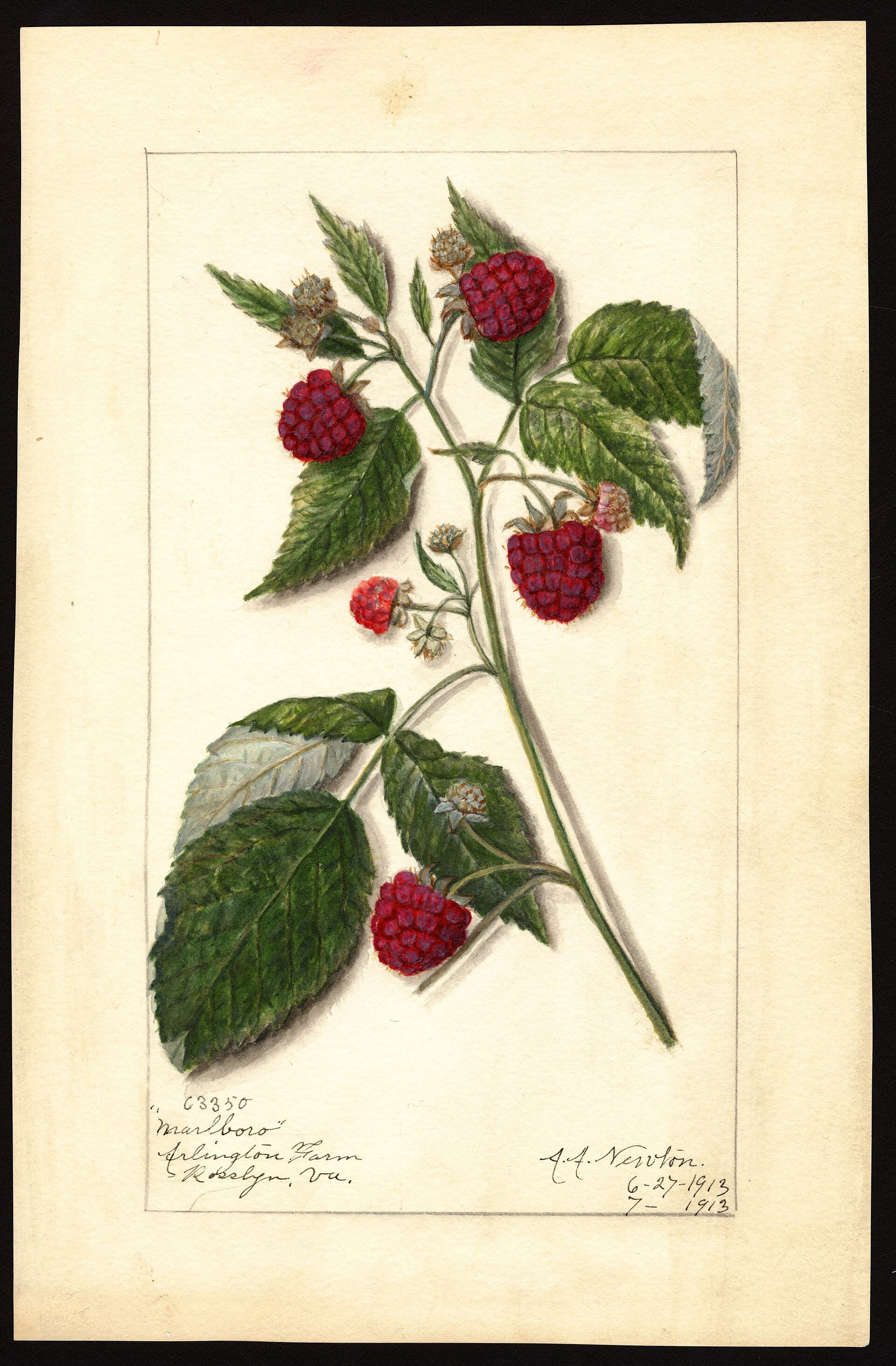
The Marlboro red raspberry, painted for the USDA on 1 July 1913 by Amanda Almira Newton, from a specimen at Rosslyn, Virginia. Newton was one of the department's most prolific pomological artists; the collection she worked on holds more than seven thousand paintings and is entirely public domain.
Specimen from Rosslyn, Arlington County, Virginia, 1 July 1913 · National Agricultural Library
Amanda Almira Newton, USDA Pomological Watercolor Collection · Public domain

Which type to grow
Grouped by what each is for rather than by catalogue order, because the useful question is which one suits your ground.
Summer-bearing red
Tall canes, one heavy crop in early summerBest for: The biggest yield and the classic flavour
Fruits on last year's wood, so it needs the two-generation pruning and proper support. Generally reckoned the better-flavoured group, and the one to grow if you will preserve.
Autumn-bearing red
Shorter, stiffer canes, fruit from August to frostBest for: Simplicity, and a long late season
Cut everything to the ground each winter, no cane identification, no mistakes, often no support. The right first raspberry, and it fruits in its first year.
Black raspberries
Arching canes that tip-root, small intense fruitBest for: Flavour, and a genuinely different fruit
Rubus occidentalis, a different species, Roe gives it its own chapter. It propagates by arching over and rooting at the tip rather than by suckering, so it stays where you put it. More susceptible to virus; keep it well away from red raspberries.
Yellow and golden
As their red counterparts, amber fruitBest for: Eating fresh
Usually sports of red varieties, so they behave identically and are pruned the same way. Sweeter and lower in acid, they do not preserve their colour well, grow them to eat off the cane.
What went wrong
Listed by what you can see, not by what the plant has, you arrive here holding the evidence and without the vocabulary. Where the answer is that nothing can be done this year, it says so.
Healthy canes, no fruit at all
Next seasonWhy: Almost always pruning a summer-bearing variety as though it were autumn-bearing, cutting to the ground removes the canes that were going to fruit.
What to do: Prune nothing this year and let it fruit; identify the type from when and where fruit appears, then prune correctly from then on.
Canes wilt, with dark patches near the base
Fixable nowWhy: Cane blight, entering through wounds, or spur blight.
What to do: Cut affected canes out at ground level and remove them from the garden. Improve airflow by thinning canes, and avoid damaging stems when weeding.
Yellow leaves with green veins
Fixable nowWhy: Iron shortage, usually because the soil is too alkaline.
What to do: Mulch with compost and use an acidifying feed. Do not lime anywhere near raspberries; they want soil on the acid side of neutral.
New canes coming up all over the garden
Fixable nowWhy: Normal suckering. Raspberry roots run wide and shallow.
What to do: Pull rather than cut, monthly through the growing season. Lift the good ones in winter and plant them elsewhere, they are free plants.
Small white grubs inside the fruit
Fixable nowWhy: Raspberry beetle larvae.
What to do: Pick and destroy affected fruit rather than composting it. Cultivating the soil lightly beneath the canes in winter exposes overwintering pupae to birds and frost.
Plants collapse in a wet winter
Next seasonWhy: Root rot from waterlogging, the commonest raspberry failure in a maritime climate.
What to do: Replant on a raised ridge on ground that drains. This is not fixable once established, and it is worth taking seriously before planting rather than after.
Row has declined over several years, fruit small
Next seasonWhy: Virus, spread by aphids and accumulated in the stock.
What to do: There is no cure. Remove the row, plant certified virus-free canes on fresh ground well away, and do not move suckers from the old row to the new one.
Related crops
Worked out from the botany rather than from a hand-written list, so it stays correct as the library grows.
- The same family
Also Rosaceae. Shares much of this crop's pest and disease pressure and belongs in the same rotation group.
What’s in raspberries
Per 100 grams raw, from USDA FoodData Central. The range is what USDA actually measured across its samples — it is usually wide, and your own crop sits somewhere in it rather than on the headline number.
| Nutrient | Per 100 g | % daily | Range measured |
|---|---|---|---|
| Vitamin C | 23.04 mg | 26% | 18.6–34.2 (n=8) |
| Magnesium | 19.15 mg | 5% | 16.5–24.2 (n=8) |
| Potassium | 155.8 mg | 3% | 134–206 (n=8) |
| Iron | 0.4501 mg | 3% | 0.228–0.763 (n=8) |
| Protein | 1.008125 g | 2% | 0.75–1.5625 |
| Calcium | 16.41 mg | 1% | 13.7–23.1 (n=8) |
| Water | 85.55 g | , | 84.12–87.31 (n=8) |
Source: USDA FoodData Central, “Raspberries, raw” (Foundation, published 10/28/2022). Percentages are of the FDA adult Daily Value, a labelling reference rather than a personal requirement. Raw values; boiling leaches water-soluble vitamins and some carotene, so a cooked serving is not the same figure.
Saving your own seed
Nobody grows raspberries from seed, and the reason is the same as for potatoes and garlic: named varieties are clones, and seed from them does not come true.
Propagation is by suckering and it is effortless. Lift a rooted sucker while dormant in winter, cut its connection to the parent, and plant it. That is a complete new raspberry, identical to the one you took it from.
Black raspberries do it differently and just as easily: their canes arch over, touch the ground and root at the tip. Peg a tip down in late summer, sever it in spring, and you have another plant.
The one warning is virus. Raspberry viruses accumulate invisibly and spread through propagated material, so a row propagated from itself indefinitely will decline. Where a planting is more than about ten years old, buy fresh certified stock rather than moving suckers from it.
Farm rooted clothing · Est. 2005
The guides are free. The shop is the business.
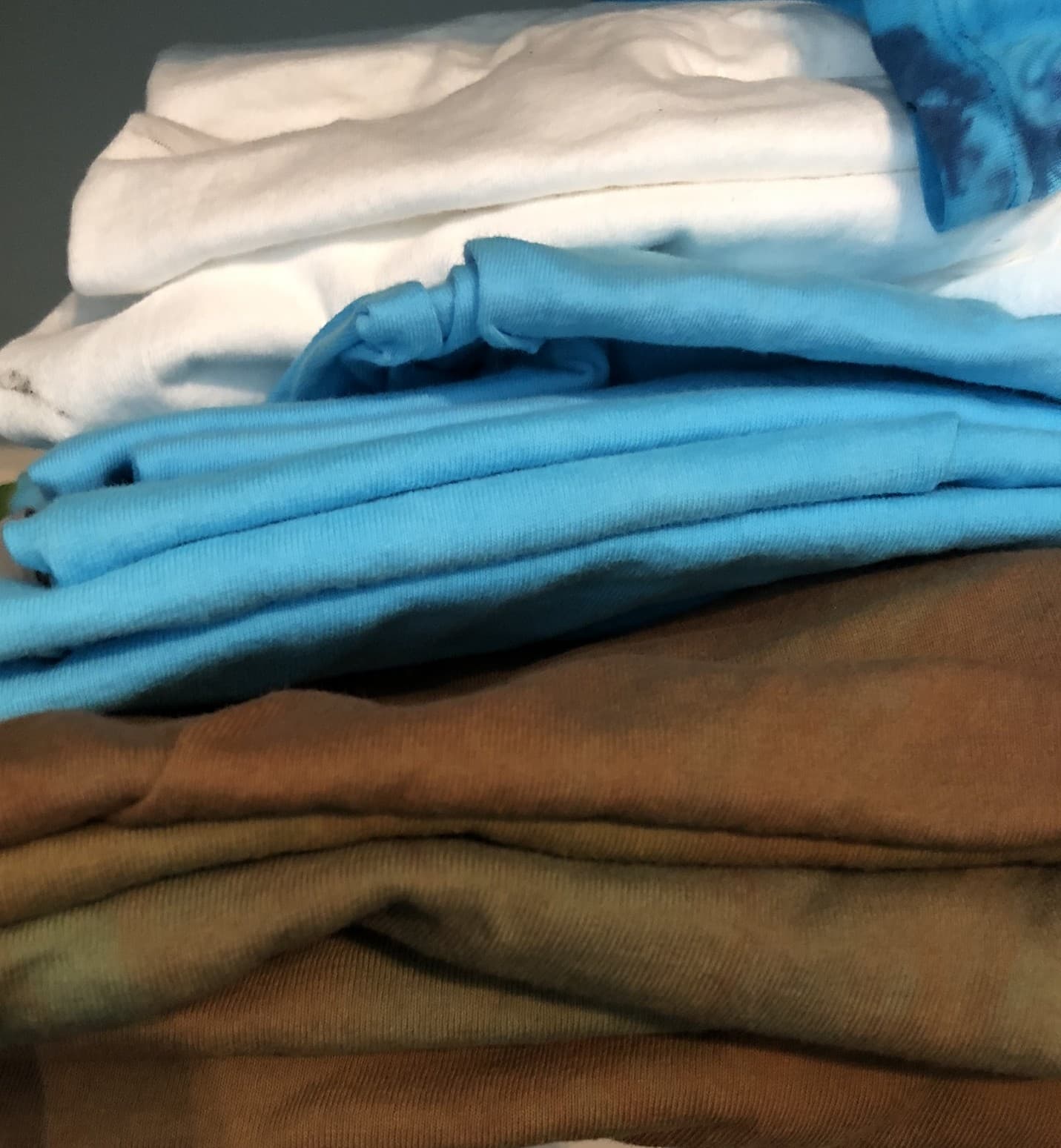
Sun & Rain Works is a small apparel outfit in Eugene, Oregon, with agricultural roots and a slow path toward farming. The raspberries guide you just read comes from the same place as the shirts.
More growing guides
We're working through the vegetables one at a time, with dates counted from your own frost station and the old books read properly. Occasional notes from Eugene, Oregon, an art business with agricultural roots, working its way toward farming.
We'll email you to confirm before sending anything. After that, occasional seasonal notes from Sun & Rain Works, we won't share your address, and every email has an unsubscribe link.
Growing advice here is current horticultural practice, drafted with AI assistance and checked against the sources this page names. Where it quotes a book, the book is named and linked. Where practice is genuinely contested, or local enough that we would be guessing, the text says so, your county extension service beats any national guide, including this one, on pest timing.
The photographs are not AI-generated. Every one is our own work, public domain, or licensed, and carries its author and licence beneath it.