Growing guide
How to grow pears
Grown almost exactly like an apple, with one exception that decides whether you get anything worth eating: a pear left to ripen on the tree has already gone over by the time it looks ready.
Pyrus communis · Rosaceae, with apple, plum, cherry, strawberry and raspberry
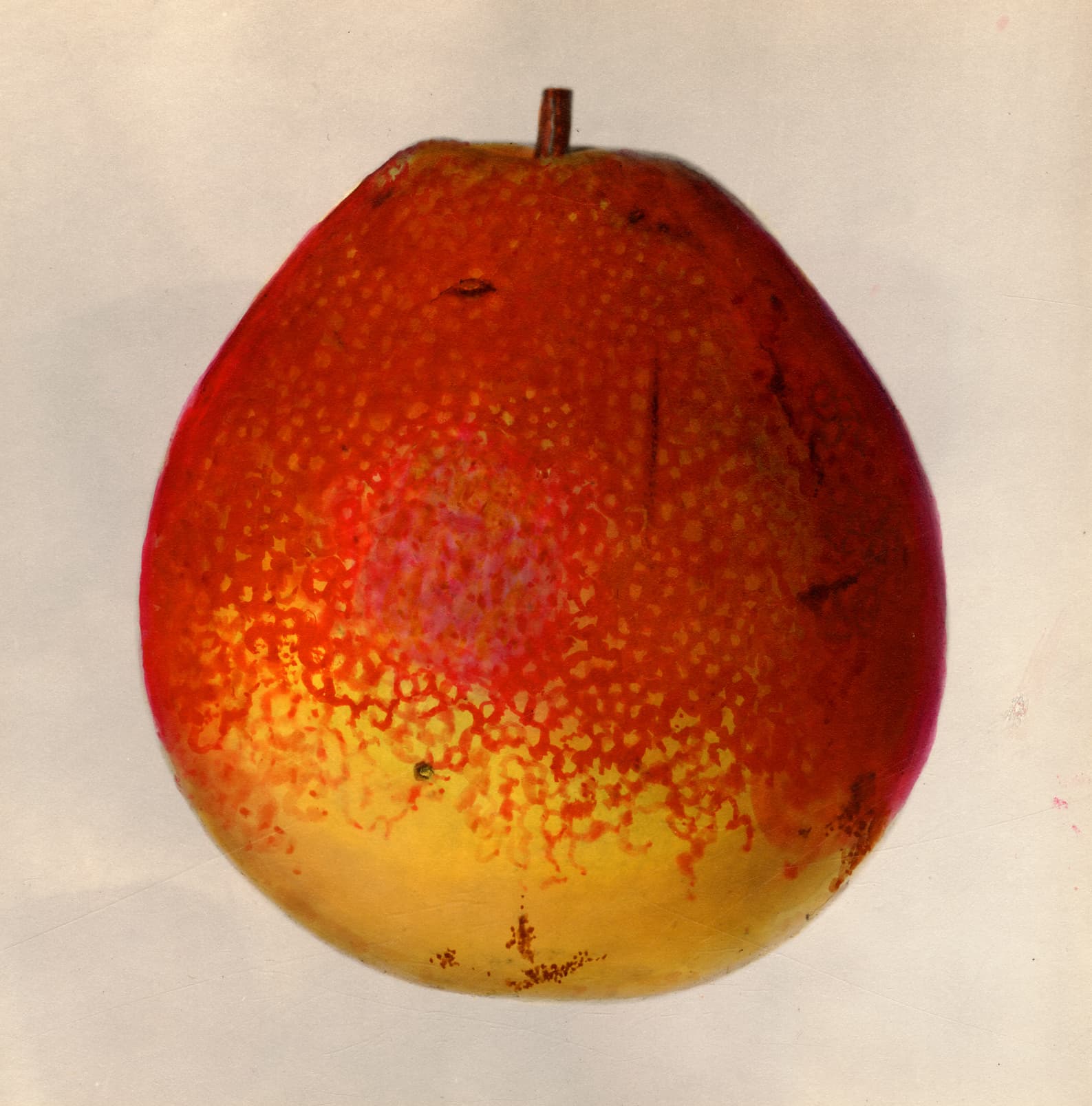
Above: L. C. C. Krieger, USDA Pomological Watercolor Collection · Public domain
,_with_this_specimen_originating_in_Hood_River,_Oregon_from_1_November_1935_Pomological_Watercolor_POM00006996_(cropped).jpg)
moderate. Nearly everything transfers from apples, and the one thing that does not, when to pick, is the thing that decides the crop. Pears are also fussier about warmth and more exposed to frost, because they flower earlier.
At a glance
- Family
- Rosaceae (rose family)
- Life cycle
- Long-lived tree, often a century
- Grown from
- A grafted tree, usually on quince
- Size decided by
- The rootstock, as with apples
- Flowering
- Earlier than apples, more frost risk
- Planting
- Bare-root in winter dormancy
- Pollination
- Needs a second compatible variety
- First crop
- 3–5 years on quince, longer on seedling
- Picking
- Unripe, then ripened indoors
- Biggest single risk
- Leaving the fruit on the tree
Pick them unripe, this is the whole crop
A pear does not ripen properly on the tree. Left hanging, it continues to soften from the core outwards, so the flesh around the pips turns brown and mealy while the outside still looks and feels like a good pear. Old growers called it sleepy. You find out when you cut one open.
So a pear is picked while still firm and finished indoors. The test is simple and worth learning: lift the fruit to horizontal with your palm. If it separates from the spur with a slight twist, it is ready to pick. If it clings, leave it a few more days.
Then ripen at room temperature and check daily by pressing gently at the neck, next to the stalk, that softens first, and it is the only part worth testing. A pear tested at the fat end is a pear you have already bruised.
Late varieties want cold storage first: a few weeks somewhere cool and dark before being brought into the warm to finish. That is how a pear picked in October is eaten in December.
Bartrum makes a useful point in the other direction. Dessert pears, he writes, often cook well if gathered before they are ripe, so a tree picked slightly too early is not a loss, it is stewed pears. There is no equivalent rescue for one picked too late.
- Pears rot from the core outwards while looking perfect outside.
- Lift to horizontal, if it parts with a twist, pick it.
- Ripen indoors and test at the neck. Too early cooks; too late is waste.
They flower before apples, and pay for it
This is the second real difference, and Bartrum states it plainly in 1902: the pear blooms early, some time before the apple. It needs more warmth, and more protection. To plant pears in a north aspect even on a wall is a mistake.
Earlier blossom means more exposure to late frost, and pear blossom is killed at around 28°F, a temperature that arrives after the apples are safely still in bud. In a maritime spring that is a real and recurring loss.
This is where your own frost dates do actual work. The gap between the date frost usually finishes and the date it is safely finished is the window that decides a pear crop, and it differs by weeks between two towns in the same county.
The practical answers are all about siting. Give a pear the warmest wall you have, ideally facing the sun. Avoid frost pockets, low ground where cold air collects on a still night. And where a tree is small enough, fleece over the blossom on a clear still night is worth the trouble in a way it rarely is for apples.
It is also why pears reward wall training more than apples do. A fan or espalier against a warm wall gets radiated heat at night, ripens its wood better, and flowers into shelter rather than into open air.
- Pears bloom before apples, so late frost catches them more often.
- Blossom dies around 28°F. Site out of frost pockets, on a warm wall.
- Wall training is worth more for pears than for apples, for the warmth.
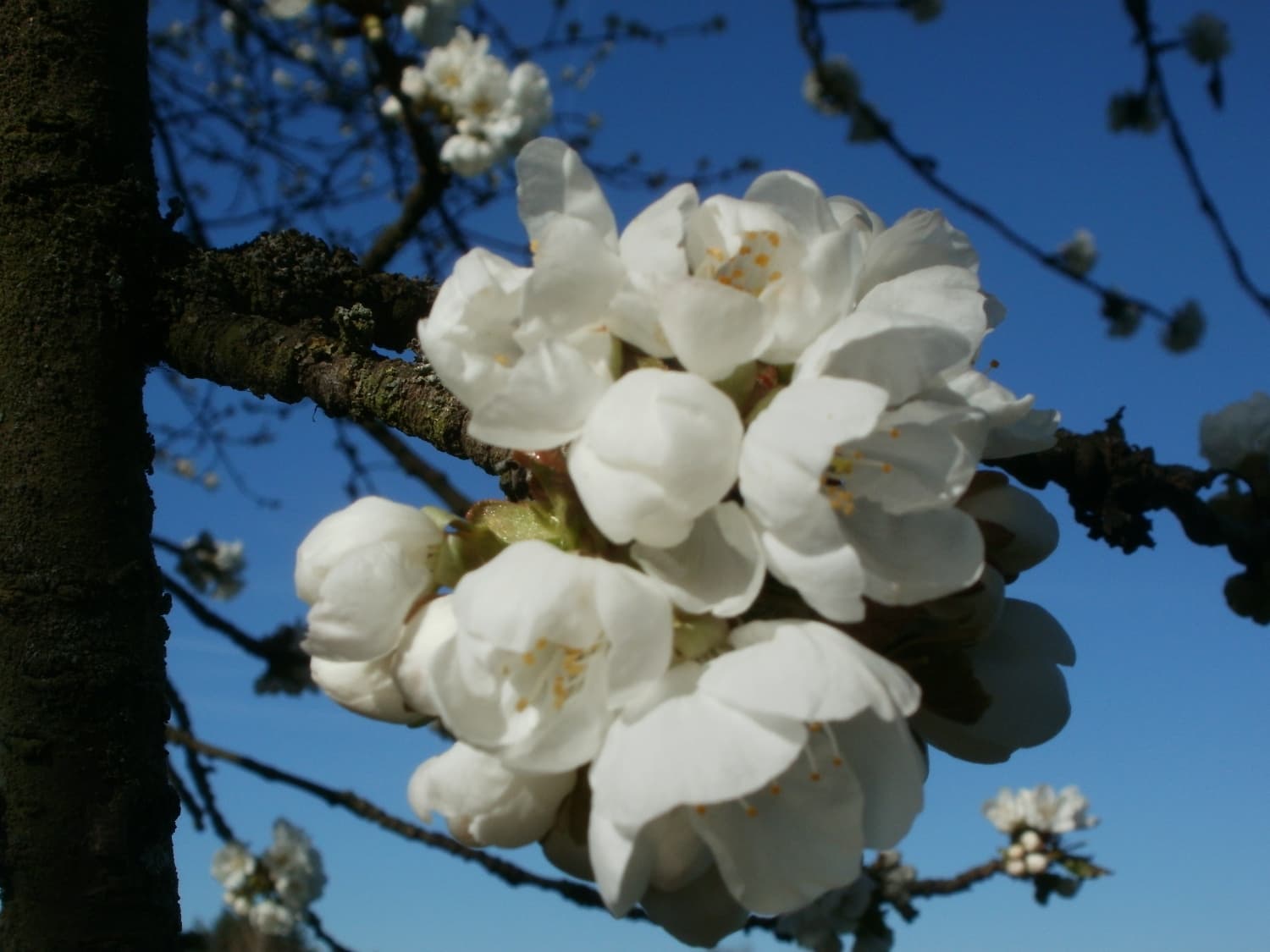
This is the part that dies. Pear blossom is killed at around 28°F, and it opens weeks before the apples beside it are out of bud, so a frost that costs an apple grower nothing can cost you the entire pear crop.
Old pear tree on a traditional orchard meadow, April
AnRo0002 · CC0

Quince, and why some varieties will not take
As with apples, the rootstock decides the size of the tree, and the story is simpler because there are essentially two families.
Quince rootstocks, Quince A and the more dwarfing Quince C, give a tree eight to eighteen feet that crops in three to five years. This is what almost every garden pear is on, and what you want.
Pear seedling stock makes an enormous, long-lived, slow-to-crop tree. The pear orchards that survive from a century ago are on it, and it is the wrong choice for a garden unless you are planting for grandchildren.
There is one complication with no equivalent in apples. Some pear varieties are graft-incompatible with quince, they simply fail to unite, or unite and then break at the join years later. Williams' Bon Chrétien is the classic example. Nurseries solve this with an interstem: a compatible variety grafted between the quince and the one you wanted, so the tree carries two graft unions.
That is worth knowing at the point of sale, because a tree with an interstem is not a defect, it is the reason the variety is available at all.
Bartrum records the scale this once operated at: sixty-four varieties known in one early list, a hundred and thirty-eight seventy years later, six hundred and thirty by 1829, and one nineteenth-century grower claiming over a thousand sorts worked on quince stock.
- Quince A or C for a garden tree. Pear seedling makes a monster.
- Some varieties will not graft onto quince and need an interstem.
- An interstem tree has two graft unions and that is correct, not faulty.
Pollination, pruning and the one disease that matters
Pears need a pollination partner exactly as apples do, a different variety flowering at the same time, matched by pollination group. A single pear in an isolated garden crops poorly or not at all, and a few varieties are triploid and give nothing back.
Pruning is apple pruning. Winter for structure and vigour, summer for restraint on trained forms, and the same single rule underneath: light and air must reach the fruiting wood. Pears spur very freely, so thinning congested spur systems on an older tree matters more than it does on an apple.
Thin the fruit in June to one or two per cluster. Pears are less prone to biennial bearing than apples but not immune, and crowded fruit stays small.
The disease to know is pear rust, increasingly common where junipers grow nearby, bright orange spots on the upper leaf surface, with growths beneath. It needs both hosts to complete its cycle, so the honest answer is that removing your own junipers helps and a neighbour's are beyond your control.
Otherwise pears are, if anything, less trouble than apples: scab affects them but usually less severely, and codling moth prefers apples given the choice.
Sources
- Same pollination-group rules as apples. One tree alone is a poor crop.
- Prune like an apple, but thin congested spurs more, pears spur freely.
- Pear rust needs junipers nearby. Yours you can remove; theirs you cannot.
A handbook from 1902, and what it is good for
The Book of Pears and Plums has been on our shelf since we built it and this is the first guide to read it properly. It is number XI in the Handbooks of Practical Gardening, and its preface is signed from Wakes Colne Rectory, Essex, in July 1902, internal evidence for a book whose title page carries no year, which is why our shelf lists it as undated.
It is English, so the varieties do not transfer and should be checked against regional advice before you buy anything. What does transfer is the method, and on that it is the clearest short treatment of pears we have found: chapters on stocks, pyramids, columnar trees, espaliers, horizontals on walls, fans, bushes, cordons and arches, which is a far wider range of trained forms than a modern book will offer.
The reason those forms fill a whole book is the reason above: an English pear needs warmth it does not reliably get, so growers learnt a dozen ways to put a tree against a wall. A Pacific Northwest garden has the same problem and can borrow the same answers.
Read it for training and siting. Ignore its variety lists, and, as with any book of this age, ignore its spray recommendations entirely.
- 1902, English, and the best short treatment of pear training we have.
- Nine trained forms, because English pears need a wall's warmth.
- Take the method, not the varieties, and none of the spraying.
Which type to grow
Grouped by what each is for rather than by catalogue order, because the useful question is which one suits your ground.
Early dessert pears
Ripen late summerBest for: Eating within days
The shortest window of any fruit here, often ready and over inside a week. Worth growing precisely because a perfectly ripe early pear cannot be bought.
Mid-season dessert
Picked early autumn, ripened indoorsBest for: The reliable garden pear
Where most of the good eating is. Flemish Beauty, painted above from a Hood River specimen, belongs here, an old European variety that became a Pacific Northwest staple.
Late keepers
Picked hard in October, stored coldBest for: Eating in December
Need a period of cold storage before being brought into the warm to finish. The varieties Bartrum says become first rate only when properly kept.
Cooking and stewing pears
Firm, often gritty rawBest for: Long slow cooking
Bred to hold their shape rather than to be eaten raw. Bartrum's practical note applies to the whole group: dessert pears gathered before they are ripe cook well too, so an early picking is never wasted.
Perry pears
Small, hard, astringentBest for: Fermenting
The pear equivalent of cider apples, tannic and inedible fresh. Long-lived and enormous on their own roots; a perry pear planted now is a tree for the next century.
What went wrong
Listed by what you can see, not by what the plant has, you arrive here holding the evidence and without the vocabulary. Where the answer is that nothing can be done this year, it says so.
Fruit is brown and mealy at the core but looks perfect outside
Next seasonWhy: Left on the tree too long. A pear ripens from the inside out.
What to do: Pick earlier next season, lift the fruit to horizontal and take it if it parts with a slight twist. Ripen indoors and test at the neck.
Blossom set but no fruit followed
Next seasonWhy: Frost on early blossom, or no compatible pollination partner.
What to do: Check whether frost was forecast during flowering, pear blossom dies around 28°F. Plant a partner in the same pollination group, and site future trees on a warm wall out of frost pockets.
Bright orange spots on upper leaf surfaces
Fixable nowWhy: Pear rust, which alternates between pears and junipers.
What to do: Remove affected leaves. Remove junipers on your own ground if you have them; if the source is a neighbour's, the tree will live with it, it disfigures more than it kills.
Tree grew for years and has never fruited
Next seasonWhy: Probably on pear seedling rootstock rather than quince, or too heavily winter-pruned.
What to do: Patience, a seedling-stock pear can take a decade. Ease off winter pruning, which stimulates growth, and summer-prune instead to slow it into fruiting.
A branch or the whole tree snapped at the graft
Next seasonWhy: Graft incompatibility between the variety and quince stock, showing up years later.
What to do: Not repairable. When buying a variety known to be incompatible, choose a tree with an interstem, the extra graft union is the fix, not a fault.
Small hard gritty fruit
Fixable nowWhy: Drought while fruit was sizing, or a congested spur system carrying too much.
What to do: Water in dry spells and mulch. Thin fruit to one or two per cluster in June, and thin crowded spurs on older trees in winter.
Blackened shoots that look scorched, dying back fast
Fixable nowWhy: Possibly fireblight, a bacterial disease of the rose family.
What to do: Cut well back into clean wood, sterilising between cuts, and burn what you remove. Where it is established locally this is a notifiable concern in some areas, check regional guidance rather than treating it as ordinary dieback.
Related crops
Worked out from the botany rather than from a hand-written list, so it stays correct as the library grows.
- The same family
Also Rosaceae. Shares much of this crop's pest and disease pressure and belongs in the same rotation group.
What’s in pears
Per 100 grams raw, from USDA FoodData Central. The range is what USDA actually measured across its samples — it is usually wide, and your own crop sits somewhere in it rather than on the headline number.
| Nutrient | Per 100 g | % daily | Range measured |
|---|---|---|---|
| Fibre | 3.1 g | 11% | 2.5–3.7 (n=24) |
| Vitamin C | 4.3 mg | 5% | 1.5–5.7 (n=16) |
| Vitamin K | 4.4 µg | 4% | 2.2–7.8 (n=16) |
| Potassium | 116 mg | 2% | 86–144 (n=50) |
| Folate | 7 µg | 2% | 4–14 (n=16) |
| Magnesium | 7 mg | 2% | 6–7 (n=51) |
| Iron | 0.18 mg | 1% | 0.11–0.43 (n=55) |
| Protein | 0.36 g | 1% | 0.22–0.59 (n=29) |
| Calcium | 9 mg | 1% | 6–13 (n=51) |
| Vitamin A | 1 µg | 0% | , |
| Water | 83.96 g | , | 81.63–85.08 (n=32) |
| Energy | 57 kcal | , | , |
Source: USDA FoodData Central, “Pears, raw” (SR Legacy, published 4/1/2019). Percentages are of the FDA adult Daily Value, a labelling reference rather than a personal requirement. Raw values; boiling leaches water-soluble vitamins and some carotene, so a cooked serving is not the same figure.
What the wartime archive says about pears
2 passages from the USDA’s 1943–46 victory garden material, with our note on whether each still holds. Pulled from the annotations themselves rather than listed here by hand.
- Fruit at homeStill holds
Strawberries, bush fruits and grapes can be grown fairly easily in many, many areas. Cherries, plums and perhaps other stone fruits, likewise, are adapted to many areas. Apple and pears, because of insects and disease are more difficult to…
A Victory Garden Program for 1945
- Dwarf rootstockStill holds
Dwarf forms of these fruits, particularly, may be considered for small home plantations because they may be more easily sprayed and cared for than ordinary stocks.
A Victory Garden Program for 1945
Saving your own seed
Pears behave exactly as apples do: highly heterozygous and self-incompatible, so every pip is a new individual and nearly all of them are small, hard and not worth the fifteen years it takes to find out.
Every named pear is therefore a clone, maintained by grafting, and pears are unusually long-lived, so some varieties in cultivation have been propagated continuously for several centuries.
Propagation is by grafting a scion of one-year wood onto a quince rootstock in late winter, the same whip-and-tongue technique used for apples. The one extra consideration is compatibility: if your variety does not take on quince, you need an interstem, which means two grafts rather than one.
Bartrum's variety counts are worth sitting with. Sixty-four sorts in an early list, a hundred and thirty-eight seventy years on, six hundred and thirty by 1829, and one grower claiming more than a thousand worked on quince. That expansion happened entirely through grafting, every one of those was a chance seedling somebody thought worth keeping.
Farm rooted clothing · Est. 2005
The guides are free. The shop is the business.
Sun & Rain Works is a small apparel outfit in Eugene, Oregon, with agricultural roots and a slow path toward farming. The pears guide you just read comes from the same place as the shirts.
More growing guides
We're working through the vegetables one at a time, with dates counted from your own frost station and the old books read properly. Occasional notes from Eugene, Oregon, an art business with agricultural roots, working its way toward farming.
We'll email you to confirm before sending anything. After that, occasional seasonal notes from Sun & Rain Works, we won't share your address, and every email has an unsubscribe link.
Growing advice here is current horticultural practice, drafted with AI assistance and checked against the sources this page names. Where it quotes a book, the book is named and linked. Where practice is genuinely contested, or local enough that we would be guessing, the text says so, your county extension service beats any national guide, including this one, on pest timing.
The photographs are not AI-generated. Every one is our own work, public domain, or licensed, and carries its author and licence beneath it.