Growing guide
How to grow strawberries
The first fruit most people plant and the one most often left to decline quietly. A strawberry bed is not permanent, it is a three-year cycle, and knowing that is most of the skill.
Fragaria × ananassa · Rosaceae, with raspberry, apple, pear and plum
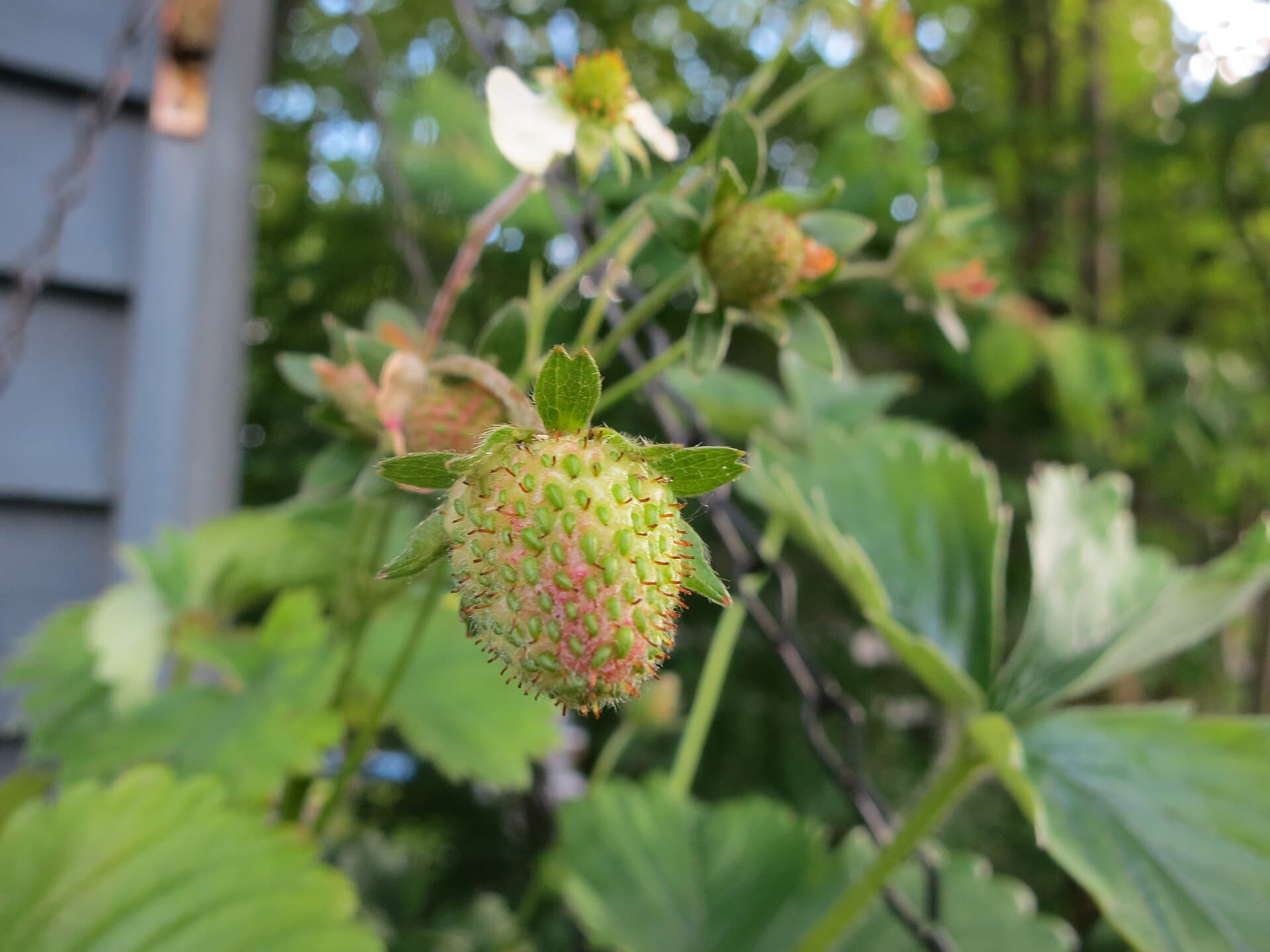
Above: Ruth Hartnup · CC BY 2.0
.jpg)
easy. Easy to grow and easy to let decline. Nothing about the plant is demanding; the discipline is in replacing it before it wears out, which is the step almost everyone skips.
At a glance
- Family
- Rosaceae (rose family)
- Life cycle
- Perennial, productive for 3–4 years
- Grown from
- Bare-root crowns or runner plants
- Hardiness
- Hardy, but the blossom is not
- Planting
- Early spring, or late summer for next year
- Soil
- Rich, free-draining, slightly acid
- Sun
- Full sun for flavour
- First crop
- The season after planting
- Spacing
- 12–18″ apart in rows 3ft apart
- Biggest single risk
- Late frost on open blossom
Junebearing, everbearing, or day-neutral
Three types, and they behave so differently that advice written for one is misleading for another.
Junebearing plants set flower buds in the short days of autumn and give one heavy crop in early summer. That concentrated harvest is what you want if you intend to make jam or freeze a year's supply, and the plants make runners freely. This is the traditional type and still the heaviest cropper.
Everbearing gives two smaller flushes, roughly early summer and again in autumn. Day-neutral plants ignore day length altogether and fruit steadily from summer to frost, with the smallest berries of the three and the fewest runners.
For a household that wants strawberries on cereal from June to October, day-neutral is right. For anyone who wants to preserve, junebearing is right. Most disappointment with strawberries is somebody who bought one and wanted the other.
Whichever you plant, pinch off every flower in the first year on junebearers, and for the first six weeks on the others. It feels wrong and it is the difference between a bed that crops for four years and one that exhausts itself in two.
- Junebearing: one big crop, best for preserving, makes runners freely.
- Day-neutral: steady small pickings all season, few runners.
- Pinch the first year's flowers off. It doubles the life of the bed.
Runners, and the three-year cycle
A strawberry propagates itself by throwing out runners, horizontal stems that root where they touch soil and make a new plant, genetically identical to the parent. This is both the crop's great convenience and the reason beds decline.
Left alone, a bed becomes a crowded mat. Crowded plants make small fruit, hold damp air, and get grey mould. Meanwhile the original crowns age: a strawberry plant is most productive in its second and third years, and by the fourth it is worth little.
So the discipline is a rolling replacement. Each year, let a few runners root into pots or into a clear strip of ground, and each year pull out the oldest plants. After three seasons you have replaced the bed entirely without ever losing a harvest.
The alternative, start a new bed on fresh ground every three or four years, is better still where you have the space, because it breaks the soil-borne disease cycle that builds up under strawberries.
Roe, in 1881, describes selecting the single best plant in a bed and letting only that one propagate, then repeating the selection from its offspring. That is clonal selection, and it is exactly what a modern grower does when they mark the best plant with a cane before letting it run.
- Plants peak in years two and three. Plan replacement from the start.
- Root a few runners each year, pull the oldest plants each year.
- Better still: move the bed to fresh ground every three or four years.
The blossom is the vulnerable part
The plant is thoroughly hardy, it survives winters that kill far tougher-looking things. The flower is not.
An open strawberry blossom is damaged at about 30°F and killed a little below that, and the damage is unmistakable: the centre of the flower turns black. Growers call it black eye. A flower with a black centre will not make a fruit, and there is no recovering it.
This is where your own frost dates matter more than any published month. The gap between the date frost *usually* finishes and the date it is *safely* finished is exactly the window in which strawberry blossom is at risk, and it differs by weeks between two towns.
The protection is simple and works: throw fleece or even an old sheet over the bed on any clear, still night when frost is forecast and flowers are open. Take it off in the morning so pollinators can reach them. A few nights of that saves the crop.
Straw mulch, which is very likely where the name comes from, does a second job here beyond keeping fruit clean: it moderates soil temperature and slightly delays flowering, which in a frost-prone garden is a feature rather than a cost.
- Open blossom dies at about 30°F. A blackened centre means no fruit.
- Cover with fleece on clear still nights, uncover by morning for bees.
- Straw keeps fruit clean and slightly delays flowering. Both help.
“Books will mislead more people than they help”
Edward Payson Roe gave up a pulpit to grow small fruit commercially on the Hudson, and published Success with Small Fruits in 1881. It is on our shelf, it is free, and it contains the best sentence about growing anything that we have found in any of these books.
Writing about strawberries, he reports Charles Downing's remark that no other fruit was so affected by varying soils and climates, and then draws the conclusion himself: “soil, locality, and climate make such vast differences that unless these variations are carefully studied and indicated, books will mislead more people than they help.”
That is, almost word for word, the argument this whole site is built on. A gardening book that prints one date and one variety list for an unnamed climate is not merely incomplete; it is actively misleading to most of the people reading it. Roe knew that in 1881 and said so in his own book, which takes some nerve.
It is also why the strawberry is the right crop to open our fruit section with. Of everything we grow, it is the one where local conditions most overwhelm general advice, and the one where we can do something about it, because we already know your frost dates.
- Roe, 1881: general advice misleads more readers than it helps.
- That is this site's argument, made 145 years ago about this crop.
- Strawberries are where local conditions most overwhelm general advice.
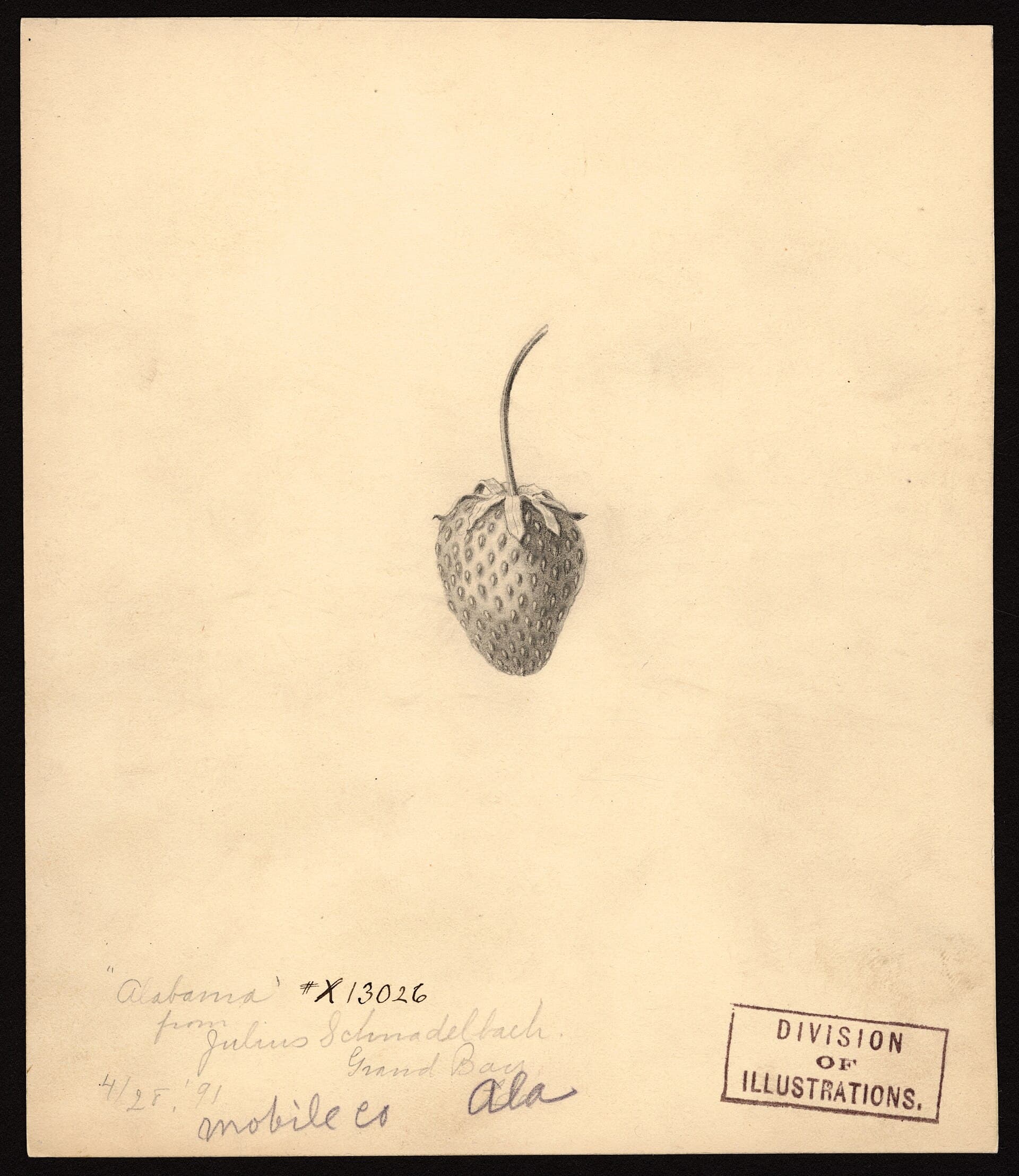
The Alabama strawberry, painted for the USDA in 1891 from a specimen grown at Grand Bay, Mobile County. Before colour photography the federal government employed artists to record fruit varieties like this; the collection runs to more than seven thousand paintings, and it is all public domain.
Specimen from Grand Bay, Mobile County, Alabama, 1891 · National Agricultural Library
USDA Pomological Watercolor Collection · Public domain

Picking, birds, and keeping the fruit clean
Pick when the whole berry is red, including the shoulders under the leaves, and pick with a short stem rather than pulling the fruit off its cap, a strawberry pulled off bruises where your fingers were and goes over within hours.
Pick in the morning while they are cool, and pick every day or two in warm weather. A ripe strawberry left one extra day is a grey mould infection waiting to spread to the fruit next to it.
Birds will take the crop, and there is no half measure that works. Netting is the answer, held clear of the fruit on hoops so blackbirds cannot simply perch and reach through, and tucked in at the edges so nothing gets underneath and trapped.
Slugs take the underside of any berry resting on soil, which is what the straw is for. Grey mould is the main disease and is largely a spacing and airflow problem, plants a foot or more apart in rows dry out after rain, plants in a crowded mat do not.
Spotted-wing drosophila is the pest that changed soft fruit growing here, and it is worth understanding rather than just spraying at. The ordinary vinegar flies a gardener knows only bother fruit that is already damaged or going over. This one has a saw-edged ovipositor, so the female cuts into sound ripening fruit and lays inside it, and the berry looks perfect until it collapses a day later. The two measures that work in a garden cost nothing: pick every day or two rather than letting fruit hang, since hanging ripe fruit is what it wants, and chill what you pick straight away, because cold slows or kills the eggs already in there. Spinosad is the home treatment the handbook lists, and some formulations of it are approved for organic growing.
One thing not to do: fresh manure or a nitrogen-heavy feed, which produces enormous leaves and very little fruit. Feed after cropping, not before it.
Sources
- Pick with the stem, in the morning, every day or two.
- Net properly on hoops, birds will otherwise take everything.
- Grey mould is an airflow problem. Space them and mulch under them.
Which type to grow
Grouped by what each is for rather than by catalogue order, because the useful question is which one suits your ground.
Junebearing
One heavy crop in early summerBest for: Preserving, freezing, and the biggest total yield
The traditional type. Sets its flower buds in short autumn days, so the crop is decided months before you see it. Makes runners freely, which makes replacing the bed easy.
Everbearing
Two flushes, early summer and autumnBest for: A longer season without going day-neutral
A reasonable compromise, though the name overpromises, two distinct crops rather than continuous fruit. Often the least satisfying of the three if you expected either extreme.
Day-neutral
Small fruit, steadily, until frostBest for: Eating fresh over months
Ignores day length entirely. Fewest runners, smallest berries, longest season, the right choice for a household that wants a bowl at a time rather than a glut, and good in containers.
Alpine strawberries
Tiny, intensely aromatic, from seedBest for: Flavour, shade, and edging
A different species, Fragaria vesca. Makes few or no runners, tolerates part shade, and is the one strawberry that comes true from seed, so it is also the only one you can genuinely save.
What went wrong
Listed by what you can see, not by what the plant has, you arrive here holding the evidence and without the vocabulary. Where the answer is that nothing can be done this year, it says so.
Flowers have blackened centres and set no fruit
Fixable nowWhy: Frost on open blossom, growers call it black eye.
What to do: Nothing for those flowers; later ones will still set. Cover the bed with fleece on clear still nights while it is flowering, and uncover each morning so bees can work.
Big leafy plants, very little fruit
Next seasonWhy: Too much nitrogen, too much shade, or plants past their third year.
What to do: Feed after cropping rather than before. If the crowns are three or four years old, replace them from runners, decline is the normal end of a strawberry plant, not a disease.
Fruit rots with grey fuzz before it ripens
Fixable nowWhy: Botrytis, encouraged by crowding, damp and fruit touching soil.
What to do: Remove affected fruit immediately, it spreads by contact. Thin the bed for airflow, mulch with straw so nothing rests on soil, and water at the base rather than overhead.
Berries hollowed out from underneath
Fixable nowWhy: Slugs, on fruit lying on damp ground.
What to do: Straw or mats under the fruit, and pick daily. Damage is almost always to berries in direct contact with soil.
Whole crop taken overnight
Fixable nowWhy: Birds, usually blackbirds.
What to do: Net over hoops so the mesh is held clear of the fruit, tucked in at ground level. Netting laid directly on plants lets birds perch and feed through it, and traps them.
Bed has become a dense mat of small plants
Fixable nowWhy: Runners left to root wherever they landed.
What to do: Thin hard back to well-spaced crowns, or start a fresh bed and pull this one out. Decide each year which runners you are keeping and cut the rest off as they appear.
Small, seedy, misshapen fruit
Fixable nowWhy: Poor pollination, cold or wet weather while flowering, or too few insects.
What to do: Largely weather and out of your hands. Do not spray anything insecticidal on open flowers, and grow something nearby that flowers at the same time to bring pollinators in.
Related crops
Worked out from the botany rather than from a hand-written list, so it stays correct as the library grows.
- The same family
Also Rosaceae. Shares much of this crop's pest and disease pressure and belongs in the same rotation group.
What’s in strawberries
Per 100 grams raw, from USDA FoodData Central. The range is what USDA actually measured across its samples — it is usually wide, and your own crop sits somewhere in it rather than on the headline number.
| Nutrient | Per 100 g | % daily | Range measured |
|---|---|---|---|
| Vitamin C | 59.62 mg | 66% | 47.25–72.1 (n=8) |
| Potassium | 160.7 mg | 3% | 121.5–195 (n=8) |
| Magnesium | 12.52 mg | 3% | 9.32–14.8 (n=8) |
| Iron | 0.255 mg | 1% | 0–0.429 (n=8) |
| Calcium | 16.9 mg | 1% | 12.3–20.8 (n=8) |
| Protein | 0.640625 g | 1% | 0.4375–0.8125 |
| Water | 90.83 g | , | 89.26–92.95 (n=8) |
Source: USDA FoodData Central, “Strawberries, raw” (Foundation, published 10/28/2022). Percentages are of the FDA adult Daily Value, a labelling reference rather than a personal requirement. Raw values; boiling leaches water-soluble vitamins and some carotene, so a cooked serving is not the same figure.
What the wartime archive says about strawberries
2 passages from the USDA’s 1943–46 victory garden material, with our note on whether each still holds. Pulled from the annotations themselves rather than listed here by hand.
- The jelly that would not jellStill holds
NANCY: (SOBBING) Look at it, look at it! It didn't jell!... It's done for, and so's my valuable sugar! ... FREYMAN: But that is bad, Johnny — wasting valuable sugar experimenting with jelly recipes, if you aren't exactly sure how to do it.
Consumer Time · July 7, 1945
- Fruit at homeStill holds
Strawberries, bush fruits and grapes can be grown fairly easily in many, many areas. Cherries, plums and perhaps other stone fruits, likewise, are adapted to many areas. Apple and pears, because of insects and disease are more difficult to…
A Victory Garden Program for 1945
Saving your own seed
Not realistically, and the reason is visible in the photograph at the top of this page: the green pips on the outside are the true fruits, each containing a seed, and the red flesh is a swollen stem.
Garden strawberries are complex hybrids, Fragaria × ananassa, a cross between two American species made in eighteenth-century Europe, so seed from them does not come true. You would get a scattering of plants unlike the parent and mostly worse.
What you do instead is clone them, and it could not be easier: peg a runner into soil or a pot, let it root, sever it from the parent. That plant is genetically identical to the one you chose it from, which is why a good variety persists for a century.
Roe describes the refinement worth copying, select the single best plant in the bed, let only that one propagate, then select again from its offspring. Over a few seasons that is real improvement, done with nothing but a label and some patience.
The exception is alpine strawberries, Fragaria vesca, which are a true species and do come true from seed. If you want a strawberry you can genuinely save, grow those.
Farm rooted clothing · Est. 2005
The guides are free. The shop is the business.
Sun & Rain Works is a small apparel outfit in Eugene, Oregon, with agricultural roots and a slow path toward farming. The strawberries guide you just read comes from the same place as the shirts.
More growing guides
We're working through the vegetables one at a time, with dates counted from your own frost station and the old books read properly. Occasional notes from Eugene, Oregon, an art business with agricultural roots, working its way toward farming.
We'll email you to confirm before sending anything. After that, occasional seasonal notes from Sun & Rain Works, we won't share your address, and every email has an unsubscribe link.
Growing advice here is current horticultural practice, drafted with AI assistance and checked against the sources this page names. Where it quotes a book, the book is named and linked. Where practice is genuinely contested, or local enough that we would be guessing, the text says so, your county extension service beats any national guide, including this one, on pest timing.
The photographs are not AI-generated. Every one is our own work, public domain, or licensed, and carries its author and licence beneath it.