Growing guide
How to grow apples
The one fruit where the most important decision is made before you plant, is invisible on the label, and cannot be changed afterwards. It is not the variety. It is the roots it is grafted onto.
Malus domestica · Rosaceae, with pear, plum, cherry, strawberry and raspberry
Above: Sun & Rain Works · © Sun & Rain Works
moderate. Undemanding once established and easy to get permanently wrong at planting. An apple tree is a twenty-year decision made in an afternoon, and the two things that decide it, rootstock and a pollination partner, are both settled before the tree goes in.
At a glance
- Family
- Rosaceae (rose family)
- Life cycle
- Long-lived tree, 20–100 years
- Grown from
- A grafted tree. Never from a pip
- Size decided by
- The rootstock, not the variety
- Hardiness
- Very hardy; needs winter chill
- Planting
- Bare-root in winter dormancy
- Pollination
- Needs a second compatible variety nearby
- First crop
- 2–4 years on dwarfing stock, 6–10 on standard
- Sun
- Full sun; airflow matters as much
- Biggest single risk
- Buying the wrong rootstock
The rootstock decides the tree
Almost every apple tree sold is two plants joined together: a variety grafted onto a rootstock chosen from a different plant entirely. The variety decides what the fruit tastes like. The rootstock decides how big the tree gets, how soon it fruits, how long it lives, and whether it needs staking for ever.
This catches people out constantly, because two trees labelled with the same variety can finish at eight feet or thirty, and nothing on the label may say which you are buying.
Very dwarfing stocks, the M27 and M9 family, give a tree six to ten feet, fruiting in two or three years, needing permanent support because the root system is too small to hold it up. They suit a small garden and a container, and they are unforgiving about drought and weed competition.
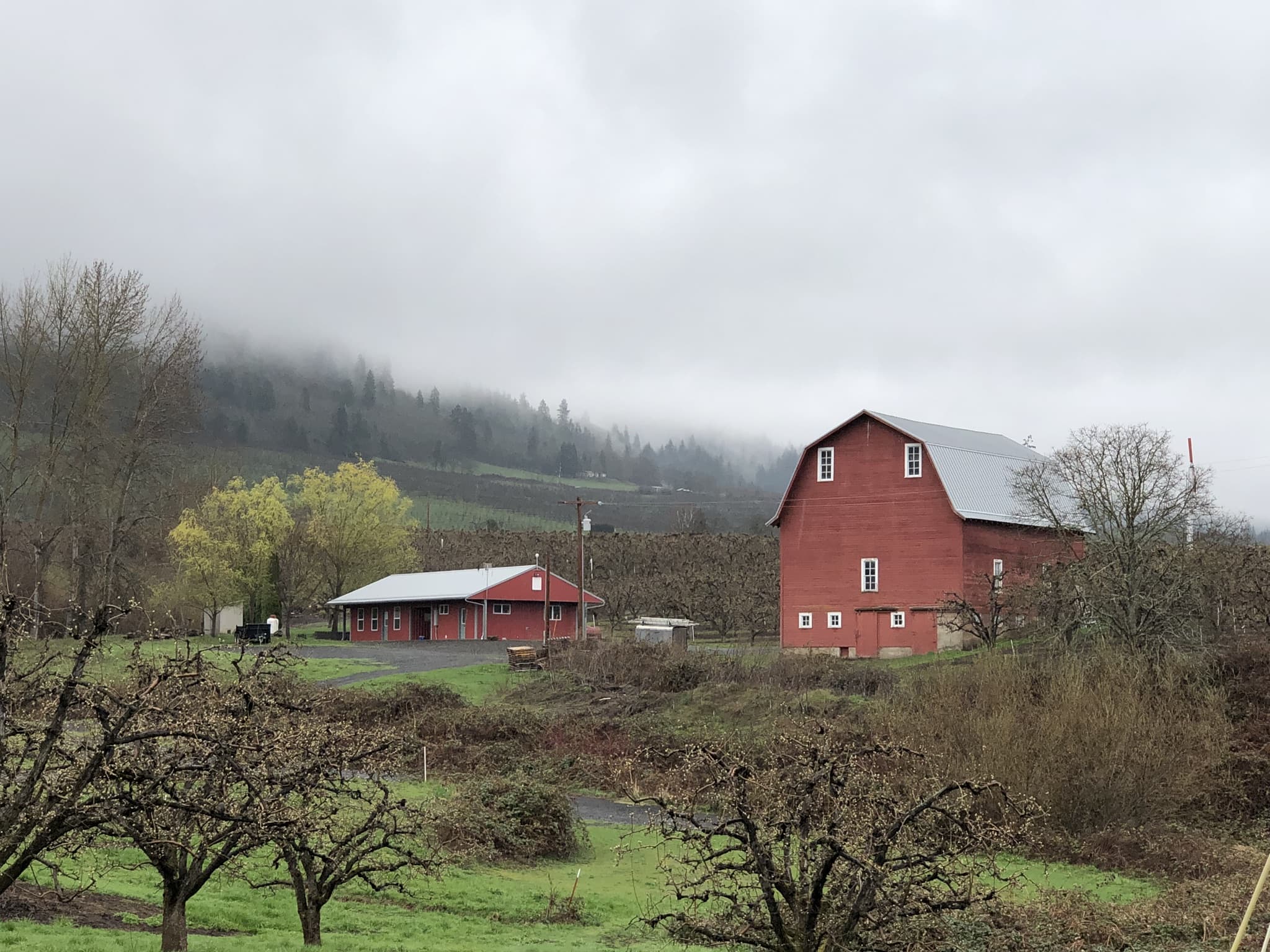
Semi-dwarfing stocks such as M26 and MM106 give twelve to eighteen feet, fruit in three or four years, and are the sensible default for most gardens. Vigorous and standard stocks such as MM111 and M25 make the twenty-five-foot trees in the photograph at the top of this page, decades to reach full size, a century of life, and a ladder for every harvest.
So decide the size you want first, then find your variety on that rootstock. Doing it the other way round is how people end up with a tree that shades the whole garden.
- Variety decides flavour. Rootstock decides size, speed and lifespan.
- Dwarfing stock fruits in 2–3 years but needs staking permanently.
- Choose the size first, then find your variety grafted onto it.
Two ways to hold a tree up
The old orchard shape is the open centre or goblet: a short trunk, three or four main limbs spreading outward, and a hollow middle so light and air reach every branch. It suits vigorous rootstocks, it makes a beautiful tree, and it needs a ladder.
The modern commercial answer is the opposite. Dwarfing stock, planted close, trained flat against wires so that every fruit is within reach from the ground and every leaf gets light. The photograph below is one version, a V-trellis, where two rows lean apart from a shared post line.
For a garden, the useful middle is a cordon, espalier or fan against a wall or a wire fence. A single-stemmed cordon on dwarfing stock takes eighteen inches of border, crops in its second or third year, and lets you grow four varieties in the space a standard tree would shade out.
Whatever the shape, the principle is identical and it is the only pruning rule worth memorising: light and air must reach the fruiting wood. Everything else is detail.
Prune in winter while dormant for shape and vigour, and in summer for restraint, summer pruning slows a tree down, which is exactly what you want on a wall-trained form.
- Open-centre goblet: beautiful, vigorous, needs a ladder.
- Trained flat on wires: everything in reach, everything lit.
- One rule underneath both: light and air must reach the fruiting wood.
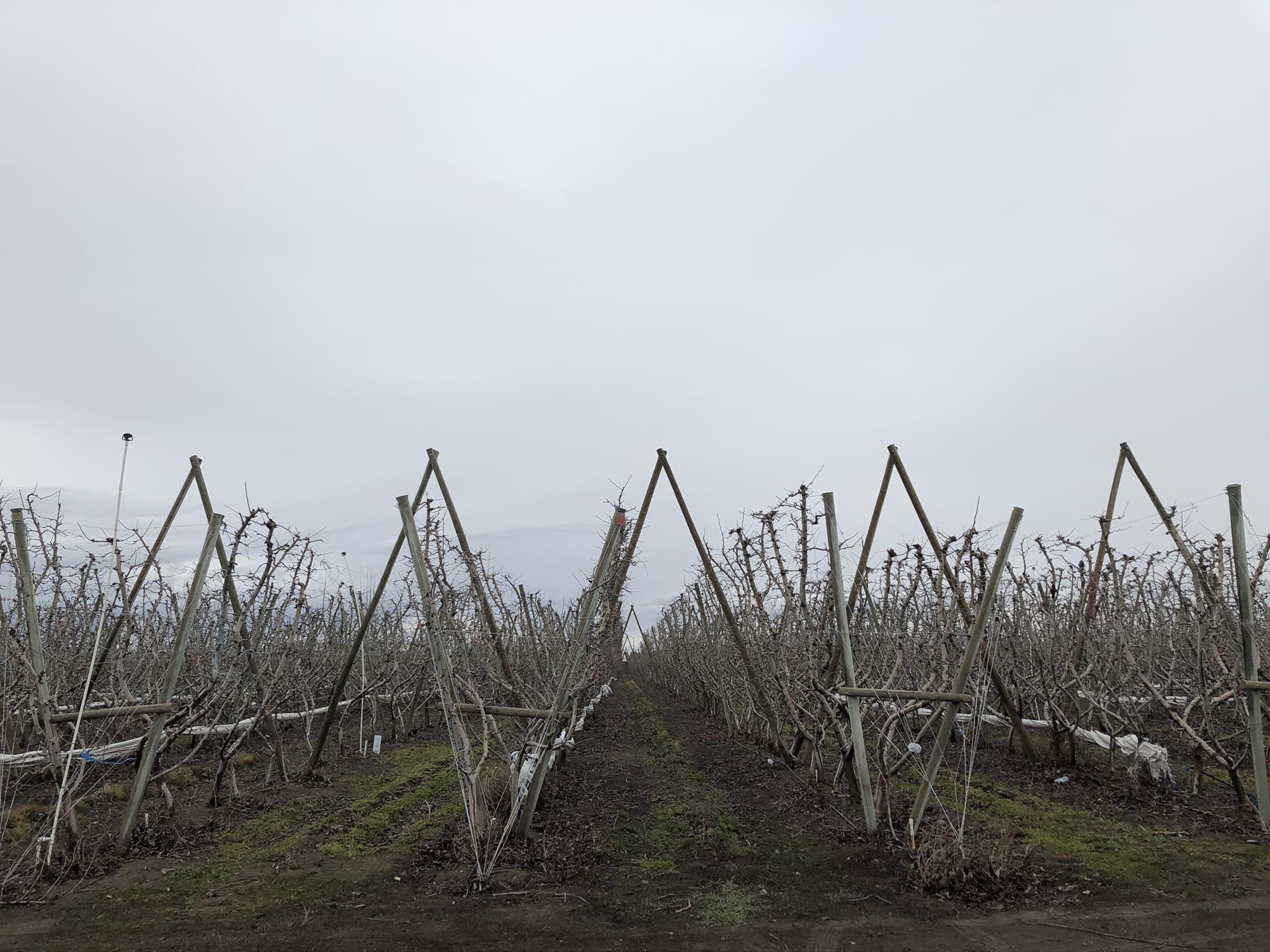
Walla Walla, Washington, the same season as the photograph above and a century of thinking apart. Every tree here is on dwarfing stock, tied flat to wires so nothing is out of reach and no fruit is shaded. The whole block is a machine for putting light on leaves.
Walla Walla, Washington, dormant season
Sun & Rain Works · © Sun & Rain Works
One apple tree is usually no apples
Most apple varieties cannot fertilise themselves and need pollen from a different variety flowering at the same time. A single tree in an isolated garden may set a light crop or none at all, and the owner reasonably concludes something is wrong with it.
Nurseries handle this with pollination groups, numbered roughly one to seven from earliest to latest flowering. A tree needs a partner in its own group or an adjacent one, group 3 works with 2, 3 or 4.
In a town this is often solved already: apple pollen travels a few hundred feet, and a neighbour's tree or even a crab apple in a hedge will do the job. In an isolated garden it will not solve itself.
Two complications worth knowing. A few varieties are triploid, Bramley is the famous one, and their pollen is sterile, so they need two other varieties nearby and give nothing back. And a family tree, with three varieties grafted onto one trunk, is the neat answer for a garden with room for exactly one tree.
Do not rely on a self-fertile label. Self-fertile varieties do set alone, but nearly all of them set a heavier, better crop with a partner.
- Most apples need a different variety flowering at the same time.
- Match pollination groups, same group or one either side.
- Triploids like Bramley need two partners and pollinate nothing.
Thinning, and the biennial habit
A tree carrying too much fruit makes small apples, breaks limbs, and, worst, exhausts itself so thoroughly that it sets almost no flower buds for the following year. That is biennial bearing: a huge crop, then nothing, then a huge crop.
Breaking the cycle is a job in June. The tree drops some fruitlets itself, the June drop, which is normal and not a problem, and then you thin what is left to one fruit per cluster, spaced four to six inches along the branch. It feels like vandalism and it is the difference between a bowl of large apples every year and a glut followed by a blank.
Feed and mulch in early spring, keeping the mulch off the trunk. Keep a clear circle of bare ground or mulch around a young tree, grass growing up to the trunk competes hard and noticeably slows establishment.
And check the graft union, the kink low on the stem. It must stay above soil level for the life of the tree. Bury it and the variety roots directly into the ground, escapes the rootstock entirely, and grows into the full-size tree you were trying not to plant.
Sources
- Thin to one fruit per cluster in June, 4–6″ apart. It prevents biennial bearing.
- The June drop is the tree thinning itself. Do not panic.
- Keep the graft union above soil for ever, or the dwarfing is undone.
Why no two pips make the same apple
Plant a pip from an apple you enjoyed and you will get a tree, and its fruit will not be that apple. Apples are extreme heterozygotes: every seed is a genuinely new individual, and the overwhelming majority are small, sharp and not worth the twenty years.
This is why every named apple in the world is a clone. A variety is one original seedling, grafted onward indefinitely, so a Northern Spy today is a cutting of a cutting of a tree that appeared in New York around 1800.
It also means every named variety was once a chance seedling that somebody noticed and thought worth propagating. That is the entire history of apple breeding until the twentieth century: not design, but attention.
The drawing below is what recording those varieties looked like before colour photography. The USDA employed artists to document fruit, and this sheet is a graphite cross-section of a Northern Spy, the core drawn as carefully as the outline, because a written description could not settle an argument about identity and the inside of the fruit was part of the evidence.
The handwriting records everything a modern database would: the variety, an accession number, the grower who supplied it, Wm. Andrews of South Haven, Michigan, the artist, and the dates.
- Every apple pip is a new individual. Pips do not reproduce varieties.
- Every named apple is a clone of one original chance seedling.
- Before colour photography, varieties were recorded by hand, in section.
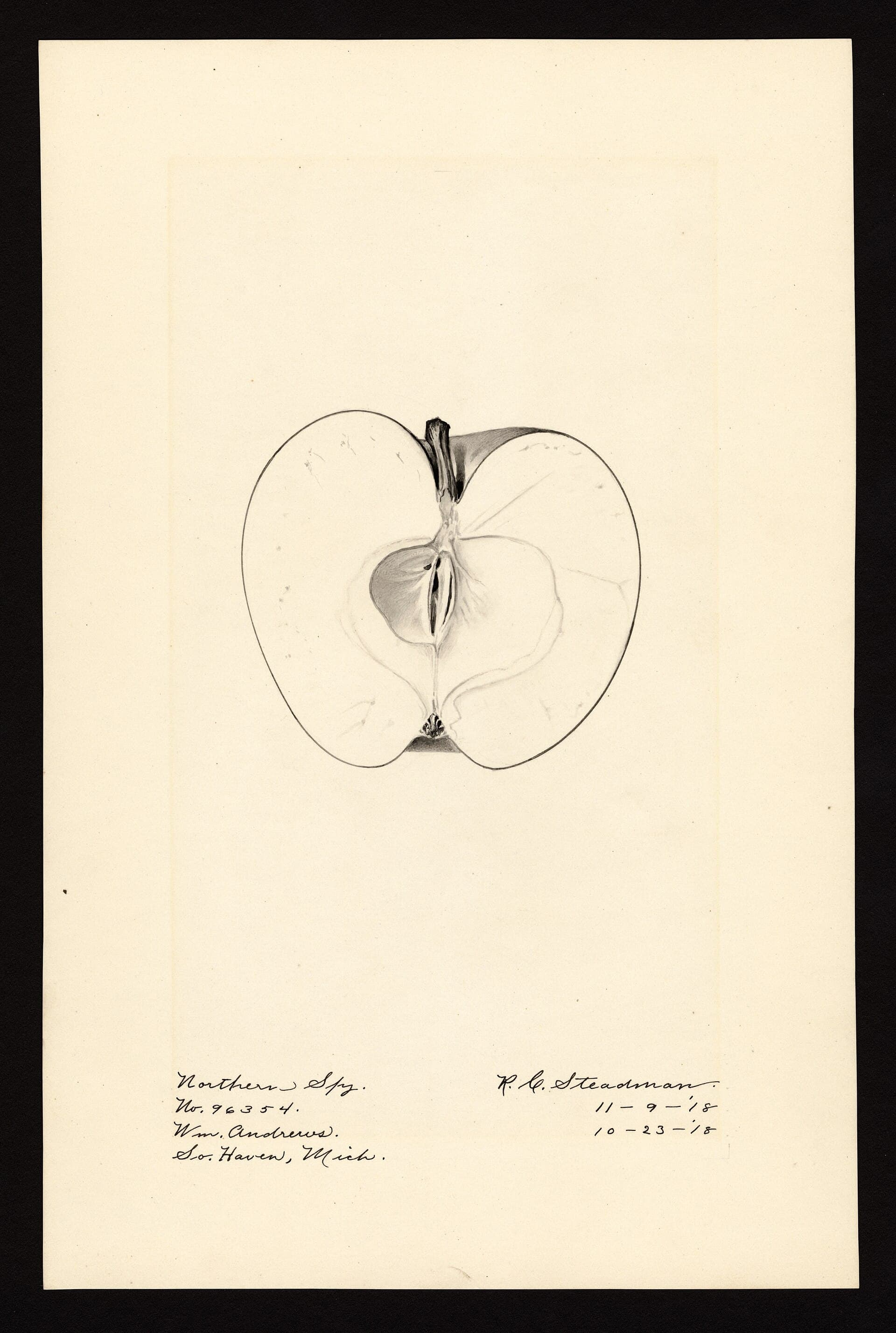
Northern Spy, drawn in graphite by Royal Charles Steadman in 1918 from a specimen supplied by Wm. Andrews of South Haven, Michigan. The USDA's pomological collection is usually described as watercolours, but it also holds line drawings like this one, and a cross-section shows what a colour portrait cannot: the shape of the core.
Specimen from South Haven, Michigan, drawn 9 November 1918 · National Agricultural Library
Royal Charles Steadman, USDA Pomological Watercolor Collection · Public domain

Which type to grow
Grouped by what each is for rather than by catalogue order, because the useful question is which one suits your ground.
Early eaters
Ripen midsummer to early autumnBest for: Eating straight off the tree
Discovery, Katy and their kind. They do not keep, a week or two at best, which is exactly why they are worth growing: this is a category the supermarket cannot sell you.
Late keepers
Picked in autumn, eaten through winterBest for: Storage, and the deepest flavour
Northern Spy, Ashmead's Kernel, Newtown Pippin. Many improve for weeks or months in store, which is a thing modern supermarket varieties largely gave up in exchange for shipping well.
Cooking apples
Large, sharp, break down when cookedBest for: Sauce, pies and baking
Bramley is the archetype and is triploid, so it needs two pollination partners and gives nothing back. High acidity is the point: it survives cooking, where a sweet dessert apple turns to bland mush.
Cider apples
Often small, tannic, unpleasant rawBest for: Fermenting
Bittersweets and bittersharps carry tannin that eating apples were bred away from. Grown in the Northwest again after a long absence, and genuinely inedible fresh, which surprises people who pick one.
Pacific Northwest heritage
VariesBest for: Growing what already works here
The Hood River valley in the photograph at the top of this page has been an apple and pear district for well over a century. Regional varieties and local nurseries are worth far more than a national list, because scab pressure in a wet spring is a local question.
What went wrong
Listed by what you can see, not by what the plant has, you arrive here holding the evidence and without the vocabulary. Where the answer is that nothing can be done this year, it says so.
Tree flowers well but sets little or no fruit
Next seasonWhy: No compatible pollination partner flowering at the same time.
What to do: Plant a second variety in the same or an adjacent pollination group, or a crab apple, which pollinates almost everything. Check whether yours is a triploid, those need two partners.
Enormous crop one year, nothing the next
Fixable nowWhy: Biennial bearing, brought on by letting the tree overcrop.
What to do: Thin to one fruit per cluster in June, four to six inches apart. In the blank year, thin especially hard on any tree that does flower, to reset the rhythm.
Small fruitlets drop in early summer
Fixable nowWhy: The June drop, the tree shedding what it cannot carry.
What to do: Nothing. It is normal and helpful. Thin what remains afterwards rather than before.
Olive-brown blotches on leaves, scabby cracked fruit
Next seasonWhy: Apple scab, which thrives in a wet spring, so, here, most springs.
What to do: Rake up and remove fallen leaves in autumn, since the fungus overwinters on them. Prune for airflow. Choose scab-resistant varieties when planting; that decision matters more than anything you can do later.
Sunken dark patches on fruit, cankers on branches
Fixable nowWhy: Apple canker, entering through wounds, worse on wet heavy soil.
What to do: Cut affected wood back to clean growth and remove it from the garden. Improve drainage. Prune in dry weather so cuts close cleanly.
Grubs and brown tunnels in the fruit
Fixable nowWhy: Codling moth larvae.
What to do: Hang pheromone traps in late spring to catch the flight, and pick up windfalls promptly rather than leaving them as a nursery.
A dwarf tree has grown enormous
Next seasonWhy: The graft union was buried, so the variety rooted above it and escaped the rootstock.
What to do: Not reversible. When planting, keep the kink in the lower stem several inches clear of the soil, and check it again after the soil settles.
Related crops
Worked out from the botany rather than from a hand-written list, so it stays correct as the library grows.
- The same family
Also Rosaceae. Shares much of this crop's pest and disease pressure and belongs in the same rotation group.
What’s in apples
Per 100 grams raw, from USDA FoodData Central. The range is what USDA actually measured across its samples — it is usually wide, and your own crop sits somewhere in it rather than on the headline number.
| Nutrient | Per 100 g | % daily | Range measured |
|---|---|---|---|
| Fibre | 2.4 g | 9% | 1.4–3.5 (n=29) |
| Vitamin C | 4.6 mg | 5% | 4–5.5 (n=3) |
| Potassium | 107 mg | 2% | 88–136 (n=26) |
| Vitamin K | 2.2 µg | 2% | 0.9–4.3 (n=20) |
| Magnesium | 5 mg | 1% | 4–6 (n=26) |
| Folate | 3 µg | 1% | , |
| Iron | 0.12 mg | 1% | 0.09–0.18 (n=16) |
| Protein | 0.26 g | 1% | 0.17–0.57 (n=29) |
| Calcium | 6 mg | 0% | 4–9 (n=26) |
| Vitamin A | 3 µg | 0% | , |
| Water | 85.56 g | , | 82.39–87.52 (n=38) |
| Energy | 52 kcal | , | , |
Source: USDA FoodData Central, “Apples, raw, with skin (Includes foods for USDA's Food Distribution Program)” (SR Legacy, published 4/1/2019). Percentages are of the FDA adult Daily Value, a labelling reference rather than a personal requirement. Raw values; boiling leaches water-soluble vitamins and some carotene, so a cooked serving is not the same figure.
What the wartime archive says about apples
5 passages from the USDA’s 1943–46 victory garden material, with our note on whether each still holds. Pulled from the annotations themselves rather than listed here by hand.
- The knifeStill holds
Pare with as sharp a knife as you have with a blade of stainless steel, glass, plastic, or silver — so foods won't be discolored.
Oven drying the surplus
- Bagging the fruitStill holds
Enclosing fruit clusters in paper bags will offer some protection.
Victory Garden Insect Guide
- The jelly that would not jellStill holds
NANCY: (SOBBING) Look at it, look at it! It didn't jell!... It's done for, and so's my valuable sugar! ... FREYMAN: But that is bad, Johnny — wasting valuable sugar experimenting with jelly recipes, if you aren't exactly sure how to do it.
Consumer Time · July 7, 1945
- Fruit at homeStill holds
Strawberries, bush fruits and grapes can be grown fairly easily in many, many areas. Cherries, plums and perhaps other stone fruits, likewise, are adapted to many areas. Apple and pears, because of insects and disease are more difficult to…
A Victory Garden Program for 1945
- Dwarf rootstockStill holds
Dwarf forms of these fruits, particularly, may be considered for small home plantations because they may be more easily sprayed and cared for than ordinary stocks.
A Victory Garden Program for 1945
Saving your own seed
Apples do not come true from seed, and unusually the reason is worth understanding rather than just accepting.
The species is self-incompatible and highly heterozygous, so every pip is a genuinely novel individual carrying an unpredictable shuffle of its parents. Plant ten pips from one apple and you get ten different trees, nearly all of them small, sharp and not worth the decade it takes to find out.
So every named variety in the world is a clone, maintained by grafting. Northern Spy is not a type of apple; it is one tree that appeared in New York around 1800, propagated onward ever since.
If you want to propagate a tree you like, take a cutting of one-year wood in winter and graft it onto a rootstock, whip-and-tongue in late winter is the classic method, and it is far more learnable than it looks. That is a genuine skill worth having, and the only way to reproduce an apple.
The one reason to grow from pips is the one that produced every variety we have: chance. Somebody noticed a seedling worth keeping. It takes years, nearly always disappoints, and is exactly how Northern Spy and every other apple came to exist.
Farm rooted clothing · Est. 2005
The guides are free. The shop is the business.
Sun & Rain Works is a small apparel outfit in Eugene, Oregon, with agricultural roots and a slow path toward farming. The apples guide you just read comes from the same place as the shirts.
More growing guides
We're working through the vegetables one at a time, with dates counted from your own frost station and the old books read properly. Occasional notes from Eugene, Oregon, an art business with agricultural roots, working its way toward farming.
We'll email you to confirm before sending anything. After that, occasional seasonal notes from Sun & Rain Works, we won't share your address, and every email has an unsubscribe link.
Growing advice here is current horticultural practice, drafted with AI assistance and checked against the sources this page names. Where it quotes a book, the book is named and linked. Where practice is genuinely contested, or local enough that we would be guessing, the text says so, your county extension service beats any national guide, including this one, on pest timing.
The photographs are not AI-generated. Every one is our own work, public domain, or licensed, and carries its author and licence beneath it.