Growing guide
How to grow garlic
You plant it when everything else is finishing and dig it when everything else is starting. Nine months in the ground, almost no attention in between, and the decision that matters is made before the first clove goes in.
Allium sativum · Amaryllidaceae, with onion, leek, shallot and chive
Above: Dwight Sipler · CC BY 2.0
.jpg)
easy. Among the least demanding things you can grow, and the hardest to hurry. It asks for one afternoon in autumn, one in early summer, and one at harvest, but it occupies the bed for nine months and there is no shortcut.
At a glance
- Family
- Amaryllidaceae (onion family)
- Grown from
- Cloves, not seed
- Life cycle
- Perennial, grown as an annual
- Hardiness
- Very hardy, wants a cold spell
- Planting
- About a month before your first autumn frost
- Soil
- Rich, loose, free-draining. Hates sitting wet
- Sun
- Full sun
- In the ground
- 8 to 9 months
- Spacing
- 6″ apart in rows 12″ apart, 2″ deep
- Biggest single risk
- Planting supermarket garlic
When to sow, where you actually live
Every other guide prints a month, and a month is only true somewhere. What transfers between locations is the offset: garlic go in at a time relative to the last spring frost, wherever that falls for you. Give us a ZIP and we will count it from your own NOAA weather station.
Current spacing: 6″ apart in rows 12″ apart, sown 2″ deep. Roughly 240–270 days to a first picking, though variety moves that more than any general figure admits.
Get your sowing dates →First: hardneck or softneck?
This decides most of what follows, and like determinate and indeterminate tomatoes it is frequently missing from the label.
Hardneck garlic sends up a stiff central flower stem, the scape, and forms a single ring of large, easily peeled cloves around it. It is markedly hardier, it has far more flavour range between varieties, and it does not keep as long: four to six months is typical. Because of that stiff stem it cannot be braided. In a cold-winter garden, hardneck is usually the right answer.
Softneck garlic makes no scape, packs more and smaller cloves in several layers, keeps far longer, often nine months or more, and has the flexible neck that makes braiding possible. It is what supermarkets sell, because it stores and ships. It prefers milder winters.
In the maritime Northwest both work, and the sensible move is to plant some of each: hardneck for eating well from summer to winter, softneck for the bulbs that carry you to the following spring.
There is also elephant garlic, which is not garlic at all, it is a leek that forms a huge mild bulb. Burr already knew this and lists it separately as Great-headed Garlic, identifying it as a different species.
- Hardneck: scapes, bigger cloves, hardier, keeps 4–6 months, no braiding.
- Softneck: no scapes, more cloves, keeps 9+ months, braidable.
- Elephant garlic is a leek, not garlic. Burr had this right in 1863.
Do not plant supermarket garlic
This is the one instruction that reliably decides a garlic crop, and it is the one most often ignored because the alternative is standing in a kitchen holding perfectly good-looking garlic.
Two problems. Supermarket bulbs are frequently treated to suppress sprouting, so they sit in the ground and do nothing. And they are grown for warm climates and long shipping, much of it from China or California, so even when they do grow they are poorly adapted to a cold wet winter.
The larger issue is disease. Garlic is propagated clonally, so every disease its parent carried travels with the clove: white rot, nematodes, viruses. Supermarket stock carries no assurance about any of it, and white rot in particular stays in your soil for many years. It is a genuinely bad trade for the price of a bulb of seed garlic.
Buy proper seed garlic once, from a grower in a climate like yours, and then save your own. That is the whole point of a clonal crop: after the first purchase it is free forever, and it adapts to your ground over the years.
Choose the fattest bulbs and plant only the largest cloves from each. Bulb size compounds, big cloves make big bulbs, whose big cloves make bigger bulbs, and the small inner ones are for the kitchen.
Sources
- Supermarket garlic may be sprout-suppressed and is often badly adapted.
- It also carries unknown disease, and white rot stays in soil for years.
- Buy seed garlic once, then save your own. Plant only the biggest cloves.
Planting, and which way up
Plant about a month before your first autumn frost. Our calendar counts that from your own frost dates rather than naming a month, which matters more for this crop than most, the aim is enough time to root before the ground goes cold, and not so much that it makes soft top growth that winter will burn.
Break the heads into cloves at planting time and not before. A broken clove starts losing moisture immediately, and cloves split weeks early perform noticeably worse. Leave the papery skin on each one.
Plant each clove pointed end up, flat basal plate down, about two inches deep and six inches apart in rows a foot apart. Planting upside down is the classic first-year mistake: the shoot has to turn itself around underground, which costs it weeks and often produces a bent, undersized bulb.
Then mulch. A few inches of straw over the bed moderates the freeze-thaw cycling that heaves cloves out of the ground, suppresses the weeds garlic competes with badly, and holds moisture in spring. In a wet maritime winter, make sure the bed drains, garlic tolerates cold far better than it tolerates sitting in water.
The 1912 manual gives it two sentences and gets the essentials right: garlic is planted by setting the small bulbs, or cloves, either in the autumn or early spring, and the culture is practically the same as for the onion.
- A month before the first autumn frost, enough to root, not enough to shoot.
- Split heads into cloves on planting day, not weeks before.
- Pointed end up, 2″ deep, then mulch. Drainage matters more than cold.
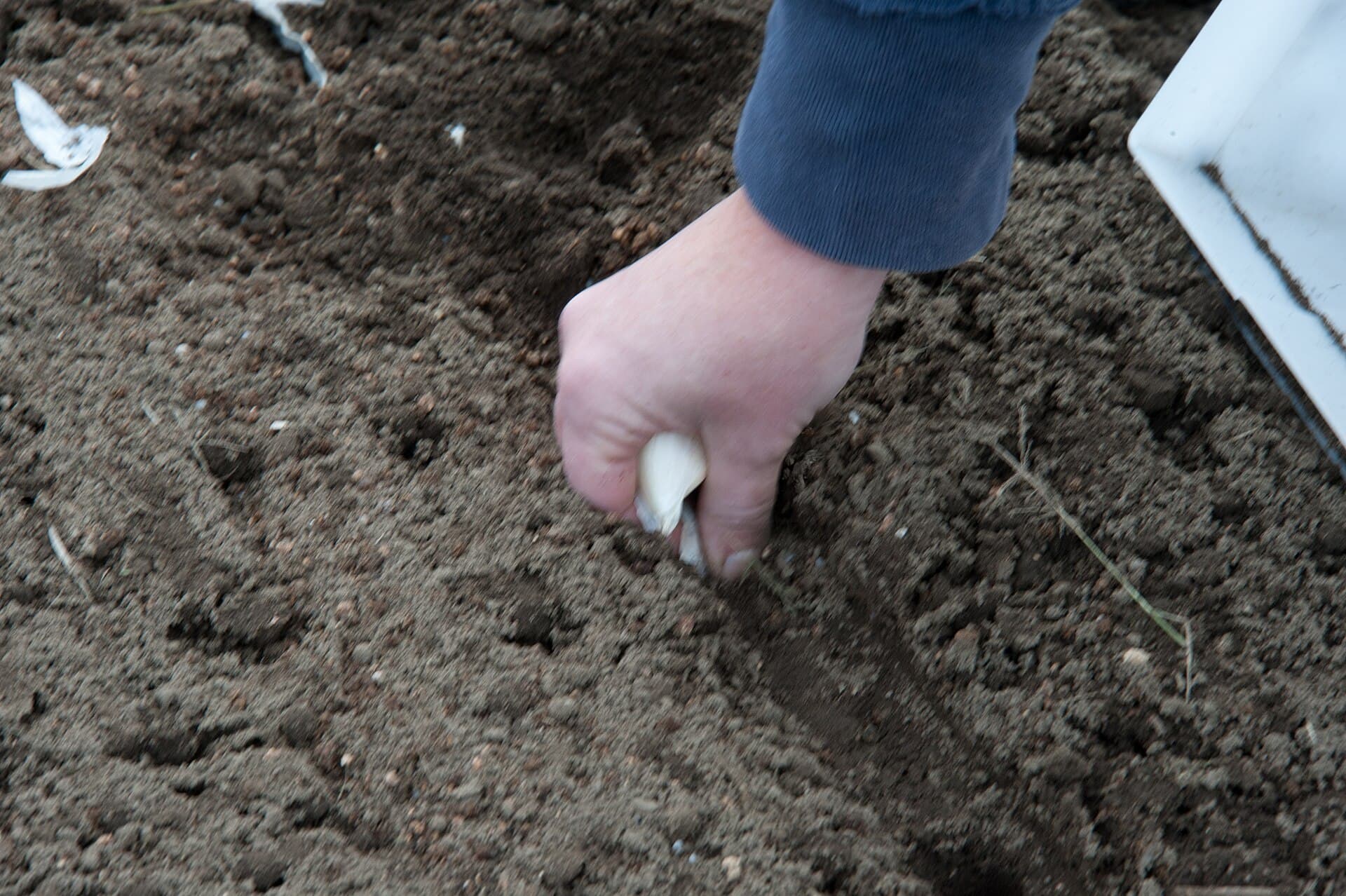
One clove, pointed end up, pressed into a drawn furrow. This is the whole technique and the whole first-year mistake in one frame, a clove planted upside down has to turn itself around underground, and it never quite catches up.
Stow, Massachusetts
Dwight Sipler · CC BY 2.0
.jpg)
Cutting the scapes
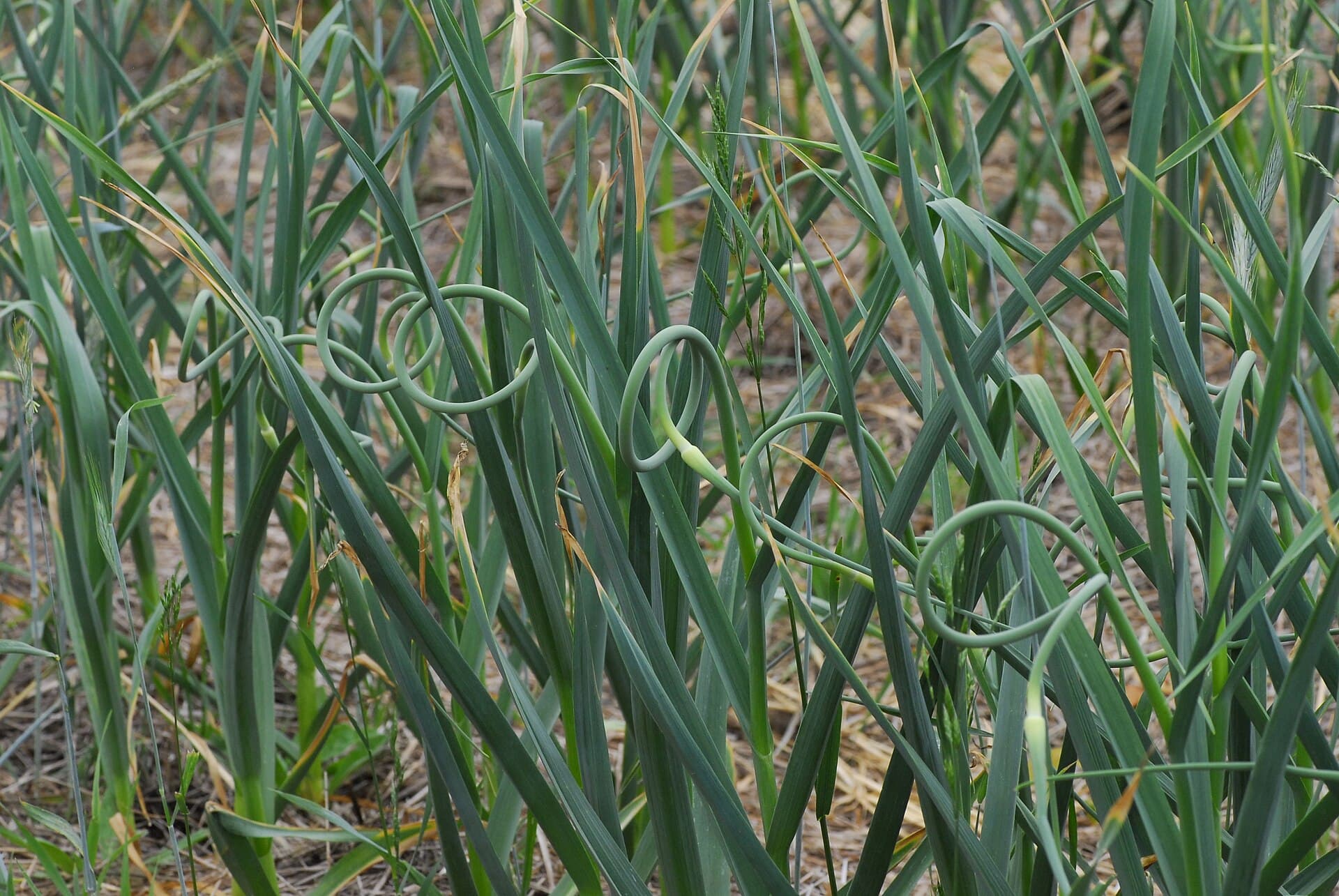
In early summer, hardneck garlic throws a stiff flower stem from the centre of the plant which curls into a loop or two before straightening, the scapes in the photograph at the top of this page.
Cut them off. A plant left to flower diverts a real share of its energy into a seed head that will mostly not produce viable seed anyway, and bulbs are meaningfully smaller for it. Cut once the curl has formed and before the stem straightens and toughens.
The reward is immediate and is the reason this is the least resented job in the garden: scapes are excellent eating. Mild, green, somewhere between garlic and asparagus, grill them, or blitz them into a pesto that freezes well.
Softneck garlic makes no scape, so if yours never does, that is not a failure. It is a softneck.
One exception worth knowing: leaving a few scapes to mature gives you bulbils, the tiny aerial cloves in the head. They take two or three seasons to reach eating size, but they are an easy way to multiply stock and they are usually free of the soil-borne diseases that travel in cloves.
- Cut scapes once they curl, bulbs are smaller if you do not.
- Eat them. Grilled or as pesto, they are the best thing in the June garden.
- No scape means you have softneck garlic, not a problem.
Knowing when to lift, and curing
This is where a good garlic crop is most often spoiled, because the plant gives an ambiguous signal and both errors are costly.
Lift when roughly the bottom third to half of the leaves have gone brown and the upper ones are still green. Every leaf corresponds to a wrapper layer around the bulb, so waiting for the whole plant to die back means the wrappers have rotted away, the bulb splits open, the cloves separate, and it will not store. Digging too early gives you an undersized bulb that never firms up.
Dig, do not pull; the stems break off surprisingly easily and a bulb left in the ground is a bulb you will not find again.
Then cure. Hang the whole plants, or lay them on racks, somewhere dry, shaded and airy for two to four weeks, not in the sun, which scalds them. They are cured when the neck is dry all the way through and the outer skins rustle.
Only then trim: roots off, stems cut to an inch or so, or leave softneck stems on to braid. Store cool, dark and dry with air movement, and never in the fridge, where the cold prompts them to sprout.
Save your biggest bulbs for replanting before you start eating the crop. It is much easier to set them aside now than to resist them in October.
- Lift when the lower third of leaves have browned and the top is still green.
- Every green leaf is a wrapper layer. Wait too long and the bulb splits.
- Cure two to four weeks in shade with air moving. Never the fridge.
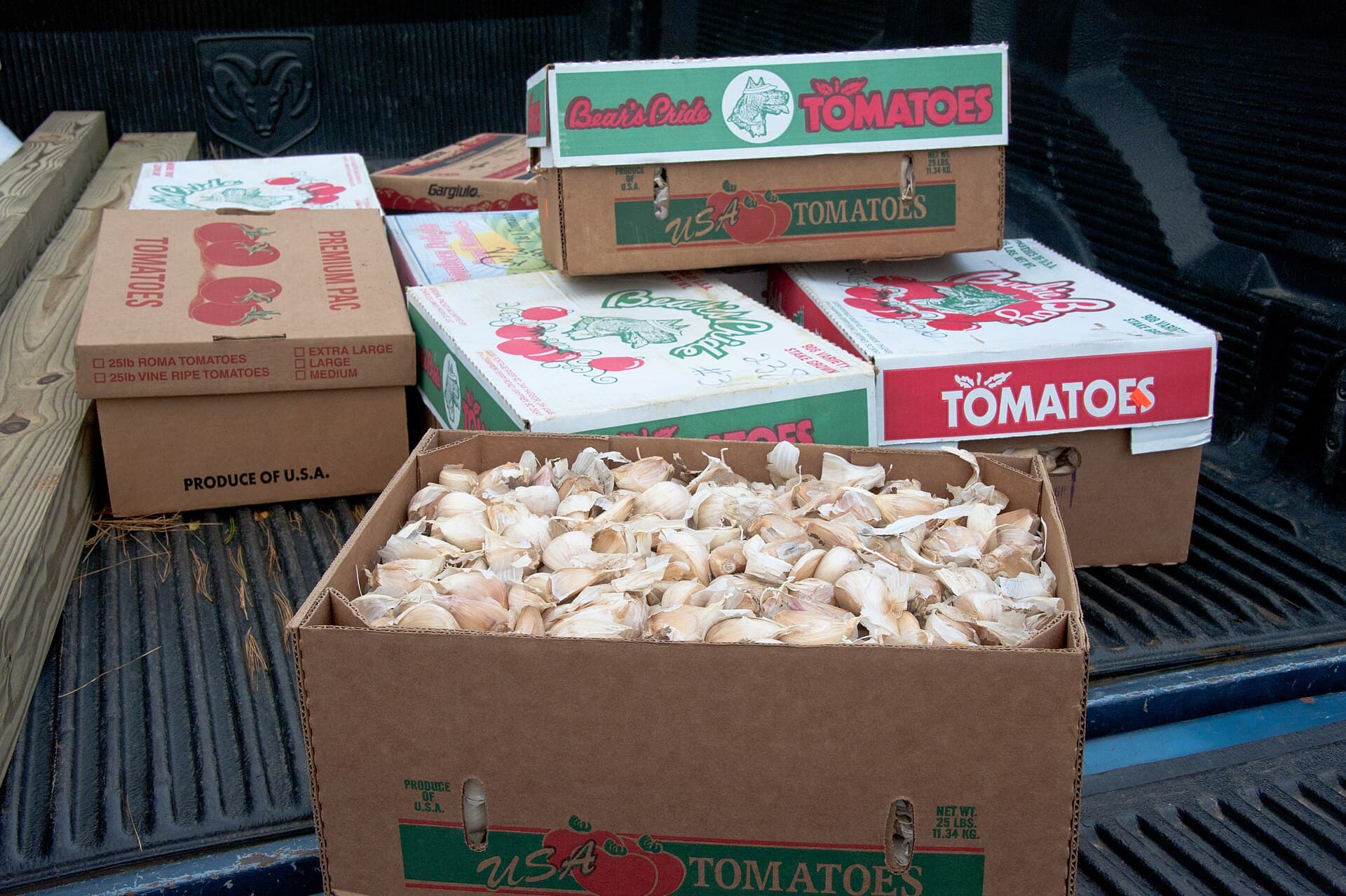
Next season's crop: heads broken down into cloves on planting day. This is a scale most gardens will never need, but it shows the step properly, the papery skin stays on each clove, and only the fat outer ones go in the ground.
Stow, Massachusetts
Dwight Sipler · CC BY 2.0
.jpg)
The crop nobody wanted to smell of
No vegetable in our 1863 census has reversed so completely, and the evidence needs handling carefully because it is easy to overstate.
Two named varieties is what Fearing Burr gives garlic, the fewest of any crop we have counted, in a book that runs to seventy-one peas. That much is his own, and it is a fact about what an American seedsman thought worth describing.
For the reason, he quotes somebody else. “It is not cultivated to any considerable extent in this country; its strong flavor, and the offensive odor it communicates to the breath, causing it to be sparingly used in our cookery.” That sentence is Burr quoting M'Intosh, a British horticultural writer, so “this country” is Britain, not America. Anyone using this quote to say Americans would not eat garlic, ourselves included on an earlier draft of this page, has read it too quickly.
What can be said is narrower and still striking: an American cataloguer, describing garlic for American gardeners, reached for a British authority's dismissal of it and let it stand. He did not contradict it, and he did not have many varieties to set against it.
The rest is a twentieth-century story with a great deal of Italian, Chinese and Mexican cooking behind it. The plant did not change, garlic is propagated clonally, so in a real sense these are the same individuals, but what people were willing to smell of did.
One more difference worth noticing while you are here. Burr has garlic planted in April or May, and modern practice plants it in autumn for bigger bulbs. Both work. The autumn habit is the improvement, and it is recent enough that a good 1863 catalogue does not mention it.
- Burr lists two varieties and blames the smell. He was reporting accurately.
- Garlic's American rise is a twentieth-century story about immigrant cooking.
- The plant did not change. The tolerance for it did.
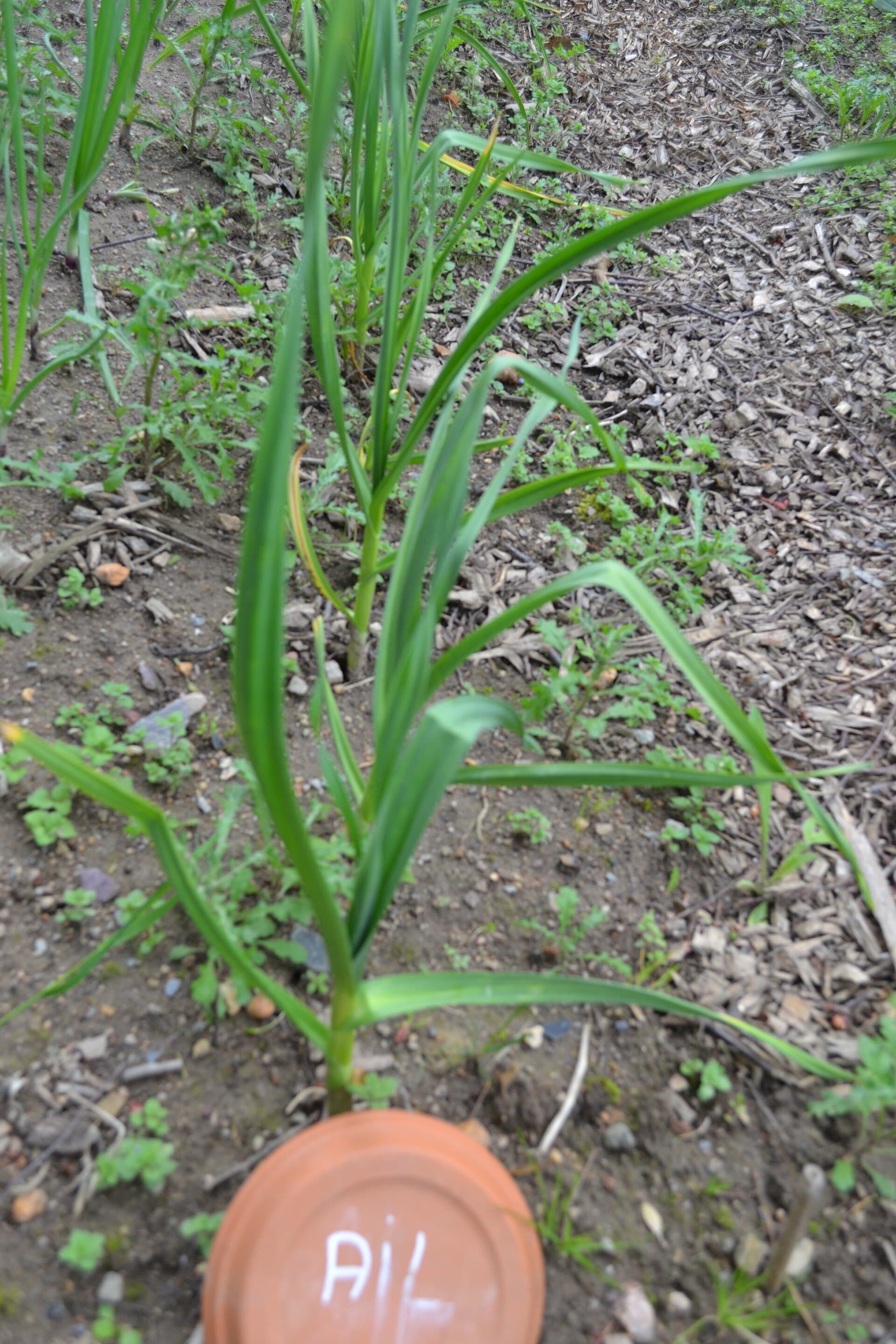
One plant, labelled in French. Garlic reached American gardens late and mostly through other people's cooking, which is why a nineteenth-century American catalogue can dismiss it in a line while a European one takes it seriously.
Seb35 · CC0

Which type to grow
Grouped by what each is for rather than by catalogue order, because the useful question is which one suits your ground.
Porcelain (hardneck)
Four to six very large cloves, bright white wrappersBest for: Cold winters and the biggest cloves
The hardiest group and the easiest to peel. Strong, hot raw, mellow cooked. Keeps around six months, good, not exceptional. Music is the variety most people meet first and it deserves the reputation.
Rocambole (hardneck)
Eight to twelve cloves, loose wrappers, tightly coiled scapesBest for: Flavour, if you will eat it before spring
Widely held to be the best-tasting garlic there is, rich and complex rather than merely hot. The trade-off is real: loose wrappers and short storage, four months or so. Grow it to eat, not to keep.
Purple stripe (hardneck)
Striking purple-streaked wrappers, 8–12 clovesBest for: Roasting
Generally reckoned the best garlic for roasting, and among the most beautiful. Middling storage. A good middle choice between porcelain's hardiness and rocambole's flavour.
Artichoke (softneck)
Many cloves in overlapping layers, thick wrappersBest for: Storage and mild winters
The commonest supermarket type and the most productive per square foot. Milder, keeps nine months or more, and reliably braidable. Less hardy than any hardneck, but in a mild maritime winter that hardly signifies.
Silverskin (softneck)
Small tight cloves, smooth silvery wrappersBest for: The longest storage, and braiding
The last garlic standing in spring, often twelve months. Strong flavoured, fiddly to peel, and the classic braiding garlic. Worth a short row purely to carry you through to the next harvest.
Elephant garlic
Enormous bulb, four to six huge mild clovesBest for: Mildness and novelty
Not garlic. It is a leek, Allium ampeloprasum, which forms a bulb, Burr lists it separately in 1863 as Great-headed Garlic and correctly identifies it as a different species. Mild enough to roast whole, and grown the same way.
What went wrong
Listed by what you can see, not by what the plant has, you arrive here holding the evidence and without the vocabulary. Where the answer is that nothing can be done this year, it says so.
Cloves never came up, or came up months late
Next seasonWhy: Supermarket garlic treated with sprout suppressant, or cloves planted upside down.
What to do: Buy proper seed garlic from a grower in a climate like yours. Plant pointed end up, the flat basal plate is the bottom.
Bulb is one solid round with no cloves
Next seasonWhy: The plant did not get enough cold, or was planted too late in spring to receive it. Garlic needs several weeks below about 40°F to divide into cloves.
What to do: Perfectly edible and rather good, treat it as a mild single-clove garlic. Plant in autumn rather than spring so it gets the winter it needs.
Bulbs small despite healthy tops
Fixable nowWhy: Crowding, weed competition, or scapes left on the plant.
What to do: Cut scapes as soon as they curl. Keep the bed genuinely weed-free, garlic has sparse roots and loses to weeds badly. Plant the fattest cloves next time.
Bulb split open with cloves separating in the ground
Fixable nowWhy: Left too long before lifting; the wrapper layers have rotted away.
What to do: Use those first, they will not store. Lift when the lower third of the leaves have browned and the upper leaves are still green.
Bulbs rot or sprout in storage
Next seasonWhy: Not cured properly, stored somewhere damp, or kept in the fridge.
What to do: Cure two to four weeks until the neck is dry through and the skins rustle. Store cool, dark, dry, with air movement, refrigeration prompts sprouting rather than preventing it.
White fluffy growth and black specks at the base
Next seasonWhy: White rot, the serious allium disease. Frequently arrives on bought bulbs.
What to do: Remove and destroy everything affected; do not compost. Never move soil or tools from that bed. It persists for many years, grow alliums as far away and for as long as you can. This is the main reason not to plant supermarket garlic.
Leaf tips yellow in late winter
Fixable nowWhy: Usually normal, cold damage or a nitrogen dip while the soil is cold.
What to do: Generally nothing. A nitrogen-leaning feed as growth resumes in early spring is the one worthwhile intervention, and only then.
2 kinds, in 1863
Two named varieties, the shortest list in the entire census, in a book that gives the pea seventy-one. Burr then quotes M'Intosh on why: “It is not cultivated to any considerable extent in this country; its strong flavor, and the offensive odor it communicates to the breath, causing it to be sparingly used in our cookery.” M'Intosh was British, so “this country” is Britain, the quote is not evidence about American tables, only about what an American cataloguer was willing to let stand unchallenged. Burr describes the Common Garlic in the chapter text without giving it a heading, and lists Great-headed Garlic while correctly identifying it as a different species: what we now call elephant garlic, and a leek. Neither named variety is held in the federal seed bank under Burr's name, which for a clonally propagated crop says more about how names travel than about extinction.
Early Rose Garlic · Great-headed Garlic
Our reading of twenty-two tomatoes →Related crops
Worked out from the botany rather than from a hand-written list, so it stays correct as the library grows.
- The same genus
The same genus, Allium. Close enough to share most pests and diseases, so keep them apart in a rotation.
What’s in garlic
Per 100 grams raw, from USDA FoodData Central. The range is what USDA actually measured across its samples — it is usually wide, and your own crop sits somewhere in it rather than on the headline number.
| Nutrient | Per 100 g | % daily | Range measured |
|---|---|---|---|
| Protein | 6.62 g | 13% | 5.31–7.94 |
| Vitamin C | 10 mg | 11% | 8.3–12.6 (n=6) |
| Fibre | 2.7 g | 10% | 2.3–3.4 (n=6) |
| Water | 63.1 g | , | 59.1–69 (n=6) |
| Energy | 143 kcal | , | , |
Source: USDA FoodData Central, “Garlic, raw” (Foundation, published 10/30/2020). Percentages are of the FDA adult Daily Value, a labelling reference rather than a personal requirement. Raw values; boiling leaches water-soluble vitamins and some carotene, so a cooked serving is not the same figure.
What the wartime archive says about garlic
One passage from the USDA’s 1943–46 victory garden material, with our note on whether each still holds. Pulled from the annotations themselves rather than listed here by hand.
- Can last, not firstStill holds
The garden advisors of the U. S. Department of Agriculture say to limit canning this year to the garden products you can't preserve so well in any other way... You'll want to store some vegetables, put some in freezer-locker storage, dry ot…
Saving the crop · May 14, 1943
Saving your own seed
The easiest crop on this site to keep going indefinitely, and the second that involves no seed at all. You replant cloves, and every plant is a clone of its parent, so a variety persists unchanged, and so does anything it is carrying.
The method is simply selection. Set aside your largest, healthiest bulbs at harvest, before you start eating the crop, and plant their fattest cloves in autumn. Bulb size compounds year on year, and after a few seasons the stock is measurably adapted to your ground.
Most cultivated garlic has lost the ability to set viable seed at all, which is why there is no isolation distance, no minimum population and no viability figure in the seed-saving table, none of those concepts apply.
Hardneck types offer a second route. Leave a few scapes to mature and the flower head fills with bulbils, tiny aerial cloves. They take two or three seasons to reach full size, but they multiply stock quickly and they are generally free of the soil-borne diseases that travel in cloves, which makes them a genuine way to clean up an infected line.
The one thing to watch is that disease clones along with the variety. If yield declines year on year for no obvious reason, buy fresh certified stock and start again rather than persevering.
Farm rooted clothing · Est. 2005
The guides are free. The shop is the business.
Sun & Rain Works is a small apparel outfit in Eugene, Oregon, with agricultural roots and a slow path toward farming. The garlic guide you just read comes from the same place as the shirts.
More growing guides
We're working through the vegetables one at a time, with dates counted from your own frost station and the old books read properly. Occasional notes from Eugene, Oregon, an art business with agricultural roots, working its way toward farming.
We'll email you to confirm before sending anything. After that, occasional seasonal notes from Sun & Rain Works, we won't share your address, and every email has an unsubscribe link.
Growing advice here is current horticultural practice, drafted with AI assistance and checked against the sources this page names. Where it quotes a book, the book is named and linked. Where practice is genuinely contested, or local enough that we would be guessing, the text says so, your county extension service beats any national guide, including this one, on pest timing.
The photographs are not AI-generated. Every one is our own work, public domain, or licensed, and carries its author and licence beneath it.