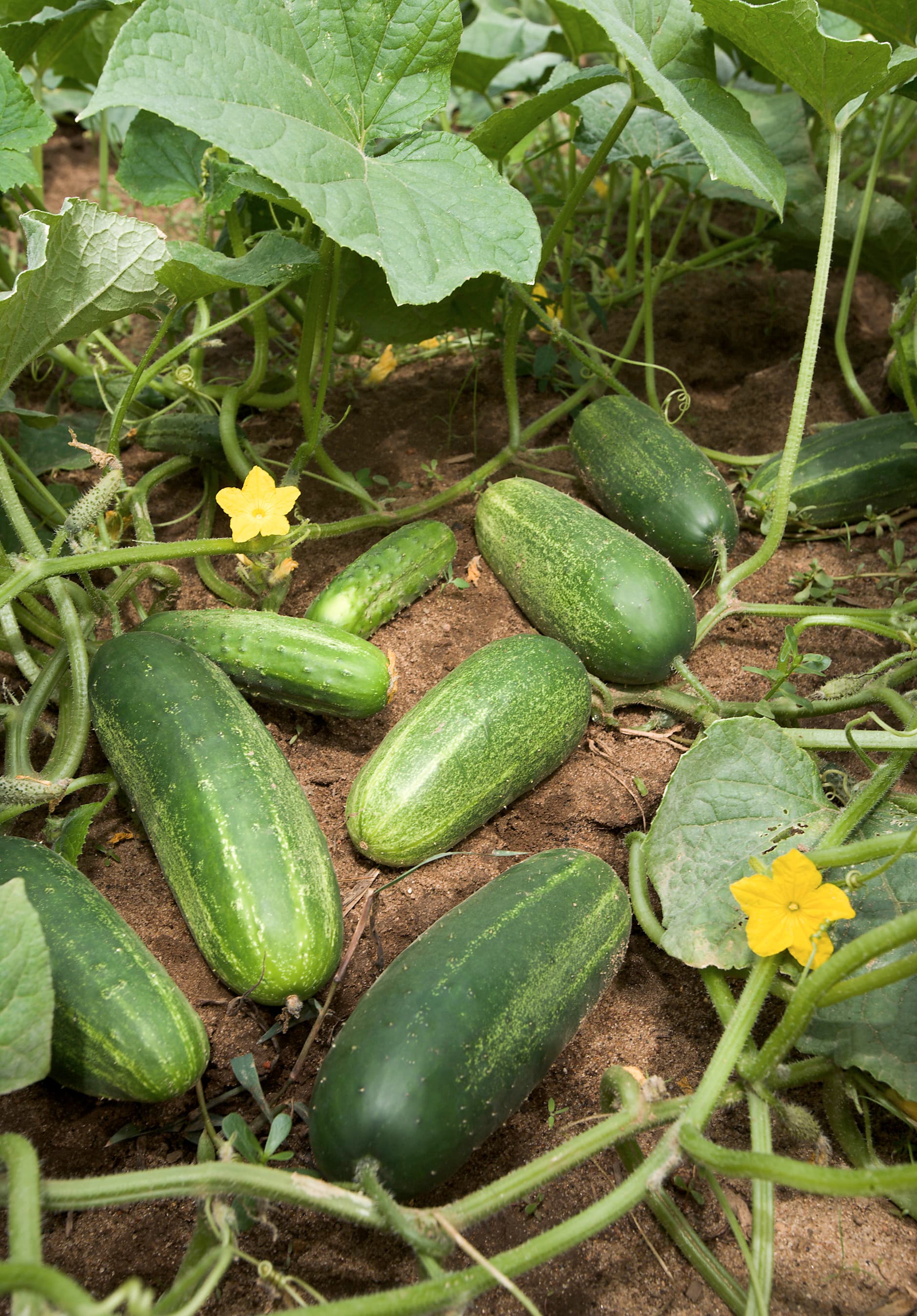
Growing guide
How to grow cucumbers
A sprawling crop that does not have to sprawl. Almost everything about growing cucumbers gets easier the moment you grow them upward instead of across.
Cucumis sativus · Cucurbitaceae, with squash, melon, pumpkin and gourds
Above: Stephen Ausmus, USDA Agricultural Research Service · Public domain

easy. Fast and productive once the soil is warm. The two common disappointments, dropped fruit and bitterness, are both about conditions rather than skill, and both have straightforward answers.
At a glance
- Family
- Cucurbitaceae (squash family)
- Life cycle
- Annual
- Hardiness
- Tender, killed by frost, stalled by cold
- Sowing method
- Direct sow, or start in something plantable whole
- Germination
- 5–10 days in warm soil
- Soil
- Rich, deep, moisture-retentive
- Sun
- Full sun
- Days to maturity
- 55–65 from sowing
- Ground needed
- A quarter as much if grown vertically
- Biggest single risk
- Cold soil at sowing
When to sow, where you actually live
Every other guide prints a month, and a month is only true somewhere. What transfers between locations is the offset: cucumber go in about 2 weeks after the last spring frost, wherever that falls for you. Give us a ZIP and we will count it from your own NOAA weather station.
Current spacing: 12″ apart in rows 36″ apart, sown 1″ deep. Roughly 55–65 days to a first picking, though variety moves that more than any general figure admits.
Get your sowing dates →Grow them up something
A cucumber left to sprawl covers a great deal of ground, sits its fruit on damp soil, hides them under leaves, and gets mildew from the bottom up because nothing dries. The same plant on a net, a trellis or a string takes roughly a quarter of the space, and every problem in that list gets smaller.
The fruit are cleaner and straighter, because a hanging cucumber grows down rather than curving around whatever it is lying against. They are far easier to find, which matters more than it sounds, a missed cucumber turns into a marrow and stops the plant. And air moves through the foliage, which delays mildew by weeks.
Cucumbers climb with tendrils and mostly do it themselves; they need a net or strings rather than a smooth pole. Put the support in at planting, not after.
The photograph below is a commercial polytunnel with plants trained up strings, which is the same principle at a larger scale. In a garden, a panel of wire mesh leant against a fence does the job.
- Vertical growing takes about a quarter of the ground.
- Hanging fruit grow straighter, stay cleaner and are easier to find.
- Use net or strings, tendrils cannot grip a smooth pole.
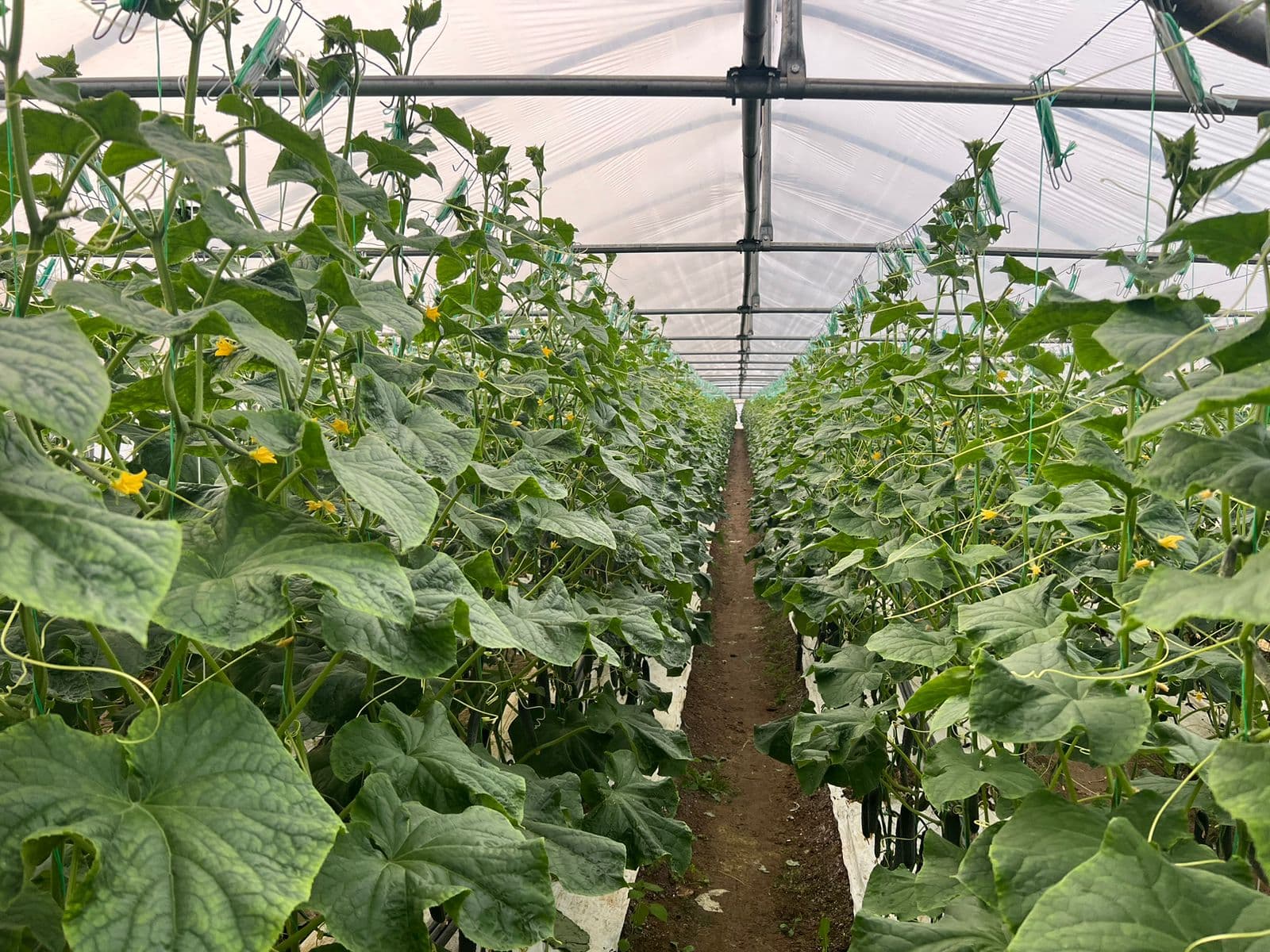
The same crop grown upward. Two rows on strings occupy the ground that a handful of sprawling plants would cover, the fruit hang clear of the soil, and there is air moving through the whole canopy, which is most of the mildew battle won before it starts.
AgroFidanishtja Havolli · CC BY-SA 4.0

Warm soil, and no root disturbance
Like all the cucurbits, cucumbers want warmth rather than merely the absence of frost. Our calendar puts direct sowing two weeks after the last frost, which is later than most packets suggest and produces better plants, seed in cold ground rots, and a seedling that is chilled sulks for a fortnight.
If you start them early, start them in something you can plant whole: a soil block, a coir pot, a paper pot. Cucumber roots resent disturbance more than most, and a plant tipped out of a plug and teased apart loses more time than it gained.
Feed the ground well before planting. This is a plant that builds a lot of vine in a short time and it is genuinely hungry.
Water steadily and generously, a cucumber is mostly water and a plant that dries out reliably makes bitter fruit. Mulching pays for itself here.
- Two weeks after last frost. Cold soil rots the seed and stalls seedlings.
- Start in something plantable whole, the roots hate disturbance.
- Steady generous water. Drought makes bitter cucumbers.
Pollination, and the varieties that must not be pollinated
Most cucumbers carry separate male and female flowers, and an insect has to move pollen from one to the other. The female is the one with a tiny cucumber already formed behind the flower. If it is not pollinated, that tiny cucumber yellows, shrivels at the tip and drops, which looks like disease and is not.
Early in the season a plant often produces a run of male flowers first. That is normal and needs no action. In cool, wet or windy weather bees do not fly, which in a maritime climate is the commoner cause. You can hand-pollinate in the morning: pick a male flower, strip the petals, and dab it into an open female.
Then there is the case that catches people out. Many modern greenhouse varieties are all-female and parthenocarpic, they set fruit without pollination at all. For those, pollination is actively unwanted, because a pollinated fruit becomes seedy, swollen and bitter. That is why some seed packets tell you to keep bees away, which reads as bizarre advice until you know why.
So check the packet. If it says all-female, parthenocarpic or seedless, do not hand-pollinate and do consider growing it under cover. If it says nothing, assume it needs insects.
- Shrivelled baby cucumbers mean an unpollinated flower, not disease.
- All-female greenhouse varieties must NOT be pollinated, fruit go bitter.
- Check the packet before you hand-pollinate anything.
Why cucumbers turn bitter
Bitterness in cucumber comes from cucurbitacins, compounds the plant produces under stress. The two reliable triggers are irregular water and temperature swings, a plant that dries out and is then soaked, or a hot spell after cool weather.
It concentrates at the stem end and just under the skin, which is why the traditional remedies work: cut an inch off the stem end, and peel it. If only part of a fruit is bitter, that is the part.
There is a limit to the peel-and-carry-on approach, and it is worth stating plainly because the failure is rare and the consequence is not. Cucurbitacins are toxic in quantity, not merely unpleasant, and a fruit carrying enough to poison somebody looks completely normal from the outside. Taste is the only warning you get, cooking does not destroy the compounds, and seasoning can hide them. So the rule is: if a mouthful tastes strongly, shockingly bitter rather than faintly so, stop eating it and throw the rest out. Do not persevere and do not cook it into something.
Prevention is the same short list as everything else on this page: steady water, mulch, and enough feeding that the plant is never checked.
Older varieties are markedly more prone than modern ones, many current varieties are bred low-cucurbitacin or burpless, and if bitterness is a recurring problem in your garden the simplest fix is a different variety rather than a different technique.
- Bitterness is a stress response, mostly to irregular water.
- It concentrates at the stem end and under the skin, trim and peel.
- Modern burpless varieties are far less prone. Change variety, not technique.
Pick constantly, and pick smaller than you think
One cucumber left to mature tells the plant its work is finished and production slows sharply. In a sprawling plant under big leaves that happens easily, which is another argument for growing them where you can see them.
Pick every day or two at peak. A cucumber goes from perfect to overgrown in a couple of warm days, and an overgrown one is watery, seedy and dull.
Pick by size rather than by calendar, pickling varieties at two to four inches, slicers at six to eight, and any of them smaller if you like them that way. Nothing is lost by picking early.
Cut with a short stem rather than pulling. Pulling tears the vine, and cucumber vines are more brittle than they look.
- One mature fruit slows the whole plant. Look under the leaves.
- Every day or two in warm weather, they overgrow in 48 hours.
- Cut with a short stem; the vines tear easily.
Mildew, beetles and wilt
Powdery mildew arrives late in the season and is effectively inevitable outdoors. White dusty patches on older leaves spread upward. Airflow delays it, base watering delays it, removing the worst leaves keeps the plant going, but by the time it takes hold you will usually have had the crop.
Downy mildew is the more serious one where it occurs: angular yellow patches bounded by leaf veins, with grey growth beneath in damp weather. It moves much faster than powdery mildew and resistant varieties are the real answer.
Cucumber beetles chew seedlings and flowers and, more importantly, transmit bacterial wilt, a plant that wilts suddenly and completely, without recovering overnight, has usually got it and cannot be saved. Row cover over young plants is the effective protection, but it has to come off at flowering unless the variety is parthenocarpic.
And the one that is not a problem: broad leaves flagging in full midday sun and recovering by evening. That is normal transpiration in a large-leaved plant. Only worry if it is still wilted in the morning.
Sources
- Powdery mildew late in the season is normal, not a failure.
- Sudden permanent wilt is usually bacterial wilt from cucumber beetles.
- Midday flagging that recovers overnight needs no action at all.
How this crop used to be spaced
A single spacing figure reads as a fact about the plant. It is not, it is a judgement about your cultivation method and your water, and two books on our shelf disagree with our figure and with each other for reasons worth knowing.
- 1912, worked by hand
- Rows 4 to 6 ft., plants 4 to 6 ft., sown 1 to 2 in.deep. That is the hand-cultivation column, the same table's horse column is far wider, because a horse and cultivator had to walk between the rows, and quoting that one is how old manuals got their reputation for wasting ground. We reproduce the table in full.
- Through a rainless summer, unwatered
- Hills about 5 to 6 feet apart in all directions. Almost exactly the 1912 figure, eighty years and one irrigation revolution apart. Solomon adds that the burpless and Japanese types do not adapt to drought, while most ordinary slicers do. Our notes on the book.
Which type to grow
Grouped by what each is for rather than by catalogue order, because the useful question is which one suits your ground.
Slicing cucumbers
Six to eight inches, smooth or lightly ridgedBest for: Eating fresh
The default. Nearly every American slicing cucumber descends from the White-spined type Burr lists in 1863, the name refers to the colour of the spines, and white-spined fruit stay green when ripe instead of turning yellow, which is why it won.
Pickling cucumbers / gherkins
Two to four inches, wartyBest for: Pickling, and heavy yields of small fruit
Bred to be picked very small and very often. They crop enormously if you keep up with them and turn into a barrow of marrows if you do not. Burr's prickly types are their ancestors.
Burpless / Japanese cucumbers
Long, slim, thin-skinnedBest for: Flavour and digestibility
Low in the compounds that cause bitterness, and thin-skinned enough not to need peeling. They want a support, the fruit are long enough to curve badly on the ground. Solomon notes these do not adapt well to dry gardening.
All-female greenhouse cucumbers
Long, smooth, seedlessBest for: Under cover, and reliable set in cool weather
Parthenocarpic, they fruit without pollination, which makes them independent of bee weather. Must be kept away from other cucumbers, because a pollinated fruit turns swollen, seedy and bitter.
Round and heirloom oddities
Spherical, yellow, or unusually colouredBest for: Interest, and tolerance of poor conditions
Lemon cucumbers and similar are often tougher and more forgiving than modern slicers, and Solomon rates the very extensive-rooted heirloom types as among the better dry-garden cucurbits.
What went wrong
Listed by what you can see, not by what the plant has, you arrive here holding the evidence and without the vocabulary. Where the answer is that nothing can be done this year, it says so.
Small fruit yellow, shrivel and drop off
Fixable nowWhy: The female flower was not pollinated, either the plant is still producing only males, or bees have not been flying.
What to do: Wait a week if it is early. Otherwise hand-pollinate in the morning with a stripped male flower, unless your variety is all-female or parthenocarpic, in which case do not.
Fruit bitter, especially at the stem end
Fixable nowWhy: Stress compounds produced after irregular watering or a temperature swing.
What to do: Cut an inch off the stem end and peel, that is where it concentrates. Water steadily and mulch. If it recurs every year, switch to a burpless variety.
Fruit swollen, seedy and bitter on a greenhouse variety
Fixable nowWhy: An all-female parthenocarpic variety got pollinated, which is exactly what it must not be.
What to do: Keep bees out, or grow that variety away from other cucumbers. This is the one crop where pollination can be the problem rather than the solution.
Fruit curled, crooked or oddly shaped
Fixable nowWhy: Fruit resting against soil or a stem while growing, or poor pollination.
What to do: Perfectly edible. Grow the plants up a support and the fruit hang straight, this is the simplest fix on the whole page.
Whole plant wilts and does not recover overnight
Fixable nowWhy: Bacterial wilt, spread by cucumber beetles.
What to do: There is no cure, remove the plant so beetles do not spread it further. Protect young plants with row cover next season, removing it at flowering unless the variety is parthenocarpic.
White dusty patches spreading across the leaves
Fixable nowWhy: Powdery mildew, normal late in an outdoor season.
What to do: Remove the worst leaves, water at the base, keep picking. Grow vertically next year for airflow, which delays it substantially.
Plant stopped producing
Fixable nowWhy: A fruit was left to mature, and the plant read its job as done.
What to do: Find and remove it, check under leaves and along the ground. Production usually resumes within a week or two.
10 kinds, in 1863
Only ten, which makes cucumber one of the least diverse crops Burr describes, and the names tell you why the modern one looks as it does. Three are prickly, one is Short Prickly and another Underwood's Short Prickly: the warts and spines that breeding later removed were simply what a cucumber was. White-spined, at the end of his list, is the ancestor of nearly every American slicing cucumber since, because white-spined fruit stay green when mature instead of yellowing.
Early Cluster · Early Frame · Early Russian · London Long Green · Long Green Prickly · Long Green Turkey · Short Prickly · Underwood's Short Prickly · White Spanish · White-spined
Our reading of twenty-two tomatoes →Related crops
Worked out from the botany rather than from a hand-written list, so it stays correct as the library grows.
- The same family
Also Cucurbitaceae. Shares much of this crop's pest and disease pressure and belongs in the same rotation group.
What’s in cucumber
Per 100 grams raw, from USDA FoodData Central. The range is what USDA actually measured across its samples — it is usually wide, and your own crop sits somewhere in it rather than on the headline number.
| Nutrient | Per 100 g | % daily | Range measured |
|---|---|---|---|
| Vitamin K | 24 µg | 20% | 16–32.2 (n=8) |
| Potassium | 169.6 mg | 4% | 136–211 (n=8) |
| Magnesium | 10.11 mg | 2% | 8.2–11.6 (n=8) |
| Calcium | 16.34 mg | 1% | 11–19.4 (n=8) |
| Protein | 0.625 g | 1% | 0.5–0.75 |
| Iron | 0 mg | 0% | 0–0 (n=8) |
| Water | 95.87 g | , | 95.38–96.38 (n=8) |
Source: USDA FoodData Central, “Cucumber, with peel, raw” (Foundation, published 10/28/2022). Percentages are of the FDA adult Daily Value, a labelling reference rather than a personal requirement. Raw values; boiling leaches water-soluble vitamins and some carotene, so a cooked serving is not the same figure.
What the wartime archive says about cucumber
One passage from the USDA’s 1943–46 victory garden material, with our note on whether each still holds. Pulled from the annotations themselves rather than listed here by hand.
- What not to dryStill holds
Home drying doesn't suit lettuce, melons, cucumbers, radishes. Asparagus can be dried, but is not so good as most dried vegetables.
Oven drying the surplus
Saving your own seed
Moderate, with the same obstacle and the same solution as summer squash. Cucumbers are insect-pollinated and cross freely with other cucumber varieties, so isolation of a quarter to half a mile would be needed to keep a variety pure by distance alone.
Hand-pollination solves it. The evening before, tape shut a female flower about to open and a male on another plant of the same variety. In the morning, open the male, strip its petals, dab it into the female, and tape the female closed again. Mark it with string.
The good news is what cucumbers do not cross with: melons, squash and pumpkins are different species and pose no risk at all. Only other cucumbers matter.
Then leave the marked fruit far past eating size, it will swell, turn yellow or brown, and go soft, which takes several weeks. Scoop the seed with its jelly into a jar and ferment it two or three days like a tomato, rinse, dry thoroughly and store. Viability is five to six years, so one fruit is a long supply.
Farm rooted clothing · Est. 2005
The guides are free. The shop is the business.
Sun & Rain Works is a small apparel outfit in Eugene, Oregon, with agricultural roots and a slow path toward farming. The cucumber guide you just read comes from the same place as the shirts.
More growing guides
We're working through the vegetables one at a time, with dates counted from your own frost station and the old books read properly. Occasional notes from Eugene, Oregon, an art business with agricultural roots, working its way toward farming.
We'll email you to confirm before sending anything. After that, occasional seasonal notes from Sun & Rain Works, we won't share your address, and every email has an unsubscribe link.
Growing advice here is current horticultural practice, drafted with AI assistance and checked against the sources this page names. Where it quotes a book, the book is named and linked. Where practice is genuinely contested, or local enough that we would be guessing, the text says so, your county extension service beats any national guide, including this one, on pest timing.
The photographs are not AI-generated. Every one is our own work, public domain, or licensed, and carries its author and licence beneath it.