
Growing guide
How to grow summer squash
The crop with a reputation for being unstoppable, which is true right up until the fruit start shrivelling on the plant, and that failure is about bees, not about you.
Cucurbita pepo · Cucurbitaceae, with cucumber, melon, pumpkin and gourds
Above: Sun & Rain Works · © Sun & Rain Works
easy. Vigorous, fast and hard to kill once it is warm. The two things that go wrong, poor pollination and powdery mildew, are both normal rather than exceptional, and neither is really a growing mistake.
At a glance
- Family
- Cucurbitaceae (squash family)
- Life cycle
- Annual
- Hardiness
- Tender, killed by the lightest frost
- Sowing method
- Direct sow, or start in pots and plant whole
- Germination
- 5–10 days in warm soil
- Soil
- Rich, deep, moisture-retentive. Heavy feeder
- Sun
- Full sun
- Days to maturity
- 45–55, the fastest crop on the site
- How many to plant
- Two. Possibly one
- Biggest single risk
- Poor pollination early in the season
When to sow, where you actually live
Every other guide prints a month, and a month is only true somewhere. What transfers between locations is the offset: summer squash go in 7 days after the last spring frost, wherever that falls for you. Give us a ZIP and we will count it from your own NOAA weather station.
Current spacing: 24″ apart in rows 36″ apart, sown 1″ deep. Roughly 45–55 days to a first picking, though variety moves that more than any general figure admits.
Get your sowing dates →Why the little ones shrivel and drop
This is the complaint people actually bring to this crop, and it is almost never a disease. A squash plant carries separate male and female flowers. The female is the one with a miniature fruit already formed behind the petals; the male sits on a plain stem. Pollen has to be physically carried from a male flower to a female one, by an insect, on the single morning the female is open.
If that does not happen, the little fruit yellows, shrivels at the tip and drops. It looks like rot and it is simply a flower that was not pollinated.
Two ordinary situations produce it. Early in the season a plant often opens a run of male flowers before any females, that is normal and needs no action. And in cool, wet or windy weather bees do not fly, so females open and close unvisited. In the maritime Northwest the second is much the commoner cause.
You can do it yourself in about fifteen seconds. Pick a male flower, tear the petals off, and dab the pollen-covered anther directly onto the centre of an open female. Do it in the morning while the flower is open. It is also exactly how you would isolate a variety for seed saving, which is the one realistic route to saving squash seed at garden scale.
- Male and female flowers are separate. Insects must move the pollen.
- Shrivelled baby fruit means an unpollinated flower, not disease.
- Hand-pollinate in the morning: strip a male flower, dab the female.
Warm soil, rich ground, and far fewer plants than you think
Squash is tender and fast. There is nothing to gain by sowing early, a plant set out into cold ground sits and sulks while one sown two weeks later overtakes it. Our calendar puts direct sowing a week after the last frost and transplants two weeks after, which is deliberate.
If you start plants early, start them in something you can plant whole. Squash roots hate disturbance, and a plant knocked out of a plug and teased apart takes a fortnight to recover.
Feed the ground heavily. This is a plant that builds an enormous amount of tissue in a short time, and the traditional method, a spadeful of compost or rotted manure buried where each plant will go, is still the simplest way to do it.
Then plant fewer than you want to. Two plants will feed a household through a summer and three will overwhelm it. This is not a joke about gluts: the plants get large, and a crowded squash bed is a mildew bed.
Solomon's unwatered spacing makes the scale plain, a sprawling heirloom summer squash can dry out a circle eight or nine feet across, and he insists on thinning each hill to a single plant because there must be no competition for water.
- No advantage to sowing early. Cold ground stalls the plant.
- Start in something you can plant whole, the roots resent disturbance.
- Two plants. Silver leaf mottling is usually varietal, not mildew.
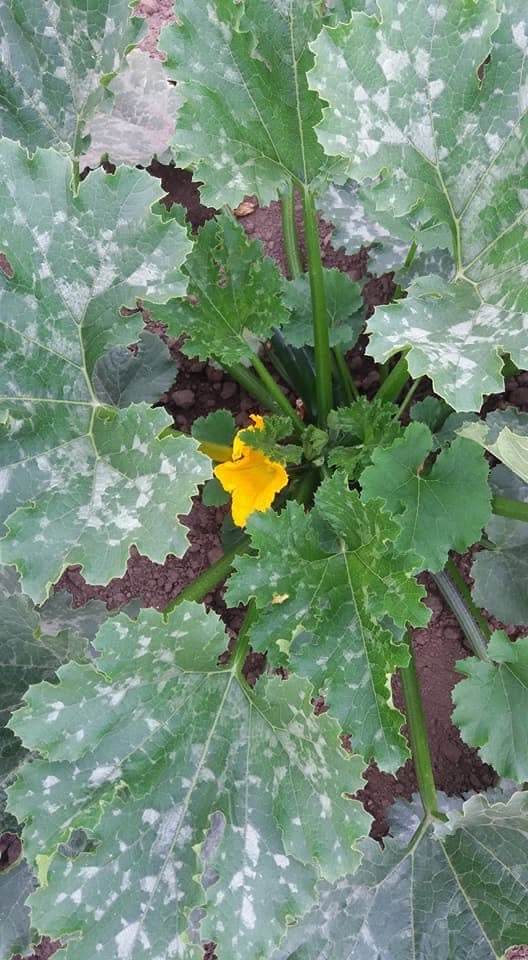
A zucchini plant from above. The silver mottling between the veins is varietal marking, not powdery mildew and not a deficiency, a great many people pull healthy plants every summer because they mistake one for the other. Mildew sits on the leaf surface and rubs off; this does not.
Sauvie Island, Oregon, 2018
Sun & Rain Works · © Sun & Rain Works
Pick small, and pick every day
A squash plant stops setting new fruit once one is left to mature, the same logic as beans and peas, and more abrupt here because a single marrow is a large investment for the plant. One overlooked zucchini under a leaf will shut down production for a week.
So pick small and pick constantly. A zucchini at six to eight inches is better eating than one at fourteen, and picking at that size keeps flowers coming. In hot weather that means checking daily; fruit can go from perfect to marrow in about forty-eight hours.
Look under the leaves properly. The fruit hides, the leaves are large, and the ones you miss are exactly the ones that stop the plant.
Cut rather than twist, leaving a short stem. Twisting tears the plant and opens a wound at the crown where rot starts.
The flowers are also a crop, and a better one than most people realise. Male flowers can be picked freely once a few are open, the plant produces far more than it needs, and they are excellent stuffed or fried.
- One fruit left to mature stops the plant. Look under the leaves.
- Six to eight inches beats fourteen, and keeps flowers coming.
- Cut with a short stem; twisting wounds the crown.

Cut and boxed in the field, at the size a commercial grower wants, which is much the same size a home grower should want. Note that these were cut with a stem rather than twisted off.
Sauvie Island, Oregon, 2018
Sun & Rain Works · © Sun & Rain Works
The zucchini is younger than the books that leave it out
The summer squash most people now grow is younger than this site's oldest sources, and knowing that explains something odd about them.
Burr's exhaustive 1863 catalogue of American vegetables describes thirty squashes and files ten as summer sorts. Not one is a zucchini. Four of the ten are scalloped bush types, so what an American gardener of the 1860s grew as summer squash was mostly what we now sell as patty pan.
The reason is a date rather than an oversight. Lust and Paris, working through Italian horticultural and culinary records for Annals of Botany in 2016, place the emergence of the zucchini in the countryside around Milan in the middle of the 19th century, perhaps as early as 1850. Cantoni describes it in 1855 and Tamaro again in 1892, both under names built on quarantina, the forty-day squash. Burr was writing in America while the plant was still a Lombard novelty.
The word is older than the vegetable, which is the sort of thing that makes a food history worth reading. Zucchini appears in an 1809 botanical dictionary as zucchini da tabacco, small dried bottle gourds used to keep tobacco in, and the Tuscan diminutive was only later attached to young squash. Italian cookbooks are using it for the vegetable by 1844.
It reached America in the 20th century, not the 19th. The same paper finds it first treated as a distinct market type around Los Angeles, with seed catalogues from 1918 selling it as Italian Squash. The popular version of this story has it arriving in the 1920s with returning immigrants, which may well be true and is not what the record shows.
- Burr's ten summer squashes of 1863 include no zucchini.
- The Zucchini Group emerged near Milan around 1850, so it was not yet in America.
- American seed catalogues were selling it as Italian Squash by 1918.
Mildew, borers and rot
Powdery mildew is inevitable rather than preventable on this crop. White dusty patches appear on the older leaves in late summer and spread. Good spacing and airflow delay it, watering at the base rather than overhead helps, and removing the worst leaves keeps the plant going, but every squash plant gets it eventually, and by the time it does you have usually had all the squash you wanted.
Squash vine borer, where it occurs, is more serious: the larva tunnels inside the stem and the whole plant wilts suddenly with no warning. It is largely an eastern and midwestern problem in North America and much less of an issue in the Pacific Northwest.
Cucumber beetles chew flowers and seedlings and can transmit bacterial wilt. Row cover over young plants protects them, but it must come off once flowering starts, or you have solved the beetle problem by creating a pollination one.
Blossom-end rot on the fruit, and rot generally where a fruit sits on wet soil, are both about water and contact. Mulch under developing fruit and water evenly.
Bitter fruit is rare, and it is the one problem here that can actually make somebody ill. Modern varieties are bred so the fruit carries no meaningful level of cucurbitacins, the bitter compounds this family makes. Seed saved from a plant that was pollinated by an ornamental gourd or another high-cucurbitacin relative can grow fruit that carries plenty, and that fruit looks perfectly ordinary. Water stress and heavy nitrogen push the levels up further. Since cooking does not destroy the compounds and seasoning can mask the taste, the rule is to stop at the first strongly bitter mouthful and discard the fruit. This is a saved-seed risk rather than a bought-seed one, and it is the practical reason our seed-saving pages tell you to hand-pollinate this crop rather than trusting distance.
One thing that is not a problem: enormous leaves wilting dramatically at midday and recovering by evening. A squash plant transpires faster than its roots can supply in full sun, and afternoon wilt on a plant that recovers overnight needs no action at all.
Sources
- Powdery mildew is inevitable late in the season, not a failure.
- Row cover protects seedlings, but take it off at flowering.
- Midday wilt that recovers by evening is normal and needs nothing.
How this crop used to be spaced
A single spacing figure reads as a fact about the plant. It is not, it is a judgement about your cultivation method and your water, and two books on our shelf disagree with our figure and with each other for reasons worth knowing.
- 1912, worked by hand
- Rows 3 to 4 ft., plants Hills 3 to 4 ft., sown 1 to 2 in.deep. That is the hand-cultivation column, the same table's horse column is far wider, because a horse and cultivator had to walk between the rows, and quoting that one is how old manuals got their reputation for wasting ground. We reproduce the table in full.
- Through a rainless summer, unwatered
- Sprawling heirloom varieties can dry out a circle 8 or 9 feet across; thin each hill to one plant. One plant per hill, not the two or three the usual garden book allows, Solomon's line is that there must be no competition for water. At that spacing a single vine is doing the work of a small bed. Our notes on the book.
Which type to grow
Grouped by what each is for rather than by catalogue order, because the useful question is which one suits your ground.
Zucchini / courgette
Straight cylindrical fruit, bush habitBest for: The default, and the heaviest cropper
Compact, enormously productive, and the reason people joke about locking their cars in August. One plant is genuinely enough for most households.
Yellow crookneck
Curved neck, bulbous end, warty skinBest for: Flavour, and an older habit
Denser-textured and better-flavoured than most zucchini to many palates. Burr lists both Bush Summer Warted Crookneck and Large Summer Warted Crookneck in 1863, so this is one of the oldest American summer squashes still grown.
Patty pan / scallop
Flattened, scalloped discBest for: Picking very small, and looks
Best at two or three inches across, when they are excellent, and dull once large. Four of Burr's ten summer squashes are scalloped types, Early White Bush, Early Yellow Bush, Green Bush and Variegated Bush, which makes this the dominant summer squash of the period.
Round and globe
Ball-shaped fruitBest for: Stuffing, and small gardens
Picked at tennis-ball size for stuffing. Often more compact plants, which matters if space is tight.
Trombetta and climbing squash
Very long, curved, viningBest for: Growing upward, and resisting borers
A different species in some cases, with solid stems that vine borers cannot exploit and a habit that lets you grow the crop up a support instead of across a bed. Worth knowing if borers are a local problem.
What went wrong
Listed by what you can see, not by what the plant has, you arrive here holding the evidence and without the vocabulary. Where the answer is that nothing can be done this year, it says so.
Small fruit yellow, shrivel at the tip and fall off
Fixable nowWhy: The female flower was not pollinated. Either the plant is producing only male flowers yet, or bees have not been flying in cool wet weather.
What to do: Wait a week if it is early in the season, females come. Otherwise hand-pollinate in the morning: strip a male flower and dab it into an open female.
White dusty patches spreading over the leaves
Fixable nowWhy: Powdery mildew. Universal on this crop late in the season.
What to do: Remove the worst leaves, water at the base rather than overhead, and keep picking. The plant will usually carry on for weeks. Space more widely next year.
Silver or grey mottling between the leaf veins
Fixable nowWhy: Almost always varietal marking, which many zucchini varieties have.
What to do: Nothing, this is not a disease. Mildew sits on the surface and rubs off between finger and thumb; varietal marking does not. Check before pulling a healthy plant.
Whole plant wilts suddenly and does not recover
Fixable nowWhy: Squash vine borer inside the stem, or bacterial wilt spread by cucumber beetles.
What to do: Look for a hole and sawdust-like frass low on the stem. Slit the stem lengthwise, remove the larva, and bury that section to root. Largely an eastern North American problem.
Leaves wilt flat at midday, fine by evening
Fixable nowWhy: Normal transpiration in full sun. The plant cannot move water as fast as it loses it.
What to do: Nothing. Only worry if the plant is still wilted in the morning.
Plant stops producing new fruit
Fixable nowWhy: A fruit was left to mature. One overlooked marrow shuts the plant down.
What to do: Find it, look under the leaves, remove it, and keep picking small. Production usually resumes within a week.
Fruit rotting where it touches the soil
Fixable nowWhy: Contact with wet ground, often combined with irregular watering.
What to do: Slip a tile, board or thick mulch under developing fruit and water evenly at the base.
10 kinds, in 1863
Ten summer squashes in 1863, out of thirty squashes in total, Burr sorts them the way growers spoke rather than botanically, into summer varieties and autumn and winter varieties. What stands out is that four of the ten are scalloped bush types, so the dominant American summer squash of the period was what we now call patty pan, sold as a novelty. The two warted crooknecks in his list are still sold under essentially the same name.
Apple Squash · Bush Summer Warted Crookneck · Early White Bush Scolloped · Early Yellow Bush Scolloped · Egg-squash · Green Bush Scolloped · Green-striped Bergen · Large Summer Warted Crookneck · Orange · Variegated Bush Scolloped
Our reading of twenty-two tomatoes →Related crops
Worked out from the botany rather than from a hand-written list, so it stays correct as the library grows.
- The same family
Also Cucurbitaceae. Shares much of this crop's pest and disease pressure and belongs in the same rotation group.
What’s in summer squash
Per 100 grams raw, from USDA FoodData Central. The range is what USDA actually measured across its samples — it is usually wide, and your own crop sits somewhere in it rather than on the headline number.
| Nutrient | Per 100 g | % daily | Range measured |
|---|---|---|---|
| Vitamin C | 17 mg | 19% | 12.8–20.3 (n=5) |
| Folate | 29 µg | 7% | 20–40 (n=6) |
| Potassium | 262 mg | 6% | 227–290 (n=6) |
| Magnesium | 17 mg | 4% | 15–19 (n=6) |
| Fibre | 1.1 g | 4% | 0.9–1.6 (n=8) |
| Vitamin K | 3 µg | 3% | , |
| Protein | 1.21 g | 2% | 0.91–1.5 (n=6) |
| Iron | 0.35 mg | 2% | 0.3–0.4 (n=6) |
| Calcium | 15 mg | 1% | 10–18 (n=6) |
| Vitamin A | 10 µg | 1% | , |
| Water | 94.64 g | , | 93.3–95.8 (n=14) |
| Energy | 16 kcal | , | , |
Source: USDA FoodData Central, “Squash, summer, all varieties, raw” (SR Legacy, published 4/1/2019). Percentages are of the FDA adult Daily Value, a labelling reference rather than a personal requirement. Raw values; boiling leaches water-soluble vitamins and some carotene, so a cooked serving is not the same figure.
What the wartime archive says about summer squash
4 passages from the USDA’s 1943–46 victory garden material, with our note on whether each still holds. Pulled from the annotations themselves rather than listed here by hand.
- Not too much of one thingStill holds
Too much of any vegetable, even if it comes from your own garden, is hard to take unless you are sure someone else can use the surplus you can't use. Plant a variety of things.
Victory Garden: Leader's Handbook
- What not to plant in a small plotStill holds
Potatoes, sweetpotatoes, sweet corn, squash, and other space-taking crops should not be planted in small gardens - gardens of perhaps less than 1,500 feet. But on farms and wherever adequate garden space permits, these crops … should be gro…
The 1944 Victory Garden Program
- Digging out the borerStill holds
Borers can often be located in wilted vines by the yellow, waxy material near the point where they cut through the stem. Slit the stem at this point with a sharp knife, and crush or remove the borers. Immediately cover the stem with moist e…
Victory Garden Insect Guide
- Hand picking, started earlyStill holds
Hand picking of the larger beetles, bugs, and caterpillars, if done consistently, will often give satisfactory control and eliminate the need for applying insecticides. This practice is most effective if started early enough to catch the fi…
Pests and diseases · “Insect Control in the Victory Garden”, 1943
Saving your own seed
Moderate, and the one crop on this site where a fiddly technique genuinely solves an impossible-looking problem.
The problem is that Cucurbita pepo crosses freely with itself across a very wide range: most summer squash, acorn squash, many pumpkins, and ornamental gourds are all the same species. Seed saved from an open-pollinated garden produces a lottery, and the isolation distance needed, half a mile, is not available to anybody.
The solution is hand-pollination, which is the same fifteen-second operation described above with one extra step. The evening before, find a female flower about to open and tape it shut, and do the same to a male. In the morning, open the male, strip its petals, dab it into the female, and tape the female closed again so no insect can add anything. Mark it with string, and let that fruit mature fully.
Then leave it far past eating size until the skin is hard and cannot be dented with a fingernail, for a zucchini that means a marrow, several weeks on. Scoop the seed, wash the pulp off, dry thoroughly, and store. Seed stays viable four to six years, so one fruit sets you up for a long time.
Farm rooted clothing · Est. 2005
The guides are free. The shop is the business.
Sun & Rain Works is a small apparel outfit in Eugene, Oregon, with agricultural roots and a slow path toward farming. The summer squash guide you just read comes from the same place as the shirts.
More growing guides
We're working through the vegetables one at a time, with dates counted from your own frost station and the old books read properly. Occasional notes from Eugene, Oregon, an art business with agricultural roots, working its way toward farming.
We'll email you to confirm before sending anything. After that, occasional seasonal notes from Sun & Rain Works, we won't share your address, and every email has an unsubscribe link.
Growing advice here is current horticultural practice, drafted with AI assistance and checked against the sources this page names. Where it quotes a book, the book is named and linked. Where practice is genuinely contested, or local enough that we would be guessing, the text says so, your county extension service beats any national guide, including this one, on pest timing.
The photographs are not AI-generated. Every one is our own work, public domain, or licensed, and carries its author and licence beneath it.