Growing guide
How to grow potatoes
The only crop here you grow from a piece of itself rather than from seed. That one fact changes everything downstream, including why you must keep piling soil over it.
Solanum tuberosum · Solanaceae, with tomato, pepper and aubergine
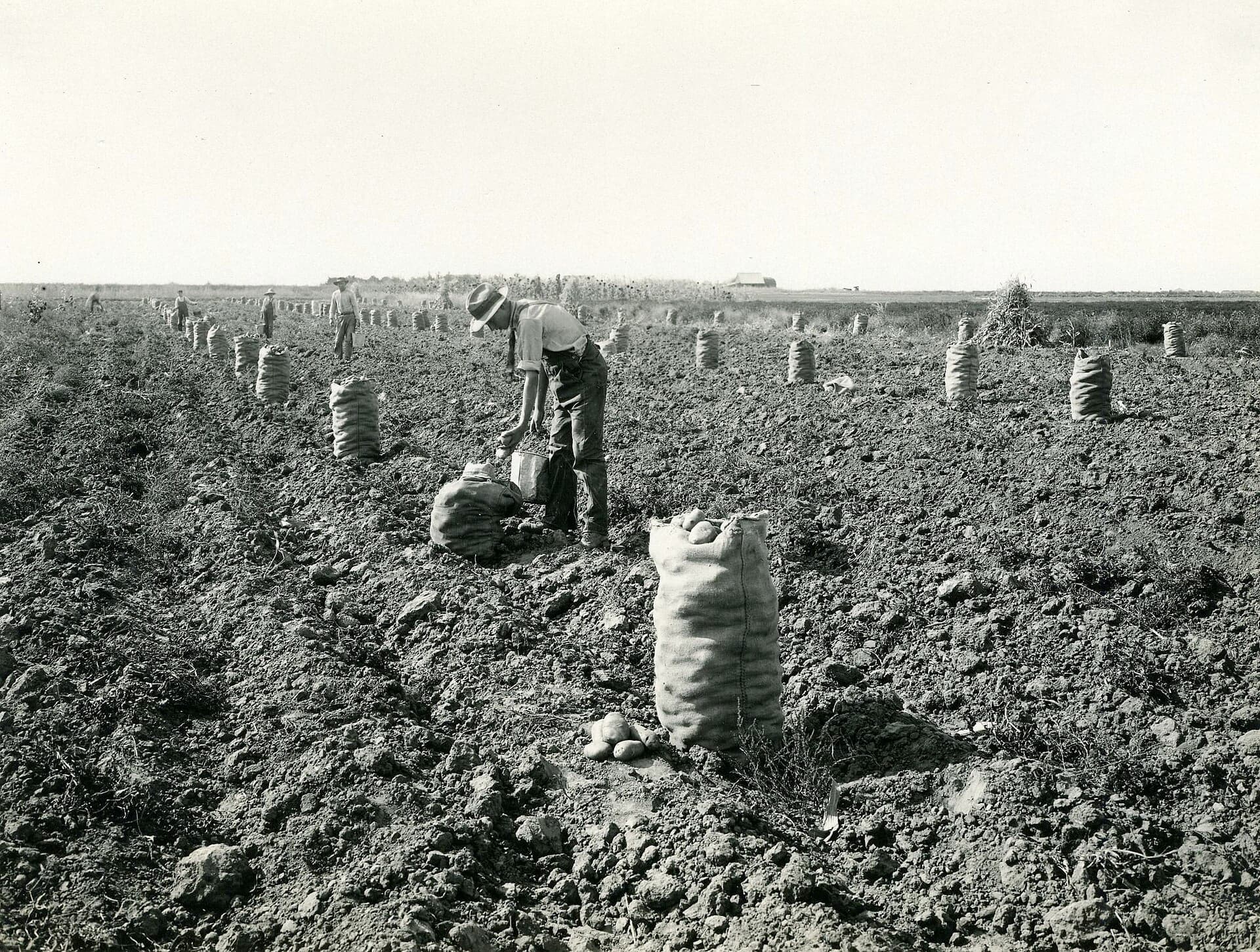
Above: waterarchives.org · Public domain

easy. Hard to fail with and easy to reduce the yield of. Nothing about growing them is delicate; the whole crop turns on planting healthy stock, covering the tubers, and lifting them dry.
At a glance
- Family
- Solanaceae (nightshades)
- Grown from
- Seed tubers, not seed
- Hardiness
- Foliage frost-tender; tubers survive
- Planting method
- Whole or cut tubers, 4″ deep
- Emergence
- 2–4 weeks, depending on soil warmth
- Soil
- Loose, deep, slightly acid. Never fresh lime
- Sun
- Full sun
- Days to maturity
- 70–120, by variety group
- Spacing
- 12″ apart in rows 30″ apart
- Biggest single risk
- Late blight in a wet summer
When to sow, where you actually live
Every other guide prints a month, and a month is only true somewhere. What transfers between locations is the offset: potatoes go in about 2 weeks before the last spring frost, wherever that falls for you. Give us a ZIP and we will count it from your own NOAA weather station.
Current spacing: 12″ apart in rows 30″ apart, sown 4″ deep. Roughly 70–120 days to a first picking, though variety moves that more than any general figure admits.
Get your sowing dates →Start with seed potatoes, not supermarket ones
A seed potato is a tuber grown specifically for planting and certified free of the virus and disease load that builds up in potato stock over generations. It is not a special kind of potato, it is an ordinary one with paperwork, and the paperwork is the entire value.
Supermarket potatoes are a poor substitute for two reasons. They are frequently treated with sprout suppressant, so they sit and do nothing. And they carry no assurance about virus, which accumulates invisibly, reduces yield year on year, and stays in your soil.
You can save your own tubers from a healthy crop and many people do, a potato is propagated by cloning, so a saved tuber is genetically identical to its parent and the variety persists unchanged. The catch is the same one: disease clones along with it. Save from visibly healthy plants, and buy in certified stock every few years to reset.
Choose by group rather than by name. First earlies are ready in around ten weeks and are dug small and waxy; second earlies follow; maincrop takes the longest, yields most, and is the group you store. In a short or blight-prone season, earlies are the safer bet, they are often out of the ground before blight weather arrives.
- Certified seed potatoes exist to guarantee freedom from virus, not vigour.
- Supermarket tubers may be sprout-suppressed and carry unknown disease.
- Earlies dodge blight by finishing before it arrives. That is a real strategy.
Chitting: a head start you can see
Chitting is sprouting the tubers before they go in the ground. Stand them in a cool, light, frost-free place, egg boxes are the traditional rig, with the end carrying the most eyes uppermost, and leave them for a few weeks.
Light is what matters. Sprouts grown in the light are short, stubby, green or purple and tough; sprouts grown in the dark are long, white and fragile, and they snap off when you plant. That difference is the whole technique.
It buys a couple of weeks, which matters most for earlies and least for maincrop. It is genuinely optional, an unchitted potato grows perfectly well, so treat it as a way of getting ahead rather than a requirement.
Solomon takes the same approach for dry gardening and pushes it further: he presprouts in daylight at room temperature for weeks, then plants one whole medium potato every 18 inches, barely covered.
Plant when the soil has begun to warm, about two weeks before your last frost. Frost kills the foliage but not the tubers, so a late frost on emerged shoots costs you a fortnight of growth rather than the crop.
- Chit in the light, dark-grown sprouts are long, white and snap off.
- It buys about two weeks. Optional, and most useful for earlies.
- Plant two weeks before last frost; frost costs foliage, not the crop.
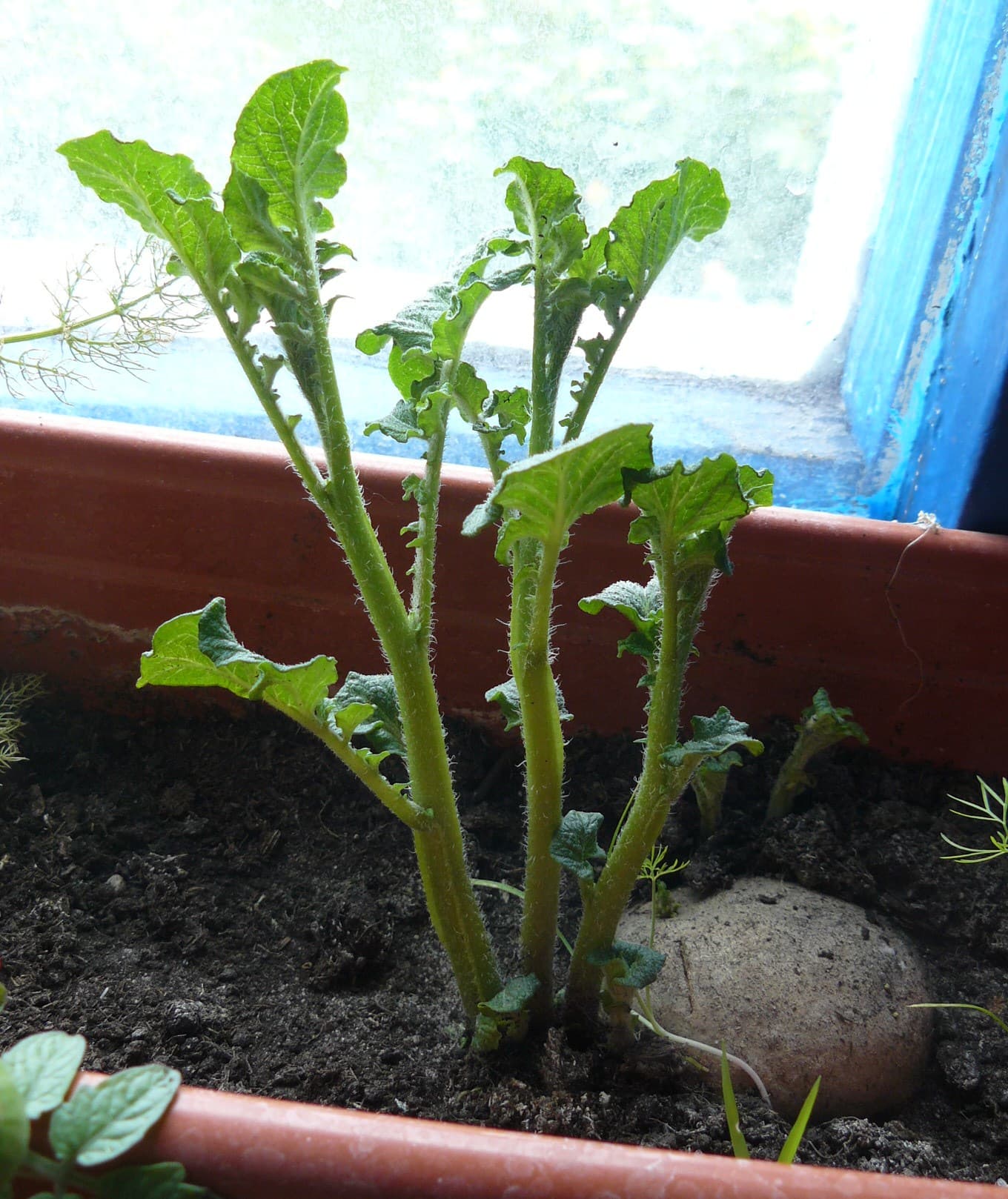
A tuber that has sprouted and been planted shallow, with the shoots away. Note how thick and green these shoots are, that is what light does. The same tuber sprouted in a dark cupboard would have thin white shoots that break off as you handle them.
MOs810 · CC BY-SA 4.0

Earthing up, and why green potatoes happen
This is the operation with no equivalent elsewhere in the garden, and the one that decides how much of your crop you can actually eat.
Potatoes form on stems, not on roots, on short underground shoots called stolons that grow from the buried stem above the seed tuber. The more buried stem there is, the more places tubers can form. Earthing up creates that stem.
It does a second, more urgent job. Any tuber exposed to light turns green, and green means solanine, which is bitter and genuinely toxic. This is not a cosmetic problem and it cannot be peeled away reliably. Every tuber must stay covered, all season.
So: when the shoots are about eight inches high, draw soil up around them from both sides of the row until only the top few inches show. Repeat once or twice as they grow, until you have a ridge. Straw or a thick mulch does the same job if you would rather not move soil, which is what growing potatoes under straw amounts to.
If you are growing in a bag or a tub, the same rule applies: start with a few inches of compost and keep adding as the shoots rise.
- Tubers form on buried stem, so more buried stem means more potatoes.
- Any tuber that sees light goes green and toxic. Keep them covered.
- Earth up at about 8″ of growth, then again. Straw mulch works too.
Blight, and the maritime problem
Late blight is the same organism that takes tomatoes, and it is the reason potato growing here has a deadline. It needs prolonged leaf wetness with mild temperatures, a Pacific Northwest late summer, and it moves fast: brown-black patches on leaves and stems, a distinctive musty smell, and a canopy that collapses within days.
The danger is that it travels down. Spores wash off the foliage into the soil and rot the tubers in the ground or, worse, in store, where one infected potato takes a sackful with it.
The response is decisive and works: the moment blight is established, cut all the foliage off at ground level and remove it. Do not compost it. Then leave the tubers in the ground for two or three weeks before lifting. That gives the spores on the soil surface time to die and lets the skins set. Cutting the tops early costs you some yield and saves the crop.
Prevention is variety choice and timing rather than spraying. Grow earlies that finish before blight weather, choose blight-resistant maincrops, space for airflow, and earth up well, a deep ridge is a physical barrier between spores and tubers.
Scab, by contrast, looks alarming and barely matters: rough corky patches on the skin, worse in dry alkaline soil, and entirely peelable. Never lime ground destined for potatoes; they want it slightly acid.
Sources
- At the first sign of blight, cut and remove all foliage immediately.
- Then wait two or three weeks before lifting. Do not dig into spores.
- Scab is cosmetic. Do not lime potato ground trying to fix it.
Lifting and storing
Earlies are ready when the plants flower, dig a single plant to check rather than guessing, and take what you need. They do not store; they are dug and eaten.
Maincrop is ready when the foliage yellows and dies back. Then wait another two or three weeks before lifting. That is when the skins set, and skin set is the whole difference between potatoes that store until spring and potatoes that rot in a month. A tuber whose skin rubs off under your thumb is not ready.
Lift on a dry day, as the photograph at the top of this page shows, and leave the tubers on the surface for a few hours to dry. Then cure them somewhere dark and airy for a week or two at cool room temperature, which lets minor damage heal over.
Store in the dark, cool but frost-free, in paper or hessian sacks that breathe. Never plastic, and never the fridge, cold converts starch to sugar and makes potatoes sweet and prone to darkening when cooked.
Check the sack occasionally. One rotting tuber will take the rest with it, and that is the ordinary way a good crop is lost after it has been successfully grown.
- Wait two or three weeks after the tops die before lifting maincrop.
- If the skin rubs off with your thumb, it is not ready to store.
- Dark, cool, frost-free, in sacks that breathe. Never the fridge.
How this crop used to be spaced
A single spacing figure reads as a fact about the plant. It is not, it is a judgement about your cultivation method and your water, and two books on our shelf disagree with our figure and with each other for reasons worth knowing.
- 1912, worked by hand
- Rows 24 to 36 in., plants 14 to 18 in., sown 4 in.deep. That is the hand-cultivation column, the same table's horse column is far wider, because a horse and cultivator had to walk between the rows, and quoting that one is how old manuals got their reputation for wasting ground. We reproduce the table in full.
- Through a rainless summer, unwatered
- One whole presprouted potato every 18 inches down the centre of a row, barely covered, with 2½ to 3 feet of unoccupied soil either side at maturity. Solomon presprouts in daylight at room temperature for weeks before planting, and plants whole rather than cut seed, a cut face is a wound in dry soil. The wide row is the water supply. Our notes on the book.
Which type to grow
Grouped by what each is for rather than by catalogue order, because the useful question is which one suits your ground.
First earlies
Small, waxy, thin-skinnedBest for: Speed, and dodging blight
Roughly ten weeks from planting to a first dig. They do not store and are not meant to, they are the new potatoes. In a wet maritime climate they are also the safest group, because they are often finished before blight weather.
Second earlies
Medium, waxy to flouryBest for: The middle of the season
A few weeks behind the first earlies, larger, and will keep for a short while. A reasonable compromise if you want one group rather than three.
Maincrop
Large, usually flouryBest for: Storage, and the biggest yield
The group worth growing if you want potatoes in January. They occupy the ground longest, which also means they are the most exposed to blight, so blight resistance matters more here than in any other group.
Salad and waxy potatoes
Small, long, firm, often yellow-fleshedBest for: Eating whole, and salads
Firm enough to hold together when boiled. Burr's Lady's Finger and the Kidney sorts are the same idea in 1863, the shape has a long history and the fingerling is not a modern invention.
Coloured heirlooms
Blue, purple, red, pink-eyedBest for: Interest, and often toughness
Burr's list is full of them, Nova-Scotia Blue, Peach-blow, Garnet Chili, Early Blue. Garnet Chili is the one that mattered: it is a parent of Early Rose, and through Early Rose a great deal of what is grown today descends from a variety in that 1863 book.
What went wrong
Listed by what you can see, not by what the plant has, you arrive here holding the evidence and without the vocabulary. Where the answer is that nothing can be done this year, it says so.
Tubers green on one side
Next seasonWhy: They were exposed to light, not earthed up enough, or lifted and left out.
What to do: Do not eat green parts; the solanine is bitter and toxic, and peeling is not reliable. Earth up more, and earlier, next time. Store in the dark.
Foliage collapses fast with brown-black patches
Fixable nowWhy: Late blight, in mild wet weather.
What to do: Cut all foliage off at ground level immediately and remove it, do not compost. Leave the tubers in the ground two to three weeks before lifting, so surface spores die and skins set.
Rough corky brown patches on the skin
Fixable nowWhy: Common scab, worse in dry, alkaline soil.
What to do: Nothing to do, and nothing much wrong, it peels off and the potato is fine. Do not lime potato ground, keep the soil evenly moist while tubers are forming, and it lessens.
Lots of leafy top growth, very few tubers
Next seasonWhy: Too much nitrogen, or too little light.
What to do: Feed for tubers rather than for leaves, potatoes want potassium more than nitrogen once growing. Avoid planting into ground freshly manured with high-nitrogen material.
Tubers rot in store within weeks
Next seasonWhy: Lifted before the skins set, stored damp, or blight spores carried in.
What to do: Sort the sack and remove anything soft, one rotting tuber spoils the rest. Next season wait for skin set, dry them before storing, and use sacks that breathe.
Small holes tunnelled through the tubers
Fixable nowWhy: Slugs, or wireworm in ground recently under grass.
What to do: Lift earlier rather than leaving a mature crop in wet soil, which is when slug damage accumulates. Ground broken from lawn is wireworm-prone for a couple of years; grow earlies there.
Potatoes taste sweet and darken when fried
Fixable nowWhy: Stored too cold, refrigeration converts starch to sugar.
What to do: Move them somewhere cool but not cold. A few weeks at normal room temperature partly reverses it.
49 kinds, in 1863
Forty-nine varieties, the longest single-crop list in our census after the pea, and written seventeen years after blight reached Ireland, by a country still cataloguing potatoes with enthusiasm. The names are the pleasure of it: Peach-blow, Jenny Lind, Lady's Finger, Nova-Scotia Blue, Poggy or Porgee. One matters beyond its name. Garnet Chili is a parent of Early Rose, and through Early Rose a great deal of what is grown commercially today traces back to a variety sitting in that 1863 list.
Ash-leaved Early · Ash-leaved Kidney · Biscuit · Black Chenango · Buckeye · Calico · California Red · Carter · Churchill · Cristy · Cups · Danvers Seedling · Davis's Seedling · Dykeman · Early Blue · Early Cockney · Early Manly · Flour-ball · Fluke Kidney · Forty-fold · Garnet Chili · Gillyflower · Green-top · Hill's Early · Irish Cups · Jackson White · Jenny Lind · Lady's Finger · Lapstone Kidney · Long Red · Mexican · Nova-Scotia Blue · Old Kidney · Peach-blow · Pink-eyed · Poggy, or Porgee · Quarry · Rohan · Shaw's Early · State of Maine · St. Helena · Taylor's Forty-fold · Tolon · Vermont White · Veto, or Abington Blue · White Chenango · White Cups · White Mountain · Worcester Seedling
Our reading of twenty-two tomatoes →Related crops
Worked out from the botany rather than from a hand-written list, so it stays correct as the library grows.
- The same genus
The same genus, Solanum. Close enough to share most pests and diseases, so keep them apart in a rotation.
What’s in potatoes
Per 100 grams raw, from USDA FoodData Central. The range is what USDA actually measured across its samples — it is usually wide, and your own crop sits somewhere in it rather than on the headline number.
| Nutrient | Per 100 g | % daily | Range measured |
|---|---|---|---|
| Vitamin C | 19.7 mg | 22% | , |
| Potassium | 425 mg | 9% | 368–506 (n=11) |
| Fibre | 2.1 g | 8% | 1.6–2.4 (n=5) |
| Magnesium | 23 mg | 5% | 19–25 (n=11) |
| Iron | 0.81 mg | 5% | 0.47–1.24 (n=11) |
| Protein | 2.05 g | 4% | 1.44–2.22 (n=11) |
| Folate | 15 µg | 4% | 9–34 (n=11) |
| Vitamin K | 2 µg | 2% | 0.8–3.6 (n=11) |
| Calcium | 12 mg | 1% | 6–16 (n=11) |
| Vitamin A | 0 µg | 0% | , |
| Water | 79.25 g | , | 77.7–83.92 (n=11) |
| Energy | 77 kcal | , | , |
Source: USDA FoodData Central, “Potatoes, flesh and skin, raw” (SR Legacy, published 4/1/2019). Percentages are of the FDA adult Daily Value, a labelling reference rather than a personal requirement. Raw values; boiling leaches water-soluble vitamins and some carotene, so a cooked serving is not the same figure.
What the wartime archive says about potatoes
3 passages from the USDA’s 1943–46 victory garden material, with our note on whether each still holds. Pulled from the annotations themselves rather than listed here by hand.
- What not to plant in a small plotStill holds
Potatoes, sweetpotatoes, sweet corn, squash, and other space-taking crops should not be planted in small gardens - gardens of perhaps less than 1,500 feet. But on farms and wherever adequate garden space permits, these crops … should be gro…
The 1944 Victory Garden Program
- Spade in the autumnStill holds
Many Victory Gardens will be planted on land that was in grass or weeds the year before, and such soil is likely to be infested with cutworms, white grubs, and wireworms. Where possible, therefore, spade or plow the ground during the fall o…
Pests and diseases · “Insect Control in the Victory Garden”, 1943
- Hand picking, started earlyStill holds
Hand picking of the larger beetles, bugs, and caterpillars, if done consistently, will often give satisfactory control and eliminate the need for applying insecticides. This practice is most effective if started early enough to catch the fi…
Pests and diseases · “Insect Control in the Victory Garden”, 1943
Saving your own seed
Different from every other crop here, because you save tubers rather than seed, and a saved tuber is a clone, genetically identical to its parent. That is why potato varieties persist unchanged for a century and a half, and why the ones in Burr's list that survive are the same plants rather than descendants.
The method is simply selection and storage: keep back medium, undamaged tubers from your healthiest plants, store them cool, dark and frost-free, and plant them next spring.
The catch is that disease clones too. Virus builds up invisibly over generations and shows only as a slow decline in yield, so buy certified stock every few years to reset, saving indefinitely is how a good variety quietly stops performing.
True potato seed does exist. If the plants set the small green fruits that look like tiny tomatoes, those contain real seed, but potatoes are highly heterozygous, so that seed produces something entirely unlike the parent. It is how new varieties are bred, and it is not how you keep one. Do not eat the fruits; they are nightshade.
Farm rooted clothing · Est. 2005
The guides are free. The shop is the business.
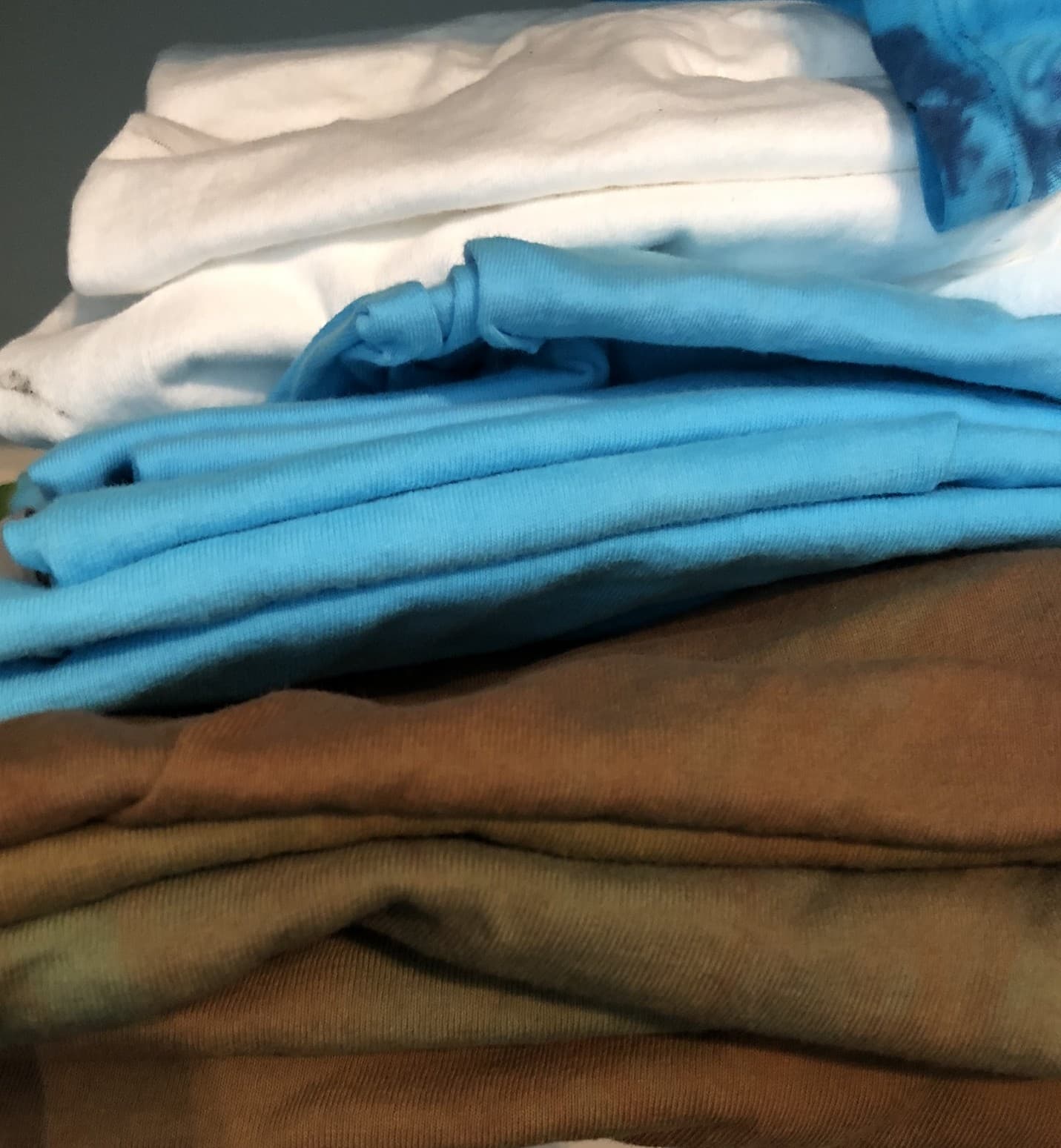
Sun & Rain Works is a small apparel outfit in Eugene, Oregon, with agricultural roots and a slow path toward farming. The potatoes guide you just read comes from the same place as the shirts.
More growing guides
We're working through the vegetables one at a time, with dates counted from your own frost station and the old books read properly. Occasional notes from Eugene, Oregon, an art business with agricultural roots, working its way toward farming.
We'll email you to confirm before sending anything. After that, occasional seasonal notes from Sun & Rain Works, we won't share your address, and every email has an unsubscribe link.
Growing advice here is current horticultural practice, drafted with AI assistance and checked against the sources this page names. Where it quotes a book, the book is named and linked. Where practice is genuinely contested, or local enough that we would be guessing, the text says so, your county extension service beats any national guide, including this one, on pest timing.
The photographs are not AI-generated. Every one is our own work, public domain, or licensed, and carries its author and licence beneath it.