
Growing guide
How to grow tomatoes
The crop people rush and regret. Nearly every contradictory piece of tomato advice you have read is correct for one kind of plant and wrong for the other, and the packet rarely tells you which you bought.
Solanum lycopersicum · Solanaceae, the nightshade family, with potato, pepper and aubergine
Above: Kolforn · CC BY-SA 4.0
,_Trimingham,_Norfolk.JPG)
moderate. Easy to keep alive and genuinely hard to grow well in a cool summer. The plant is forgiving; the weather is not, and the two big diseases are decided by things outside your control.
At a glance
- Family
- Solanaceae (nightshades)
- Life cycle
- Tender perennial, grown as an annual
- Hardiness
- Tender, killed by frost, stalled by cold
- Sowing method
- Start indoors and transplant
- Germination
- 5–10 days at 70–80°F
- Soil
- Rich, deep, well-drained. Steady moisture
- Sun
- Full sun, the more the better
- Days to maturity
- 60–85 from transplanting
- Start indoors
- 6 weeks before your last frost
- Biggest single risk
- Setting out too early into cold
When to sow, where you actually live
Every other guide prints a month, and a month is only true somewhere. What transfers between locations is the offset: tomatoes go in about 2 weeks after the last spring frost, wherever that falls for you. Give us a ZIP and we will count it from your own NOAA weather station.
Current spacing: 24″ apart in rows 36″ apart, sown 0.25″ deep. Roughly 60–85 days to a first picking, though variety moves that more than any general figure admits.
Get your sowing dates →First: determinate or indeterminate?
This single fact governs pruning, support, spacing and when the plant stops, and it is the reason tomato advice appears to contradict itself everywhere you look.
An indeterminate tomato is a vine. It grows from its tip indefinitely, flowers and fruits continuously along the way, and will keep going until frost kills it. Most heirlooms and most cherry tomatoes are indeterminate. These are the plants that want a tall stake or string, want their side shoots removed, and want their growing tip pinched out about a month before your first frost so the plant ripens what it has instead of starting more.
A determinate tomato is a bush. It grows to a genetically fixed size, sets its fruit over a short period, ripens it and is done. Most paste and canning varieties are determinate. These want a cage rather than a stake, and, this is the important part, you must not remove their side shoots, because those side shoots are where a large part of the crop is. Pruning a determinate tomato is straightforwardly destroying your own harvest.
Seed packets often bury this in small print or omit it. If yours does not say, the shape of the description tells you: anything promising a concentrated harvest for canning is determinate, anything promising fruit all season is not.
- Indeterminate = vine. Stake it, remove side shoots, pinch the top in late summer.
- Determinate = bush. Cage it, and never remove side shoots.
- If the packet does not say, a “concentrated harvest” means determinate.
Starting, and the cold-night problem
Sow indoors about six weeks before your last frost. Earlier is not better, a tomato started in January sits in a pot getting leggy while a February sowing catches up and passes it, because light rather than time is what a seedling is short of on a windowsill.
Our calendar sets plants out about two weeks after the last frost, and that gap is the single most useful number on this page. Frost kills a tomato, but cold merely stalls it, and stalling is what costs you the crop. Nights below about 50°F check a transplant so thoroughly that a plant set out two weeks later routinely overtakes it. In the maritime Northwest, where May nights are reliably cool, this is the difference between tomatoes in August and tomatoes in October.
Harden plants off properly over a week, an hour or two outside on the first day, building up. A plant moved straight from a windowsill to full sun scorches, and it never quite forgives you.
One more thing worth doing: brush your hand across the seedlings once a day, or put a fan on them. Mechanical movement produces shorter, thicker, sturdier stems, which is the difference between a plant that stands up when it goes out and one that flops.
- Six weeks before last frost. Starting earlier just makes leggier plants.
- Set out two weeks after the last frost, cold nights stall a plant for good.
- Brush the seedlings daily or run a fan; it makes them thick-stemmed.
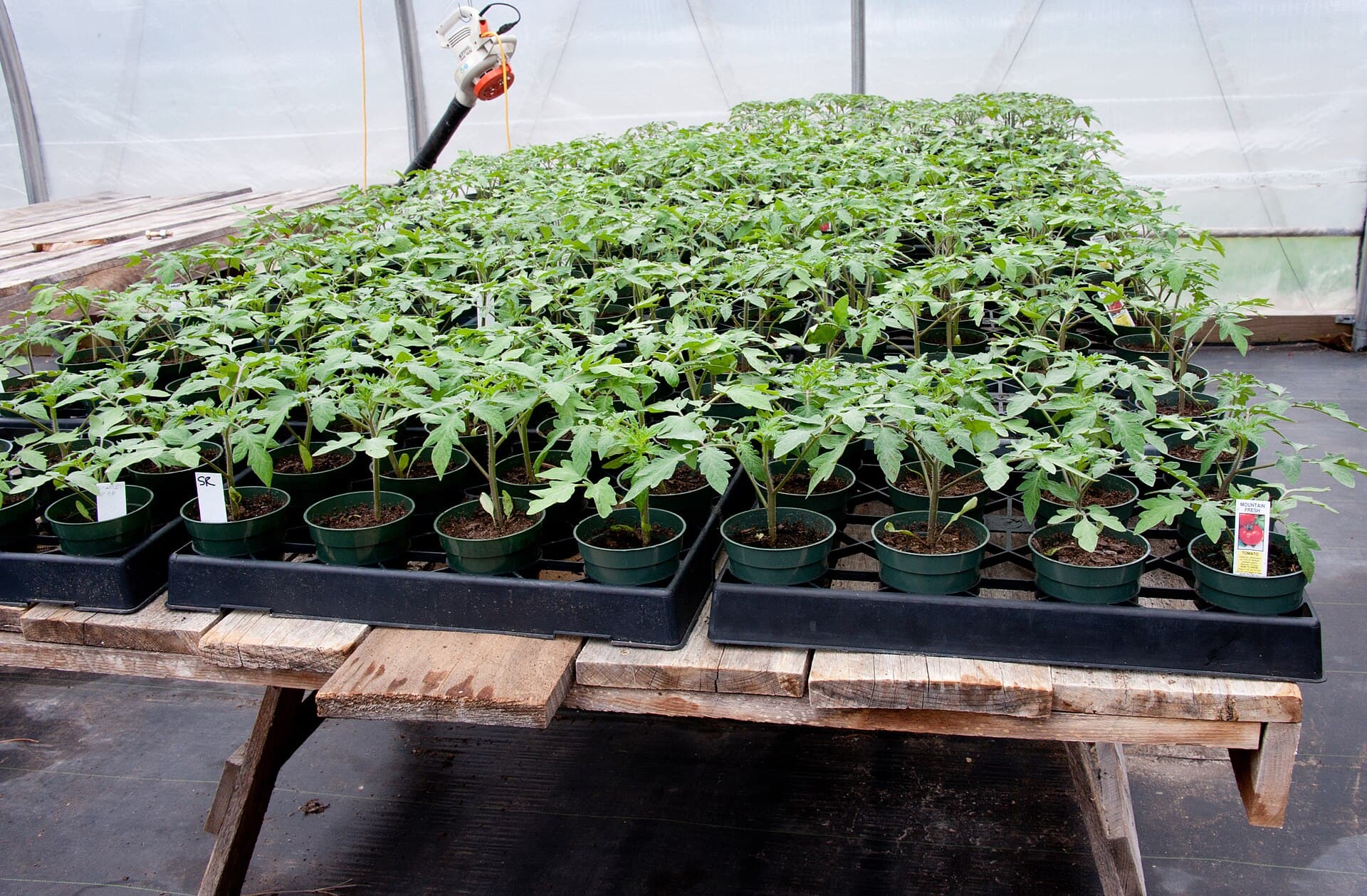
Transplants at the stage to go out: short, thick-stemmed and dark green rather than tall and pale. Plants that look like this were grown with enough light and enough air movement, a windowsill seedling twice this height with half the stem thickness is the commonest way to lose three weeks.
Stow, Massachusetts, April 2011
Dwight Sipler · CC BY 2.0
.jpg)
Plant it deep, deeper than looks reasonable
Tomatoes are one of very few plants that root from their stems. Any part of the stem buried will grow roots, so a transplant set deep builds a far larger root system than one set at the depth it grew in the pot.
Strip the lower leaves and bury two thirds of the plant. If it is leggy, do not fight it, lay it down instead. The 1912 manual describes the technique exactly: dig a shallow trench three or four inches deep, sloping up to the surface, lay the bare stem along it with the root at the deep end, cover the stem along its length and firm it. The plant turns its tip upward within a couple of days and roots along the whole buried length.
That trench method is still the standard fix for a stretched transplant, and it is better than burying the plant upright, because the buried stem then sits in warm topsoil rather than cold subsoil.
Spacing depends on habit and support. Our calendar gives 24 inches in rows 36 apart, which suits staked indeterminates. The 1912 table's figure for staked plants, 18 inches to 2 feet apart in rows three and a half to four feet, is essentially the same answer. Unstaked sprawling plants need about four feet each way, which is what Burr specifies in 1863 and what Solomon still recommends for dry gardening.
- Bury two thirds of the stem, tomatoes root from anywhere buried.
- Leggy plants: lay them in a shallow sloping trench rather than burying upright.
- Staked: 18–24 inches apart. Sprawling: about four feet each way.
Steady water, and what happens when it is not
Almost every tomato fruit disorder is a watering-pattern problem rather than a disease, and knowing that saves a lot of pointless spraying.
Blossom end rot, the sunken black patch on the bottom of the fruit, is a calcium delivery failure, not a calcium shortage. The soil almost always has enough; what fails is the plant's ability to move it to the fastest-growing tissue, and that failure is caused by irregular water. Adding calcium to the soil is the standard advice and it is usually treating the wrong thing. Water evenly, mulch, and it stops.
Splitting and concentric cracking around the shoulders is the same mechanism from the other side: a fruit that slowed in drought and then got a heavy soaking expands faster than its skin can stretch.
So: water deeply and regularly rather than lightly and erratically, and mulch to buffer the swings. Container plants need far more attention than ground ones because there is no buffer at all.
Once fruit is ripening, easing off slightly concentrates flavour, but easing off is not the same as letting the plant dry out and then rescuing it, which is how you get the split fruit you were trying to avoid.
- Blossom end rot is irregular water, not low calcium. Do not add lime for it.
- Splitting is the same problem: drought then deluge.
- Mulch. It buffers the swings better than anything you can do with a hose.
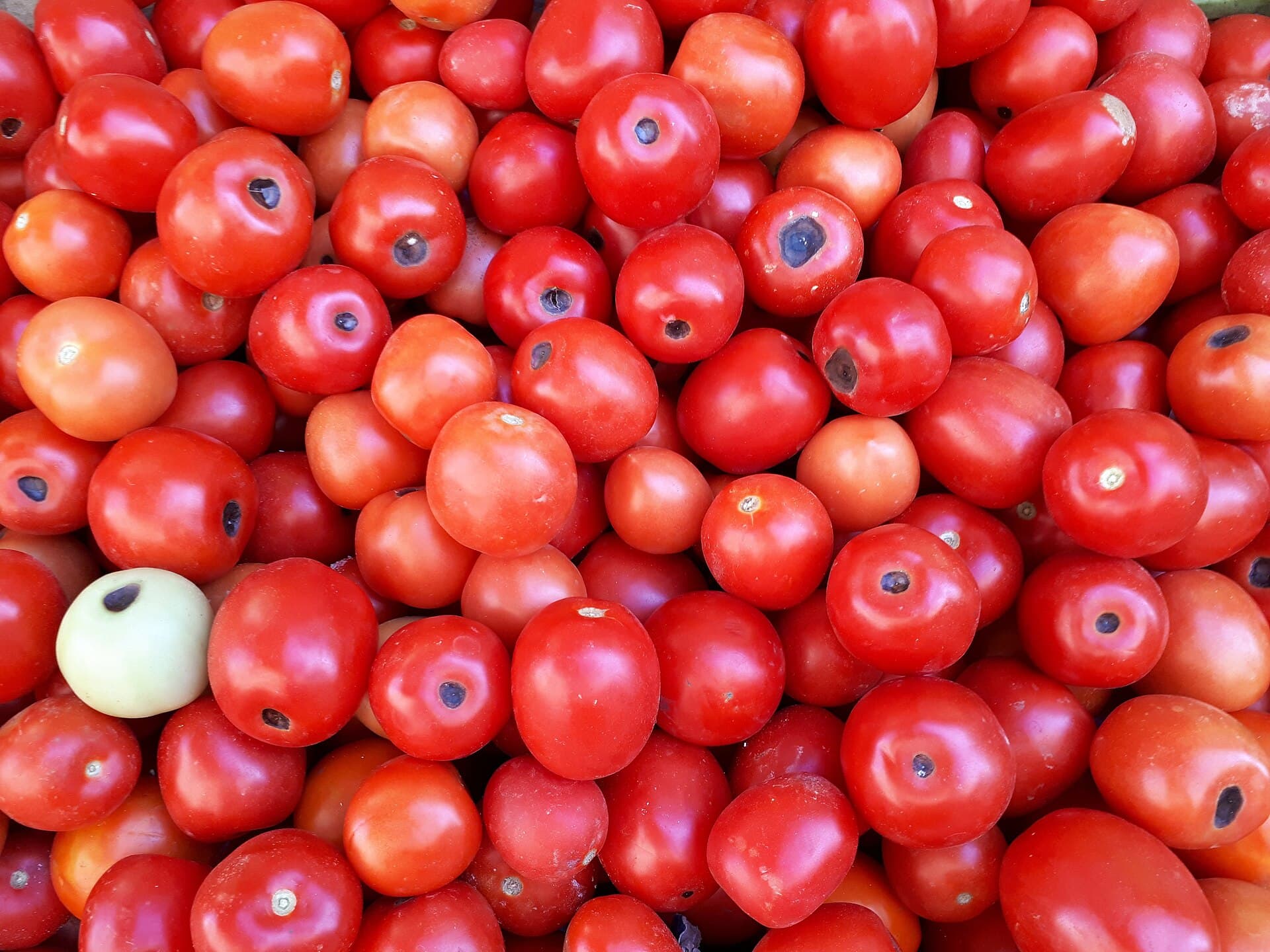
Blossom end rot at scale, a whole crate of it, being sold off cheap. The dark sunken patch is always at the blossom end, never the stem end, which is how you tell it from rot or damage. It is a watering-pattern problem, and adding calcium to the soil usually treats the wrong thing.
Photographed 7 October 2017
Fructibus · CC0

Blight, and the maritime Northwest problem
Late blight is the disease that ends tomato crops here, and it is worth understanding rather than fearing. It is a water mould, it arrives on airborne spores, and it needs prolonged leaf wetness with mild temperatures, which is a precise description of a Pacific Northwest September. Brown-black patches spread on leaves and stems, fruit develops firm brown blotches, and a plant can go from healthy to finished in under a week.
You cannot prevent the spores arriving. What you can do is make the conditions worse for them: space plants for airflow, water at the base rather than overhead, remove the lowest leaves so nothing touches the soil, and grow under cover if you can, a simple rain shelter over a tomato row is the single most effective anti-blight measure available to a home grower, because it keeps the foliage dry.
Choose early varieties. A tomato that ripens in sixty days from transplanting may be finished before blight weather arrives; one that needs eighty-five may not be. In a cool maritime summer this is a bigger lever than anything else on this list.
Early blight is a different and less dramatic disease, brown target-ringed spots working up from the lowest leaves. Remove affected leaves, mulch to stop soil splashing up, and rotate.
Blight-affected material should not be composted, and neither should potato volunteers, which host the same organism.
Sources
- Late blight needs wet leaves and mild weather. Keeping foliage dry is the lever.
- A rain shelter over the row beats every spray a home grower has access to.
- Grow early varieties: finishing before September is a real strategy here.
Getting them ripe in a cool summer
About four weeks before your first expected frost, stop the plant making new work. Pinch the growing tip out of every indeterminate, remove any flowers and any fruit too small to have a chance, and the plant redirects everything into ripening what is left. It feels wasteful and it converts a mass of green fruit into an actual harvest.
Tomatoes ripen on stored sugars, not on sunlight, so removing leaves to expose fruit to the sun does nothing useful and risks sunscald. Leaves feed the plant; leave them.
Temperature, not light, is what ripens them, and above about 85°F the pigment that turns them red simply stops being produced, which is why tomatoes in a hot spell go yellowish-orange and stall.
At the end of the season, pick everything and ripen indoors. Any tomato that has reached full size and gone from hard green to slightly paler will ripen off the plant. A brown paper bag with a banana in it works because the banana gives off ethylene. Whole trusses hung upside down in a shed work too. What does not work is a sunny windowsill, which cooks them.
- Four weeks before frost: pinch the tip, strip flowers and hopeless fruit.
- Sunlight does not ripen tomatoes, temperature does. Do not strip leaves.
- Full-size green fruit ripens indoors. A paper bag beats a windowsill.
How this crop used to be spaced
A single spacing figure reads as a fact about the plant. It is not, it is a judgement about your cultivation method and your water, and two books on our shelf disagree with our figure and with each other for reasons worth knowing.
- 1912, worked by hand
- Rows 3 to 4 ft., plants 3 ft., sown 1/2 to 1 in.deep. That is the hand-cultivation column, the same table's horse column is far wider, because a horse and cultivator had to walk between the rows, and quoting that one is how old manuals got their reputation for wasting ground. We reproduce the table in full.
- Through a rainless summer, unwatered
- No figure given: “The root system can occupy as much space as the vines will cover and then some.” The one crop Solomon declines to put a number on. His advice is to skip trellising, pruning and training altogether and let the vine sprawl, because every method that makes a tomato tidy also makes its roots compete with themselves. Our notes on the book.
Which type to grow
Grouped by what each is for rather than by catalogue order, because the useful question is which one suits your ground.
Cherry and cocktail
Small fruit, usually indeterminateBest for: Reliability in a cool summer
The most forgiving tomatoes there are: they ripen fastest, crack least in a wet spell, and crop when larger types sulk. If you have failed with tomatoes before, start here rather than with a beefsteak.
Paste and plum
Dense, low-juice fruit, usually determinateBest for: Sauce, canning and one big picking
Bred to ripen together and cook down without watering everything. Determinate, so cage them and leave the side shoots alone. Burr's Red Plum and Yellow Plum are the same idea in 1863.
Slicing / globe
Medium round fruit, either habitBest for: The everyday tomato
The category most modern varieties sit in, and where disease-resistant hybrids are most worth having. Moneymaker, in the photograph at the top of this page, is a long-established example.
Beefsteak
Very large, often ribbed, indeterminateBest for: Flavour, if you have the season for it
The best eating and the biggest gamble in a short cool summer, they need the most heat and the most time, and they crack most readily. Burr's Giant and Mammoth are the ancestors.
Coloured and striped heirlooms
Yellow, white, purple-black, green, stripedBest for: Flavour range, and seeing what was lost
Burr's 1863 list is full of them, White, Large Yellow, Yellow Pear-shaped, Yellow Cherry, Round Yellow. The uniformly red tomato is a twentieth-century commercial preference, not a fact about the species.
What went wrong
Listed by what you can see, not by what the plant has, you arrive here holding the evidence and without the vocabulary. Where the answer is that nothing can be done this year, it says so.
Dark sunken patch on the bottom of the fruit
Fixable nowWhy: Blossom end rot, calcium not reaching the fast-growing end of the fruit, caused by irregular watering rather than by a shortage in the soil.
What to do: Cut the affected part off and eat the rest. Water evenly and mulch. Do not add lime or calcium unless a soil test says to, that treats the wrong thing.
Fruit splits or cracks around the shoulders
Fixable nowWhy: A heavy watering or rain after a dry spell. The inside grew faster than the skin.
What to do: Use split fruit promptly; it will not keep. Mulch and even out watering for the rest of the season.
Brown-black patches spreading fast on leaves and stems
Fixable nowWhy: Late blight, in prolonged mild wet weather.
What to do: Remove and bin affected plants, do not compost. Pick any sound fruit immediately and ripen it indoors. Next season, keep foliage dry with a rain shelter and grow earlier varieties.
Brown spots with concentric rings on lower leaves
Fixable nowWhy: Early blight, splashing up from the soil.
What to do: Remove affected leaves, mulch to stop soil splash, and take off the lowest leaves so nothing touches the ground. Rotate next year.
Flowers form and drop without setting fruit
Fixable nowWhy: Temperature. Nights below about 55°F or days above 90°F both prevent pollination, and tomato pollen also needs some movement to shed.
What to do: Wait for conditions to ease, this corrects itself. Indoors or under cover, tap the flower trusses or run a fan; the pollen needs vibration to release.
Huge leafy plant, hardly any fruit
Fixable nowWhy: Too much nitrogen, or too little sun.
What to do: Stop feeding nitrogen and switch to something potassium-heavy. Next season, feed for fruit rather than for growth once flowering starts.
Fruit stays orange and will not go red
Fixable nowWhy: Heat. Above about 85°F the plant stops producing the pigment that makes a tomato red.
What to do: Nothing to do but wait for cooler weather, it resumes. Do not strip leaves to “let the sun in”; light is not what ripens them.
Plant set out early has sat and done nothing for weeks
Next seasonWhy: Cold nights checked it. Below about 50°F a transplant simply stalls.
What to do: It will recover but the lost weeks are gone. Next year, set out two weeks after the last frost rather than on it, the later plant genuinely catches up and passes the early one.
22 kinds, in 1863
Twenty-two tomatoes in 1863, all of them kitchen varieties, the tomato had no field-crop use, and Burr notes its cultivation had increased fourfold in the previous twenty years. It was still a novelty. What the list shows most clearly is colour: White, Large Yellow, Round Yellow, Yellow Cherry, Yellow Pear-shaped, Yellow Plum. The uniformly red tomato is a commercial preference from the following century, not a fact about the plant.
Apple-tomato · Bermuda · Fejee · Fig-tomato · Giant · Grape or Cluster · Large Red · Large Red Oval-fruited · Large Yellow · Mexican · Perfected · Red Cherry · Red Plum · Round Red · Round Yellow · Seedless · Tree-tomato · White · White's Extra Early · Yellow Cherry · Yellow Pear-shaped · Yellow Plum
Our reading of twenty-two tomatoes →Related crops
Worked out from the botany rather than from a hand-written list, so it stays correct as the library grows.
- The same genus
The same genus, Solanum. Close enough to share most pests and diseases, so keep them apart in a rotation.
What’s in tomatoes
Per 100 grams raw, from USDA FoodData Central. The range is what USDA actually measured across its samples — it is usually wide, and your own crop sits somewhere in it rather than on the headline number.
| Nutrient | Per 100 g | % daily | Range measured |
|---|---|---|---|
| Vitamin C | 13.7 mg | 15% | 7.8–19.8 (n=25) |
| Vitamin K | 7.9 µg | 7% | 2.2–60 (n=15) |
| Potassium | 237 mg | 5% | 144–385 (n=67) |
| Vitamin A | 42 µg | 5% | , |
| Fibre | 1.2 g | 4% | 0.7–2 (n=5) |
| Folate | 15 µg | 4% | 1–36 (n=19) |
| Magnesium | 11 mg | 3% | 7–15 (n=70) |
| Protein | 0.88 g | 2% | 0.59–1.06 (n=19) |
| Iron | 0.27 mg | 2% | 0.14–0.79 (n=70) |
| Calcium | 10 mg | 1% | 7–18 (n=69) |
| Water | 94.52 g | , | 92.7–95.73 (n=39) |
| Energy | 18 kcal | , | , |
Source: USDA FoodData Central, “Tomatoes, red, ripe, raw, year round average” (SR Legacy, published 4/1/2019). Percentages are of the FDA adult Daily Value, a labelling reference rather than a personal requirement. Raw values; boiling leaches water-soluble vitamins and some carotene, so a cooked serving is not the same figure.
What the wartime archive says about tomatoes
28 passages from the USDA’s 1943–46 victory garden material, with our note on whether each still holds. Pulled from the annotations themselves rather than listed here by hand.
- Canning safelyMostly holds
However, leaders must caution Victory Gardeners against canning any vegetables other than tomatoes without using a pressure cooker, for danger of food spoilage and possible poisoning.
Victory Garden: Leader's Handbook
- Grow tomatoes before anything elseStill holds
No matter how small your garden is... no matter what other vegetables you have to slight... no matter if you have only a flower border to grow them in.... be sure to have tomatoes.
Victory Garden Tomatoes
- How many plantsOf its time
The answer is: Anywhere from a dozen to 15 plants for each member of your family. Have some early-variety tomatoes and some intermediate or late variety. That will give you tomatoes all season long.
Victory Garden Tomatoes
- Tomatoes as a vitamin C sourceOf its time
Tomatoes rank up at the top of the list for vitamin C. Ripe or green, fresh or canned, tomatoes are rich in C.
Victory Garden Tomatoes
- Bury the stemStill holds
Set the plants fairly deep, 3 or 4 inches in the ground. The best are stocky bushy plants, 6 to 10 inches high. If your plants are long and spindling, bury part of the stem along with the roots. That will make stronger plants because new ro…
Victory Garden Tomatoes
- When to set plants outStill holds
Be sure all danger of frost is past before you set plants out in the garden. Tomatoes like it warm rather than wintry. But set them out in the cool of the evening or on a cloudy day so they can establish themselves before they have to take…
Victory Garden Tomatoes
- Paper collars against cutwormsStill holds
Guard against them by putting a paper collar around each tomato plant as you set it in the garden. The paper collar should go down into the soil and also stand 2 or 3 inches above ground.
Victory Garden Tomatoes
- Water the ground, not the plantStill holds
Sprinkling tomatoes is not the best way of supplying water to tomatoes. Sprinkling wets the leaves and fruit... is likely to encourage disease and crack the tomatoes. A better way to water is to run water into a furrow beside the plants, or…
Victory Garden Tomatoes
- Blossom-end rotMostly holds
One of the troubles in growing tomatoes is blossom-end rot. This is due mostly to an uneven supply of water. You can help avoid blossom end rot by keeping the soil evenly and moderately moist.
Victory Garden Tomatoes
- Staking and pruning to a single stemMostly holds
Save space in your garden by staking tomato plants and pruning them to a single stem. That way you can set plants as close as 2 feet in each direction.
Victory Garden Tomatoes
- PhosphorusSuperseded
But tomatoes do best in ground prepared with plenty of rotted manure, with superphosphate added... or with a balanced garden fertilizer, high in phosphorus.
Victory Garden Tomatoes
- The arithmetic of dryingStill holds
An oven can take 4 to 8 pounds — preferably 6 — of a prepared fruit or vegetable at one drying load. It takes most of a day for the load to dry.
Oven drying the surplus
- Don't manure the tomatoesStill holds
Over fertilizing with manure, or other fertilizer rich in nitrogen, also causes the plants to “go to leaves” and produce little fruit... Work a handful of victory garden fertilizer into about a bucketful of soil at the spot where each plant…
The Question Box · April 18, 1944
- Saving the garden from an early frostStill holds
Tomatoes, peppers and egg plants can be kept for two weeks or longer if brought in before damaged by the frost. The tomatoes may be used green or those nearly mature would probably ripen on a shelf or window sill... Some gardeners pull up t…
The Question Box · August 31, 1944
- Washing what you sprayedOf its time
Dusted tomato fruits should be washed thoroughly before they are eaten or marketed.
Victory Garden Insect Guide
- Eight weeks indoorsMostly holds
Plant the seeds of tomato, pepper and eggplant at the same time — and make it about 8 weeks before the date of setting them outdoors in the garden. Allow about one week for the plants to appear aboveground. Then allow about 2 weeks or so be…
Planning and starting · March 17, 1943
- Why they had to start their ownOf its time
Other years northern gardeners have bought early tomato plants — or cabbage, pepper or onion plants that were grown in the South and shipped north. This year with labor and shipping short, you may not be able to buy these southern-grown pla…
Planning and starting · March 17, 1943
- Resistance, namedStill holds
Seed catalogs indicate the resistance of a variety after the name. Example: “Marglobe (wilt resistant).” If that is not done, the resistance is usually mentioned in the description of the variety.
Pests and diseases · “Prevent Vegetable Diseases”, 1944
- The cutworm collar, to specificationStill holds
Use for this collar a piece of lightweight cardboard about the size and stiffness of the penny postcard. The opening in the rolled paper should be about four times the size of the main stem of the plant, to permit the entrance of air and li…
Pests and diseases · “Insect Control in the Victory Garden”, 1943
- Parasitic and non-parasiticStill holds
Tomatoes, the plant pathologists say, are subject to two different classes of diseases. They may suffer from either non-parasitic ailments, or from parasitic ailments. The non-parasitic troubles that may beset your tomatoes come from too li…
When things go wrong · July 25, 1944
- Blossom-end rot, diagnosed by weatherStill holds
This is caused by having very good growing weather while the fruit is small, then a severe drought. Well, the remedy for that ailment is to get busy with the hose before the drought has caused serious damage. Give the plants a good soaking…
When things go wrong · July 25, 1944
- “Of course, there's always an exception”Mostly holds
The wise Victory gardener won't bother to save seed of most crops. Of course, there's always an exception. Tomatoes and a few other crops come under that heading. But even with these, which are fairly safe, a gardener will want to get exper…
When things go wrong · August 2, 1945
- The love apple and the Supreme CourtStill holds
It took the highest court in the land — the Supreme Court of the United States — to designate it as fruit or vegetable... Once this fruit, which we commonly consider a vegetable, was thought to be poisonous to eat, so it was used merely as…
When things go wrong · June 29, 1942
To can snap beans, lima beans, peas, and corn — in fact, all vegetables except tomatoes — the canning specialists recommend canning only under steam pressure. The reason is that certain spoilage organisms are not [destroyed at boiling tempe…
Saving the crop · May 14, 1943
- Open kettle, argued on nutritionMostly holds
Many people inquire about the “open-kettle” method of canning tomatoes, but the home economists say that tomatoes lose a great deal of vitamin C when you use this method... Housewives sometimes ask about saving tomatoes by making catsup and…
Saving the crop · May 14, 1943
- A yield figure you can plan withMostly holds
A bushel of tomatoes, which will give — on the average — about 15 to 20 quarts of canned goods, can be grown in about 50 row feet.
The kitchen · February 23, 1945
- How to tell a cutworm from a rabbitStill holds
HEZEKIAH: Rabbits wouldn't be likely to just cut a plant off and leave it there. They'd eat it. JIM: But why on earth would a cutworm be so ornery as to — HEZEKIAH: That's where a cutworm hides — during the daytime. In fact, he's been hidin…
Consumer Time · April 24, 1943
- Sugar is not what makes it safeStill holds
NANCY: I'm about to — well — about to can some tomatoes, dear. PAUL: (ASIDE) Heaven help us. (TO HER) Does it take sugar? NANCY: (YEARNINGLY) No!
Consumer Time · July 7, 1945
Saving your own seed
The best crop to learn seed saving on. Tomato flowers pollinate themselves before they open, so a plant comes true with almost no isolation, ten to fifty feet between varieties, and nothing at all if you grow only one.
The method has one step that looks strange and is worth doing. Scoop the seed and its jelly into a jar with a little water and leave it two or three days until a skin forms on top and it smells actively unpleasant. That fermentation breaks down the gel coat around each seed, which is a germination inhibitor, and it also kills off several seed-borne diseases.
Then rinse in a sieve until the seeds are clean, spread them on a plate or a piece of glass to dry, not paper, which they stick to, and store somewhere cool.
Burr's figures still hold: he gives tomato seed five years of viability and twenty-one thousand seeds to the ounce. Modern storage advice says four to six, so 1863 was right. One good fruit gives you more seed than you can use in a decade.
The one caveat: hybrids labelled F1 will not come true. Save from open-pollinated varieties, which is most heirlooms, and check the packet before committing a season to it.
Farm rooted clothing · Est. 2005
The guides are free. The shop is the business.
Sun & Rain Works is a small apparel outfit in Eugene, Oregon, with agricultural roots and a slow path toward farming. The tomatoes guide you just read comes from the same place as the shirts.
More growing guides
We're working through the vegetables one at a time, with dates counted from your own frost station and the old books read properly. Occasional notes from Eugene, Oregon, an art business with agricultural roots, working its way toward farming.
We'll email you to confirm before sending anything. After that, occasional seasonal notes from Sun & Rain Works, we won't share your address, and every email has an unsubscribe link.
Growing advice here is current horticultural practice, drafted with AI assistance and checked against the sources this page names. Where it quotes a book, the book is named and linked. Where practice is genuinely contested, or local enough that we would be guessing, the text says so, your county extension service beats any national guide, including this one, on pest timing.
The photographs are not AI-generated. Every one is our own work, public domain, or licensed, and carries its author and licence beneath it.