Growing guide
How to grow lettuce
The fastest crop in the garden and the one most often wasted. Nearly every lettuce failure is the same failure, one long row sown once, all of it ready in the same week, and bitter by the next.
Lactuca sativa · Asteraceae, with chicory, endive, artichoke and sunflower
Above: Sun & Rain Works · © Sun & Rain Works
easy. Genuinely easy to grow and genuinely easy to waste. Nothing about it is technically demanding; the whole skill is in sowing a little at a time and cutting before the weather turns it.
At a glance
- Family
- Asteraceae (daisy family)
- Life cycle
- Annual
- Hardiness
- Half-hardy, takes light frost, hates heat
- Sowing method
- Direct sow or transplant; both work well
- Germination
- 2–10 days; stalls above about 80°F
- Soil
- Moisture-retentive and fertile; not fussy otherwise
- Sun
- Full sun in spring, afternoon shade in summer
- Days to maturity
- 45–60, and far less for cut leaves
- Succession
- A short row every 2 weeks. Non-negotiable
- Biggest single risk
- Bolting, heat and long days
When to sow, where you actually live
Every other guide prints a month, and a month is only true somewhere. What transfers between locations is the offset: lettuce go in about 4 weeks before the last spring frost, wherever that falls for you. Give us a ZIP and we will count it from your own NOAA weather station.
Current spacing: 8″ apart in rows 14″ apart, sown 0.25″ deep. Roughly 45–60 days to a first picking, though variety moves that more than any general figure admits.
Get your sowing dates →Sow a little, often, this is the whole technique
A packet of lettuce sown in one go gives you a fortnight of glut followed by a bed of bitter, bolting plants you feel guilty about. It is the single most common vegetable-growing mistake and it has one fix: sow a short row, three or four feet is plenty for most households, every two weeks from early spring until late summer.
The plants themselves cost you nothing to stagger. What staggering buys is a continuous supply from the same small piece of ground, and it removes the pressure to eat a crop faster than you want to.
Our sowing calendar puts the first outdoor sowing about four weeks before your last frost, which for most people is earlier than feels reasonable. Lettuce germinates in cold soil perfectly well; what it will not do is germinate in hot soil, which is why the late-summer sowings are the ones that fail and why they are best started in a shaded corner or indoors.
- A short row every two weeks beats one long row, always.
- Cold soil is fine. Hot soil is what stops germination.
- Start late-summer sowings somewhere shaded, or indoors.
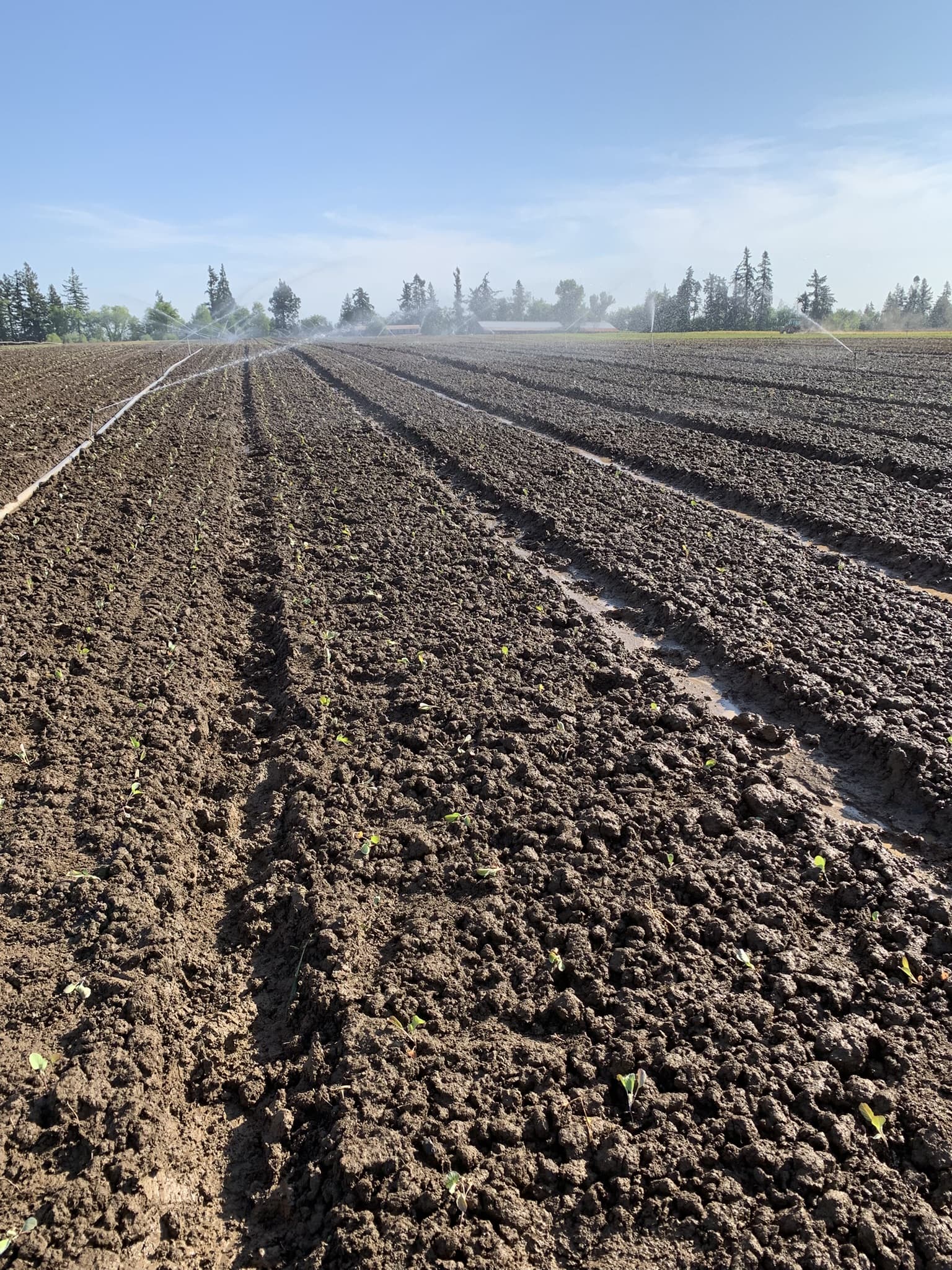
Newly set lettuce at the stage where a home grower would still be looking at bare ground. Note the even spacing, every plant has been given the same room, which is what makes a whole row ready at once. In a garden that is exactly what you are trying to avoid.
Oregon City, Oregon
Sun & Rain Works · © Sun & Rain Works
Bolting, and why it turns bitter
Lettuce bolts, sends up a flower stem and stops making leaves, in response to heat and lengthening days. As it does, the plant fills with a milky latex, and that latex is what makes a bolted lettuce bitter. The bitterness is not a sign the plant is old; it is a sign the plant has switched jobs.
There is no reversing it. Once the centre begins to elongate and the plant starts to look like it is standing up rather than sitting down, you have a few days at most. Cut it and use it, or pull it.
Everything you can do is preventative. Choose bolt-resistant varieties for summer sowings, seed catalogues label them and the labelling is broadly honest. Give afternoon shade once the weather warms, which can be as simple as sowing on the east side of taller crops. Keep water steady, because a plant that has been checked by drought bolts sooner. And accept the seasonal shape of the crop: in most climates midsummer lettuce is a fight, and the spring and autumn crops are the ones worth planning around.
Solomon puts the maritime Northwest version of this plainly. Spring-sown lettuce will size up beautifully with no irrigation at all if it has room, a foot apart with two feet of elbow room either side, but lettuce cut after mid-June gets bitter without regular heavy watering, and he keeps a dedicated irrigated bed for exactly that reason.
- Bitterness is the latex of a bolting plant. It cannot be reversed.
- Steady water delays bolting; drought stress brings it forward.
- Spring and autumn are the real lettuce seasons. Midsummer is a fight.
Shallow roots, steady water
Lettuce is almost entirely leaf and its roots are shallow, so it has very little buffer against a dry spell. A plant that dries out and recovers is checked, and a checked lettuce is tougher, more bitter and closer to bolting than one that grew evenly.
That does not mean drowning it. Steady and moderate beats heavy and occasional, and mulch does more for this crop than for almost anything else in the garden because it holds moisture in exactly the top few inches where the roots are.
The other reason to water carefully: wet leaves that stay wet overnight invite rot, particularly in a dense heading variety where water sits in the heart. Water in the morning, at the base, and give the plants enough room for air to move between them.
- Shallow-rooted: steady moderate water, not heavy and occasional.
- Mulch pays off more here than on almost any other crop.
- Water at the base in the morning so leaves are dry by night.
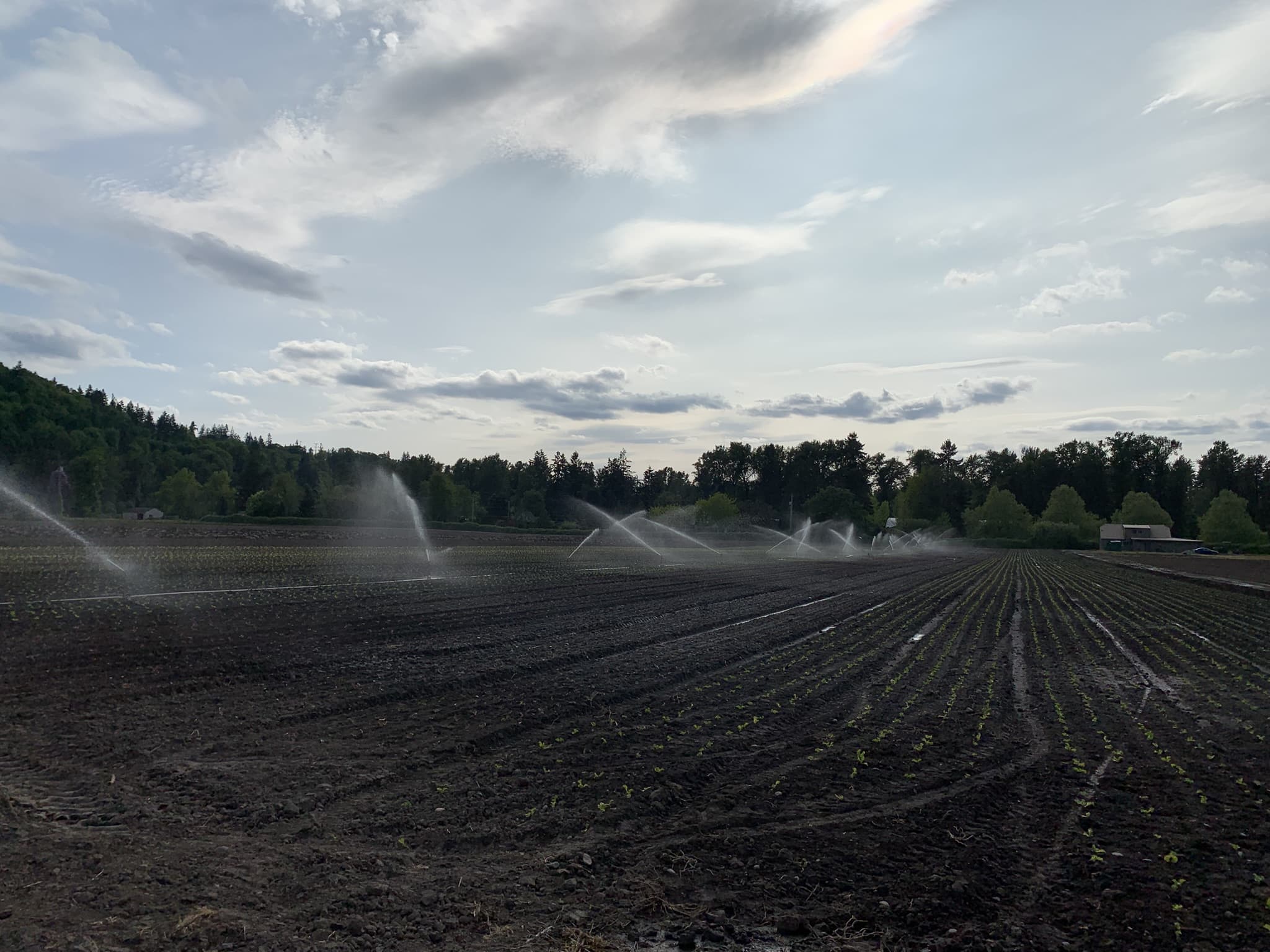
First irrigation after planting. The critical watering for any transplanted lettuce is this one, it settles soil around roots that have just been disturbed, and a plant that checks now never quite catches up.
From our field library
Sun & Rain Works · © Sun & Rain Works
Direct sow or transplant, both are right
Unusually, lettuce is happy either way, and the choice is about what you want rather than what the plant needs.
Direct sowing is less work and gives slightly better plants, because nothing is ever checked. Sow thinly a quarter-inch deep and thin to your final spacing, eating the thinnings, which is the whole point of the exercise.
Transplanting gives you control. You can start plants in modules while the bed is still occupied, set them out at exactly the spacing you want, and skip the thinning entirely. It also dodges the slug problem at the seedling stage, which in a wet spring is not a small thing. Set plants out no deeper than they sat in the module, a lettuce buried to its growing point rots.
Commercially the decision is made for you, and the photograph below shows why: a mechanical planter sets thousands of identical transplants at identical spacing in a fraction of the time. The home-garden version is a trowel and an afternoon, and the principle is the same.
- Direct sowing gives marginally better plants; transplanting gives control.
- Never bury the growing point, a deeply set lettuce rots.
- Transplanting sidesteps slug damage at the seedling stage.
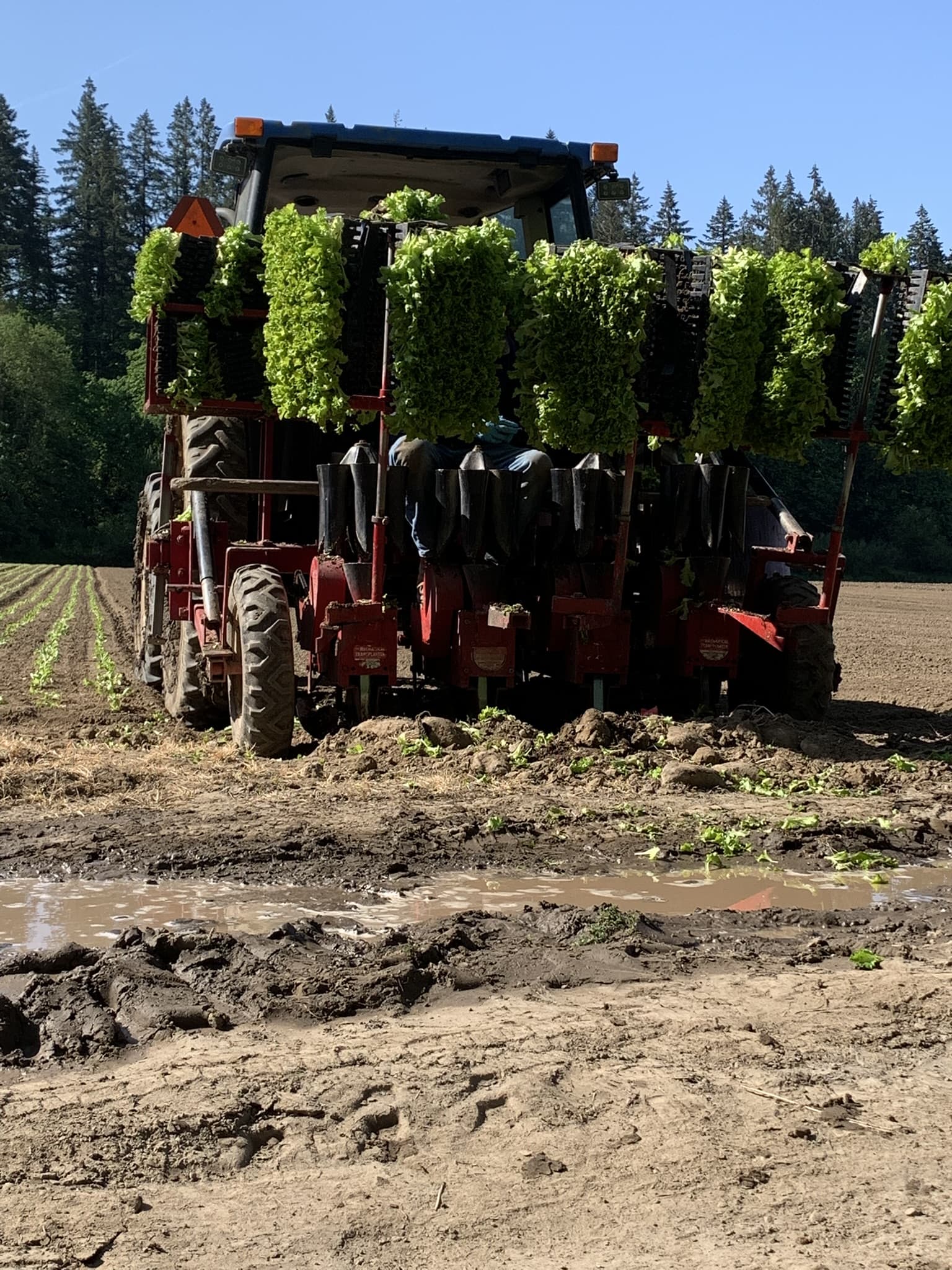
Mechanical transplanting at field scale. Worth seeing because it makes the underlying logic obvious, every plant goes in at the same depth, the same spacing, and into soil that has been prepared to exactly the same tilth. That consistency is what you are approximating with a trowel.
From our field library
Sun & Rain Works · © Sun & Rain Works
Cut and come again, or take the whole plant
Loose-leaf types can be harvested by taking outer leaves and leaving the centre to keep growing, which turns one plant into weeks of picking. Take no more than a third at a time and always leave the growing point.
The better method for most people, and the one the 1912 manual recommends for spinach for the same reason, is to cut whole plants and let the neighbours take the room. Cut about an inch above the soil with a knife and many varieties will regrow a second, smaller flush.
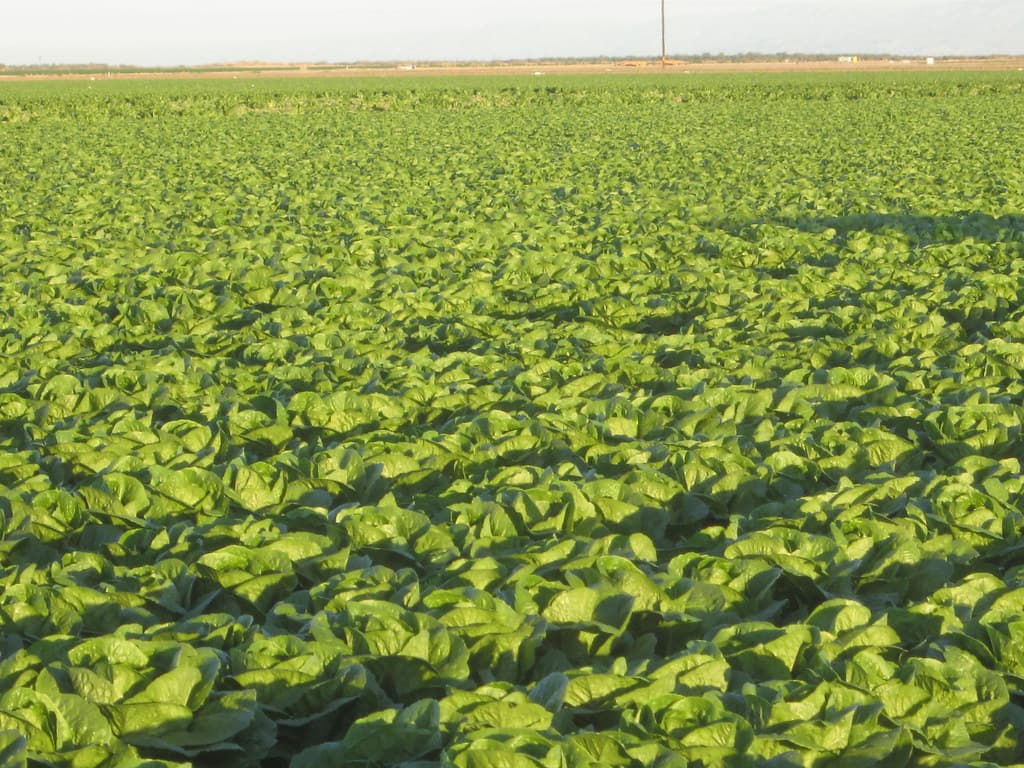
Heading types, butterhead, crisphead, and the romaine in the photograph at the top of this page, are cut once, whole. Take them as soon as the heart feels firm rather than waiting for a size, because the days between firm and bolting are few in warm weather.
Cut in the morning if you can. Lettuce cut in the cool of the day is crisp and keeps for days; the same plant cut at four in the afternoon is limp before it reaches the kitchen and never fully recovers.
- Loose-leaf: take a third of the outer leaves, leave the centre.
- Heading types are cut once, as soon as the heart firms.
- Cut in the morning. Afternoon-cut lettuce never crisps up again.
Slugs, aphids, and rot in the heart
Slugs and snails are the main enemy, and they take seedlings rather than mature plants, which is the argument for transplanting rather than direct sowing in a wet spring. A lettuce that has four true leaves is largely out of danger; one that has just germinated can vanish overnight.
Aphids colonise the undersides of leaves and, worse, get down into the heart of a heading variety where they cannot be washed out. Catch them early, and encourage the hoverflies and ladybirds that eat them rather than reaching for anything.
In wet weather the characteristic failure is rot starting in the heart or at the base, grey mould and bottom rot both thrive where leaves stay wet and air does not move. The fixes are spacing, morning watering and not planting into ground that sits wet.
One physiological problem worth naming because it looks like a disease and is not: tipburn, where leaf margins go brown and papery. It is a calcium delivery problem caused by fast growth and irregular water, not a deficiency in the soil, and even watering is the answer rather than feeding.
Sources
- Slugs take seedlings, not mature plants, get past four true leaves.
- Aphids in the heart of a heading type cannot be washed out. Catch them early.
- Brown papery leaf margins are tipburn: irregular water, not disease.
How this crop used to be spaced
A single spacing figure reads as a fact about the plant. It is not, it is a judgement about your cultivation method and your water, and two books on our shelf disagree with our figure and with each other for reasons worth knowing.
- 1912, worked by hand
- Rows 12 to 18 in., plants 4 to 6 in., sown 1/2 in.deep. That is the hand-cultivation column, the same table's horse column is far wider, because a horse and cultivator had to walk between the rows, and quoting that one is how old manuals got their reputation for wasting ground. We reproduce the table in full.
- Through a rainless summer, unwatered
- One foot apart in a single row with 2 feet of elbow room on each side. About four times the ground our own figure gives it, and it buys spring lettuce that stays sweet unwatered. Solomon is candid that nothing saves lettuce cut after mid-June, that one he grows on an irrigated bed. Our notes on the book.
Which type to grow
Grouped by what each is for rather than by catalogue order, because the useful question is which one suits your ground.
Loose-leaf
No head; open rosette of leavesBest for: Cut-and-come-again, and the fastest return
The easiest and quickest, ready in a few weeks and pickable for many more. Least prone to rot because nothing traps water. If you grow one type, grow this one.
Cos / romaine
Upright, elongated headBest for: Heat tolerance and standing longest
Generally the most bolt-resistant and the most robust in the field, which is why it dominates commercial growing. Burr's 1863 catalogue treats cos as a category of its own with seventeen varieties, so this is not a modern preference.
Butterhead / Boston
Loose, soft round headBest for: Flavour and texture, spring and autumn
The best eating of the lot and the least tolerant of heat. A spring and autumn crop in most climates; in a warm summer it will bolt before it hearts.
Crisphead / iceberg
Tight, dense headBest for: Storage and crunch
The hardest to grow well at home, it needs a long cool spell to heart properly, and it rots from the middle if the weather turns wet while it is doing so. Worth attempting once the easier types are reliable.
Winter and overwintering lettuce
Varies; usually hardy cos or cabbage typesBest for: Standing through a mild winter
An underused category and the one the old catalogues take most seriously, Burr lists Brown Winter Cabbage, Green Winter Cabbage, Large Winter Cabbage, Green Winter Cos and Red Winter Cos. That is five varieties named for a season most modern seed racks ignore entirely.
What went wrong
Listed by what you can see, not by what the plant has, you arrive here holding the evidence and without the vocabulary. Where the answer is that nothing can be done this year, it says so.
Plant stands up tall, leaves taste bitter
Fixable nowWhy: Bolting. Heat and long days have switched the plant from making leaves to making seed, and the latex that comes with it is the bitterness.
What to do: Not reversible, use it immediately or pull it. Sow a fresh succession row, choose a bolt-resistant variety for summer, and give afternoon shade.
Nothing germinated in a summer sowing
Fixable nowWhy: Soil too warm. Lettuce germination stalls above about 80°F, which is the opposite of what people expect from a cool-season crop.
What to do: Sow in a shaded spot, start in modules somewhere cool, or wait until the soil drops. Watering the drill before sowing cools it a surprising amount.
Brown papery edges on otherwise healthy leaves
Fixable nowWhy: Tipburn, calcium not reaching the fastest-growing leaf margins. Caused by irregular water and rapid growth, not by soil deficiency.
What to do: Even out watering and mulch. Do not add calcium; the soil almost certainly has enough and the problem is delivery.
Rot starting in the heart or at the base
Fixable nowWhy: Grey mould or bottom rot, both encouraged by leaves that stay wet and air that does not move.
What to do: Remove affected plants entirely. Space more widely, water at the base in the morning, and avoid beds that sit wet. Loose-leaf types are much less prone if this keeps happening.
Seedlings vanish overnight
Fixable nowWhy: Slugs and snails, which take lettuce at the cotyledon stage and ignore it later.
What to do: Transplant rather than direct-sow in a wet spring, a plant with four true leaves is largely safe. Clear hiding places, and go out after dark with a torch.
Aphids deep in the heart of a headed plant
Next seasonWhy: Colonies established early on leaf undersides and moved inward as the head closed.
What to do: Once inside a head they cannot be washed out, that plant is for the compost. Check leaf undersides weekly on the next crop and blast early colonies off with water.
Plants small, pale and slow
Fixable nowWhy: Hunger or competition. Lettuce is shallow-rooted and loses to weeds quickly.
What to do: Weed, water, and give a nitrogen-leaning feed, this crop is all leaf and responds within days.
50 kinds, in 1863
The longest list of any crop we have counted so far, and by a distance: fifty varieties in one 1863 catalogue, thirty-three cabbage-heading and seventeen cos. Read the names and a pattern jumps out, Brown Winter, Green Winter, Large Winter, Green Winter Cos, Red Winter Cos. This was a crop expected to stand outdoors through the cold half of the year, at a latitude where that is genuinely difficult, and a modern seed rack offers almost nothing for the job.
Brown Dutch · Brown Silesian or Marseilles Cabbage · Brown Winter Cabbage · Early or Summer Cape · Early Simpson · Early White Spring or Black-seeded Gotte · Endive-leaved · English Endive-like Curled-leaved · Green Curled · Green Winter Cabbage · Hammersmith Hardy · Ice Cabbage · Imperial Head · India · Large Brown Cabbage or Mogul · Large Red Cabbage · Large Winter Cabbage or Madeira · Malta or Ice Cabbage · Neapolitan · Palatine · Spotted Cabbage (black-seeded) · Spotted Cabbage (white-seeded) · Stone Tennis-ball · Summer Cabbage · Tennis-ball · Turkey Cabbage · Versailles · Victoria or Red-bordered · White Gotte (black-seeded) · White Gotte (white-seeded) · White Silesian, or White Batavian · White Stone Cabbage · Yellow-seeded Brown Dutch · Alphange or Florence Cos (black-seeded) · Alphange or Florence Cos (white-seeded) · Artichoke-leaved Cos · Bath Green Cos · Brown Cos · Gray Paris Cos · Green Paris Cos · Green Winter Cos · Monstrous Brown Cos · Oak-leaved Cos · Red Winter Cos · Spotted Cos (black-seeded) · Spotted Cos (white-seeded) · Waite's White Cos · White Brunoy Cos (black-seeded) · White Brunoy Cos (white-seeded) · White Paris Cos
Our reading of twenty-two tomatoes →What’s in lettuce
Per 100 grams raw, from USDA FoodData Central. The range is what USDA actually measured across its samples — it is usually wide, and your own crop sits somewhere in it rather than on the headline number.
| Nutrient | Per 100 g | % daily | Range measured |
|---|---|---|---|
| Vitamin K | 118.5 µg | 99% | 90.6–133.8 (n=8) |
| Vitamin C | 15.15 mg | 17% | 11.3–20 (n=8) |
| Potassium | 277.1 mg | 6% | 164–372 (n=8) |
| Calcium | 39.84 mg | 3% | 29.7–52.3 (n=8) |
| Magnesium | 12.77 mg | 3% | 8.28–17.6 (n=8) |
| Protein | 1.09375 g | 2% | 0.8125–1.5 |
| Iron | 0.3195 mg | 2% | 0.261–0.354 (n=8) |
| Water | 94.01 g | , | 93.4–94.54 (n=8) |
Source: USDA FoodData Central, “Lettuce, leaf, green, raw” (Foundation, published 10/28/2022). Percentages are of the FDA adult Daily Value, a labelling reference rather than a personal requirement. Raw values; boiling leaches water-soluble vitamins and some carotene, so a cooked serving is not the same figure.
What the wartime archive says about lettuce
5 passages from the USDA’s 1943–46 victory garden material, with our note on whether each still holds. Pulled from the annotations themselves rather than listed here by hand.
- What not to dryStill holds
Home drying doesn't suit lettuce, melons, cucumbers, radishes. Asparagus can be dried, but is not so good as most dried vegetables.
Oven drying the surplus
- Cut and come againStill holds
We know of another gardener who set aside a small space for this purpose last summer and by clipping off the large leaves was able to supply three people with mustard greens at least once a week for nearly three months.
Planning and starting · May 10, 1944
- A garden in two window boxesStill holds
We know of a city-dweller whose only Victory Garden is a couple of window boxes. He planted lettuce (didn't put in the seed too deep, you know) in the fore part of April and before the month was out he had a fine crop more than two inches h…
Planning and starting · May 10, 1944
- Resistance, namedStill holds
Seed catalogs indicate the resistance of a variety after the name. Example: “Marglobe (wilt resistant).” If that is not done, the resistance is usually mentioned in the description of the variety.
Pests and diseases · “Prevent Vegetable Diseases”, 1944
- “Of course, there's always an exception”Mostly holds
The wise Victory gardener won't bother to save seed of most crops. Of course, there's always an exception. Tomatoes and a few other crops come under that heading. But even with these, which are fairly safe, a gardener will want to get exper…
When things go wrong · August 2, 1945
Saving your own seed
One of the four crops worth starting with. Lettuce is a self-pollinating annual, so it comes true in an ordinary garden with only ten to twenty-five feet between varieties and no other precautions.
The catch is that you must let a plant do the thing you have spent all season preventing. A lettuce saved for seed bolts, runs up to three or four feet, flowers, and occupies that ground for most of the summer, so choose your best plant, mark it, and mentally write off the space.
Choose the plant that bolted last, not the one that looked best early. Selecting for late bolting is the single most useful thing a home seed saver can do to a lettuce, and a few generations of it produces a strain genuinely better suited to your garden than anything you can buy.
Seed ripens unevenly over several weeks. Rather than waiting for one harvest, shake the flower heads into a paper bag every few days as they turn fluffy. Expect chaff; winnow it roughly and do not chase perfection, because the seed keeps three to five years and you will have far more than you can use.

Farm rooted clothing · Est. 2005
The guides are free. The shop is the business.
Sun & Rain Works is a small apparel outfit in Eugene, Oregon, with agricultural roots and a slow path toward farming. The lettuce guide you just read comes from the same place as the shirts.
More growing guides
We're working through the vegetables one at a time, with dates counted from your own frost station and the old books read properly. Occasional notes from Eugene, Oregon, an art business with agricultural roots, working its way toward farming.
We'll email you to confirm before sending anything. After that, occasional seasonal notes from Sun & Rain Works, we won't share your address, and every email has an unsubscribe link.
Growing advice here is current horticultural practice, drafted with AI assistance and checked against the sources this page names. Where it quotes a book, the book is named and linked. Where practice is genuinely contested, or local enough that we would be guessing, the text says so, your county extension service beats any national guide, including this one, on pest timing.
The photographs are not AI-generated. Every one is our own work, public domain, or licensed, and carries its author and licence beneath it.