Growing guide
How to grow peas
The first thing sown and the first thing eaten. Peas want the cold, wet end of spring that every other crop resents, which is exactly why they are the crop to start a maritime Northwest garden with.
Pisum sativum · Fabaceae, the legume family, with beans, lentils and clover
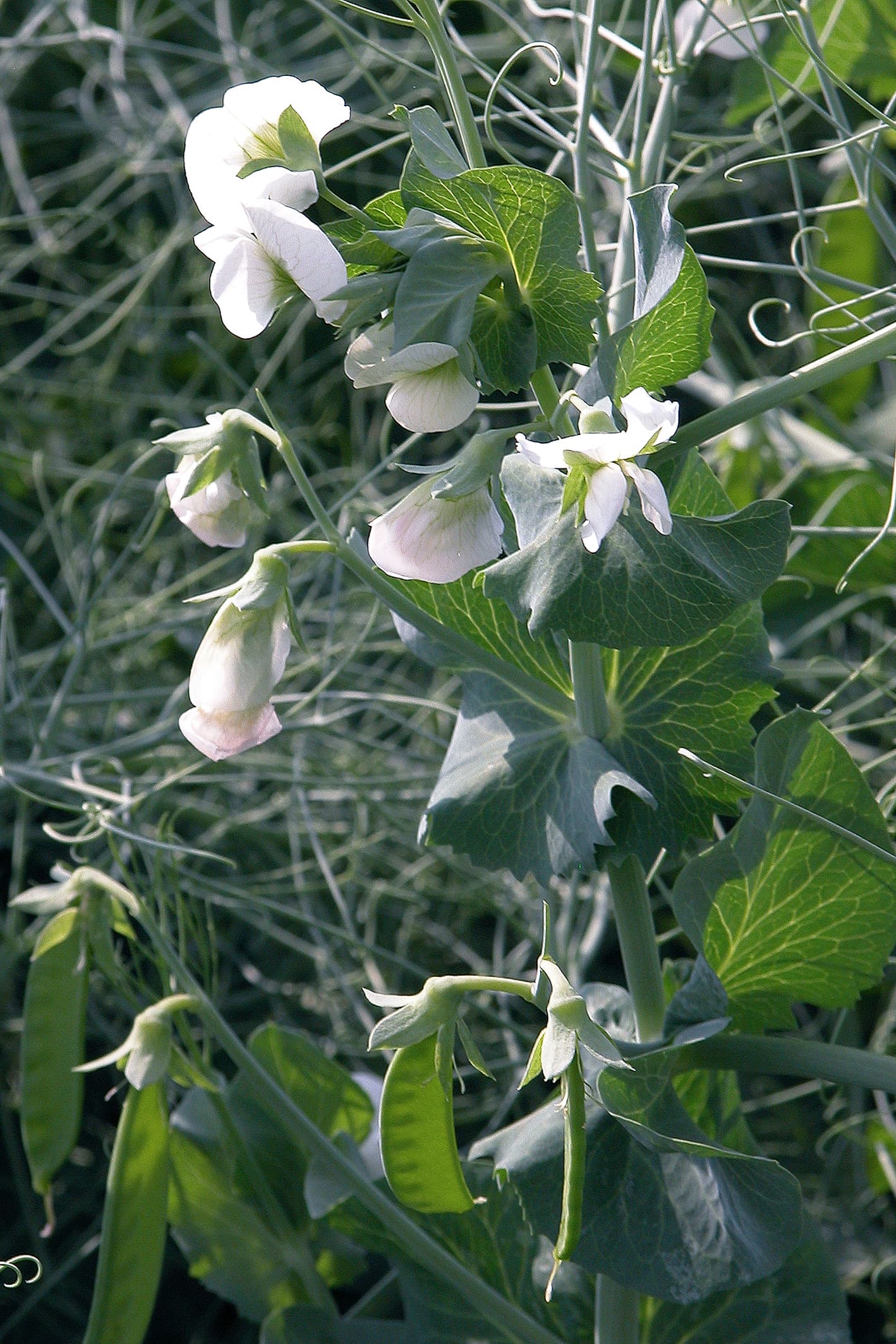
Above: INRA DIST / Jean Weber · CC BY 2.0
_Cl_J_Weber07_(24057765726).jpg)
easy. Straightforward and quick, with one common way to fail, sowing into ground that is warm and wet rather than cold and wet, which rots the seed before it germinates.
At a glance
- Family
- Fabaceae (legumes)
- Life cycle
- Annual
- Hardiness
- Hardy, young plants take frost
- Sowing method
- Direct sow; dislikes root disturbance
- Germination
- 7–14 days in cold soil
- Soil
- Any decent soil; needs no nitrogen feed
- Sun
- Full sun, but tolerates cool and grey
- Days to maturity
- 55–70 from sowing
- Succession
- Every 10–14 days through spring
- Biggest single risk
- Seed rotting in warm wet ground
When to sow, where you actually live
Every other guide prints a month, and a month is only true somewhere. What transfers between locations is the offset: peas go in about 5 weeks before the last spring frost, wherever that falls for you. Give us a ZIP and we will count it from your own NOAA weather station.
Current spacing: 2″ apart in rows 24″ apart, sown 1″ deep. Roughly 55–70 days to a first picking, though variety moves that more than any general figure admits.
Get your sowing dates →Sow early, earlier than feels sensible
Our calendar puts peas in about five weeks before your last spring frost, which is the earliest sowing of any crop on the site. That is not a rounding error. Peas germinate in cold soil, young plants shrug off frost, and the whole crop is built around finishing before summer heat arrives, because heat is what ends a pea plant, not cold.
The old rule was to sow as soon as the ground can be worked, and it holds. If the soil crumbles rather than smearing when you squeeze it, peas can go in.
The failure mode is worth stating precisely, because it is counter-intuitive: peas do not freeze, they rot. Seed sitting in ground that is wet and warm-ish, rather than wet and cold, is what fails. That is why a mild damp spell in March costs more sowings than a hard frost does, and why sowing into a raised, free-draining row matters more than waiting for warmth.
Solomon's version for a dry garden is the same crop from the other end: peas are the one thing he says needs no irrigation at all, because they mature before the summer drought sets in. Sowing early is not just about an early harvest, it is what puts the whole crop inside the wet half of the year.
- Sow as soon as soil crumbles rather than smears. Frost is not the enemy.
- Peas rot in warm wet ground more readily than they freeze in cold.
- Sow every 10–14 days through spring; the window closes when heat arrives.
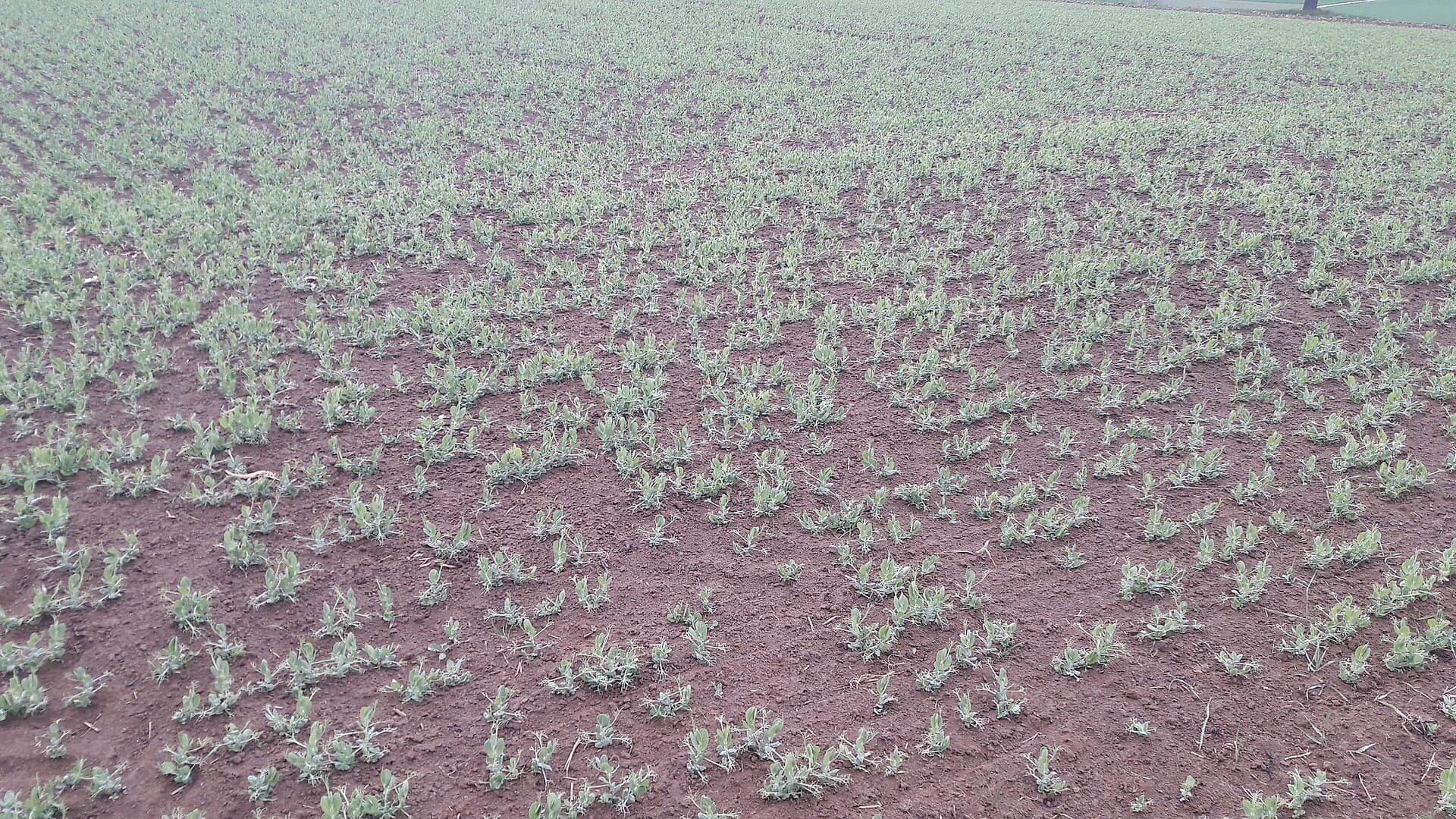
Early May, and the crop is only a few inches up. This is what peas look like when everything else in the garden is still a seed packet, the head start is the whole point of the crop.
Pea field in early May
Trauriger Clown · CC BY-SA 4.0

Support, even for the ones that say they do not need it
Every pea climbs. Varieties sold as dwarf or self-supporting climb a bit less, and what they mostly do is lean on each other until a rain flattens the row.
Give them something. Twiggy prunings pushed into the row, pea sticks, the traditional answer, work as well as anything and cost nothing. Netting, wire mesh or strings between posts all work. The 1912 manual suggests three-foot poultry netting, and specifically recommends sowing a double row six inches apart with the trellis between them, which is a genuinely efficient use of one support.
Put the support in at sowing or immediately after. Pushing stakes into a row of established peas tears roots, and a pea that has flopped and been propped up never does as well as one that climbed cleanly from the start.
Height matters more than strength. A tall variety on a three-foot support crops well up to three feet and then sprawls; the plants are light, so the support only needs to hold them up, not hold them down.
- There is no such thing as a pea that does not want support.
- Twiggy sticks are as good as anything and free.
- Put support in at sowing, installing it later tears roots.
Do not feed them nitrogen
Peas fix their own nitrogen through bacteria in root nodules, so a nitrogen-rich bed produces a mass of lush vine and very few pods. The 1912 manual is explicit: fertilizers high in nitrogenous matter should not be applied immediately before planting, as they tend to produce too great a growth of vines at the expense of pods. Ground well manured the previous year is ideal.
What they do want is drainage and a soil that is not acid. Phosphorus and potassium are useful; nitrogen is not.
Because of that nitrogen fixing, peas leave the ground better than they found it, cut the plants off at soil level when they finish rather than pulling them, and the nodules stay behind to break down where the next crop can use them. It costs nothing and it is the reason peas sit at the head of so many traditional rotations.
Depth is one place old and new advice diverge usefully. Our figure is an inch; the 1912 table says two to three. Its explanation is the interesting part, sow in the bottom of a six-inch furrow and cover with only two or three inches, then fill the trench in as the plants grow. That buries the stem progressively and gives a sturdier plant, which is a technique rather than a depth.
- No nitrogen. Lush vines and no pods is a feeding problem.
- Cut plants off at ground level when finished; leave roots to break down.
- The old furrow method: sow deep in a trench, fill it in as they grow.
Pick constantly, and know which kind you grew
The three types are picked at completely different stages, and picking at the wrong one is the commonest disappointment.
Snow peas, the flat-podded, eatable-podded sorts Burr calls sugar peas, are picked when the pod is full size but the peas inside are still barely visible bumps. Wait and the pod turns fibrous.
Snap peas are picked when the pod has filled out and gone round but is still glossy and crisp. Dull and matt means starchy.
Shelling peas are picked when the pods are well filled and still bright green. A pod that has gone pale or waxy has peas in it that have started converting sugar to starch, which is precisely the difference between a garden pea and a supermarket one.
Whichever you grow, pick every day or two. A pea plant's purpose is to make seed, and once a few pods mature fully the plant reads its job as done and stops flowering. Constant picking keeps it going for weeks longer.
- Snow peas: flat pods, peas barely visible. Snap: round and glossy.
- Shelling peas: well filled and bright green. Pale means starchy.
- Pick every day or two, or the plant stops flowering.
What goes wrong
Powdery mildew is the usual end of a pea crop, a white bloom on leaves and pods in warm dry spells late in the season. It is largely a signal that the crop is finishing rather than a disaster; keep picking, and sow a later succession further apart with better airflow if you want to push the season on.
Pea aphids build up quickly in warm weather and are the classic sight on a stressed crop. Predators usually catch up; a hard spray of water knocks numbers back in the meantime.
Mice and birds take sown seed and emerging shoots, which is a genuinely common cause of a row that never appeared. If germination is patchy, dig one up before blaming the seed. Netting over the row until plants are a few inches high solves it.
Pea moth, whose larvae are the maggots found in pods later in the season, is worst on midsummer crops. Very early and very late sowings largely dodge its flight period, which is another argument for sowing early.
Sources
- Powdery mildew usually means the crop is ending, not failing.
- A row that never came up is often mice, not bad seed. Dig one up and look.
- Early and late sowings dodge pea moth; midsummer ones do not.
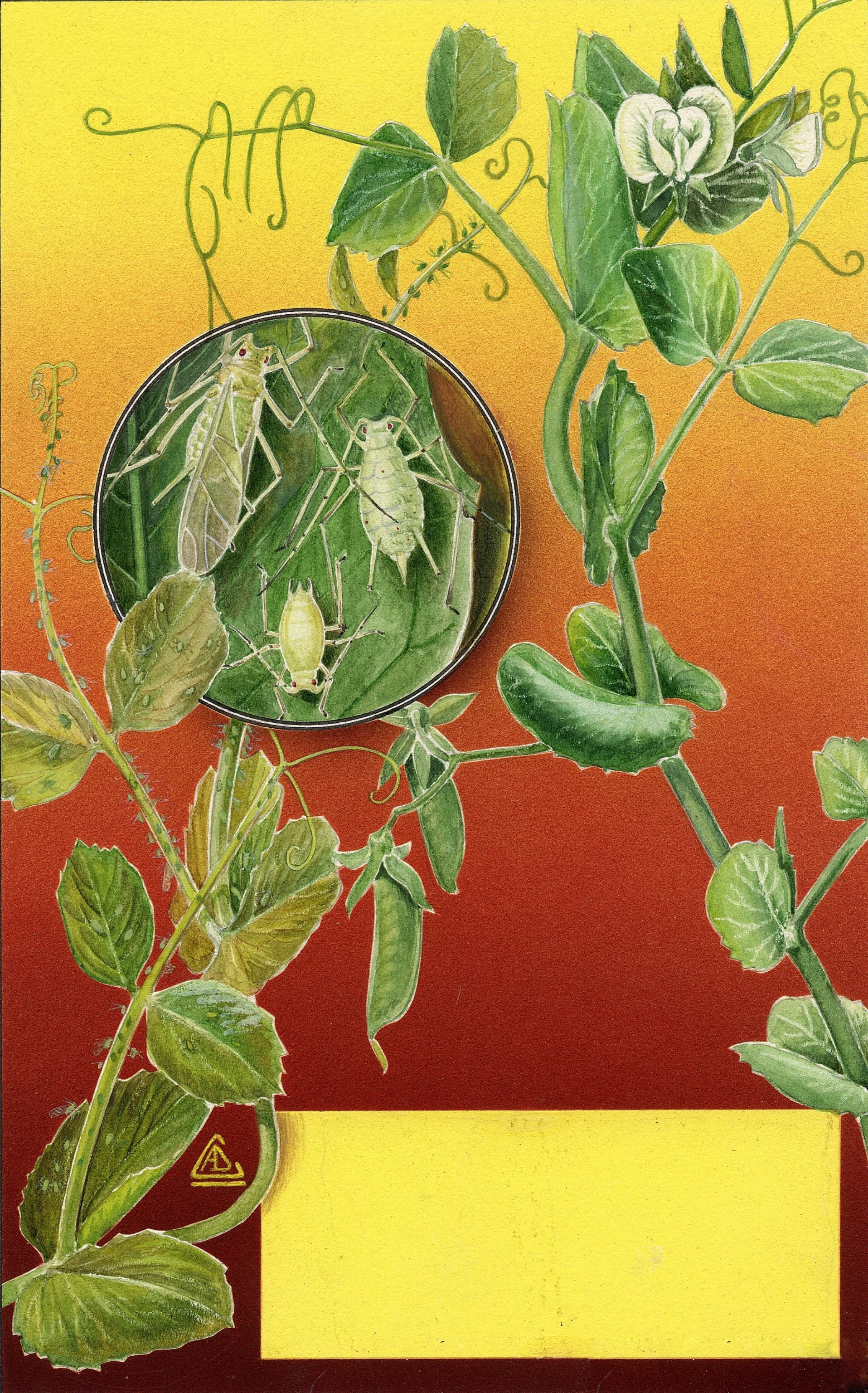
The pea aphid, photographed for the USDA. Colonies build fastest on plants already stressed by heat or drought, which is why a late crop gets them and an early one usually does not.
Art Cushman, USDA Systematic Entomology Laboratory · CC BY 3.0 US

How this crop used to be spaced
A single spacing figure reads as a fact about the plant. It is not, it is a judgement about your cultivation method and your water, and two books on our shelf disagree with our figure and with each other for reasons worth knowing.
- 1912, worked by hand
- Rows 30 to 36 in., plants 15 to ft., sown 2 to 3 in.deep. That is the hand-cultivation column, the same table's horse column is far wider, because a horse and cultivator had to walk between the rows, and quoting that one is how old manuals got their reputation for wasting ground. We reproduce the table in full.
- Through a rainless summer, unwatered
- Both pole and bush varieties are planted thickly in single rows about 4 feet apart. The one crop Solomon says needs no water at all, it is finished before the drought bites. The four feet is between rows, not between plants; the peas themselves still go in thick. Our notes on the book.
Which type to grow
Grouped by what each is for rather than by catalogue order, because the useful question is which one suits your ground.
Shelling peas
Round pods, peas removed and poddedBest for: The real reason to grow peas at all
The gap between a garden shelling pea eaten within an hour and anything you can buy is the largest of any vegetable, because the sugars start converting to starch the moment the pod is picked. Everything else on this list is easier; this is the one worth the trouble.
Snap peas
Round, thick, edible podsBest for: Yield per square foot, and children
Eaten whole, so nothing is wasted and there is no podding. The most productive of the three by weight and the least fiddly. A modern type, nothing quite like it appears in Burr.
Snow peas / mangetout
Flat, edible podsBest for: Quick cropping and stir-frying
Picked before the peas swell, so they are ready earlier than anything else in the row. Burr lists nine of these under Eatable-podded or Sugar Pease, including purple-, red-, yellow- and white-podded sorts, so the colour range once ran well past green.
Dwarf peas
18–30 inchesBest for: Containers and windy sites
Less to support and quicker to crop, but lower yielding and finished sooner. Tom Thumb is in Burr's 1863 list and is still sold under that name, which is a rarer survival than it sounds.
Tall peas
Five to six feetBest for: Yield over a long season
Need real support and pay for it. Burr's tall marrow peas dominate the 1863 list, because a Victorian kitchen garden had walls and frames to grow them up and wanted the longest possible picking season.
What went wrong
Listed by what you can see, not by what the plant has, you arrive here holding the evidence and without the vocabulary. Where the answer is that nothing can be done this year, it says so.
Row never came up
Fixable nowWhy: Seed rotted in wet, warm-ish ground, or mice ate it. Both are far commoner than bad seed.
What to do: Dig where a seed should be. If it is soft and rotten, re-sow into better-drained ground; if it is gone, net the next sowing until plants are a few inches high.
Masses of leafy vine, very few pods
Next seasonWhy: Too much nitrogen. Peas fix their own and a rich bed pushes them into growth instead of flower.
What to do: Nothing this year; they will pod eventually and less than they should. Next time follow a manured crop rather than manuring for peas.
White powdery bloom on leaves and pods
Fixable nowWhy: Powdery mildew, in warm dry weather late in the crop's life.
What to do: Keep picking, pods are still edible. Treat it as the signal to pull the crop and sow something else. Space later sowings more widely for airflow.
Plants flowered well, then stopped
Fixable nowWhy: A few pods were left to mature fully, so the plant read its job as done.
What to do: Pick every day or two, and remove any over-mature pods you find. The plant often restarts.
Maggots inside the pods
Next seasonWhy: Pea moth larvae, from eggs laid at flowering.
What to do: Nothing to do now. Shift sowing dates earlier or later next year so flowering misses the moth's flight period, this is the single most effective control at garden scale.
Plants collapse and sprawl after rain
Fixable nowWhy: No support, or support added too late.
What to do: Prop them now, gently. Next time put pea sticks or netting in at sowing, a pea that has been flat never fully recovers.
Crop finishes abruptly in early summer
Next seasonWhy: Heat. Peas are a cool-season crop and simply stop when it warms.
What to do: Not a fault, this is the crop's shape. Sow earlier next year, and use the ground for beans, which want exactly the weather peas cannot take.
71 kinds, in 1863
The longest list in our whole census, more peas than lettuces, more than cabbages, more than any other crop Burr describes. The reason is written into the names: Batt's Wonder, Beck's Prize-taker, Fairbeard's Champion of England, Knight's Tall Green Marrow, Veitch's Perfection. These are breeders' names, and the pea was the crop Victorian breeders competed over. It is not a coincidence that peas are also self-pollinating: a variety, once made, stays made, which is the same reason a home gardener can save pea seed successfully today.
Auvergne · Batt's Wonder · Beck's Prize-taker · Bedman's Imperial · Bellamy's Early Green Marrow · Bishop's Early Dwarf · Bishop's New Long-podded · Black-eyed Marrow · Blue Cimeter · Blue Imperial · Blue Prussian · Blue Spanish Dwarf · British Queen · Burbridge's Eclipse · Carter's Victoria · Charlton · Champion of Paris · Climax · Dantzic · Dickson's Favorite · Dillistone's Early · Dwarf Marrow · Early Dan O'Rourke · Early Frame · Early Hotspur · Early Warwick · Early Washington · Fairbeard's Champion of England · Fairbeard's Nonpareil · Fairbeard's Surprise · Flack's Imperial · General Wyndham · Hair's Dwarf Mammoth · Harrison's Glory · Harrison's Perfection · King of the Marrows · Knight's Dwarf Blue Marrow · Knight's Dwarf Green Marrow · Knight's Dwarf White Marrow · Knight's Tall Blue Marrow · Knight's Tall Green Marrow · Knight's Tall White Marrow · Matchless Marrow · Milford Marrow · Missouri Marrow · Ne Plus Ultra · Noble's Early Green Marrow · Prince Albert · Queen of the Dwarfs · Ringwood Marrow · Royal Dwarf or White Prussian · Sebastopol · Shillings Grotto · Spanish Dwarf · Tall White Marrow · Taylor's Early · Thurston's Reliance · Tom Thumb · Veitch's Perfection · Victoria Marrow · Warner's Early Emperor · Woodford's Marrow · Common Dwarf Sugar · Early Dwarf Dutch Sugar · Giant Eatable-podded · Large Crooked Sugar · Purple-podded or Australian · Red-flowered Sugar · Tamarind Sugar · White-podded Sugar · Yellow-podded Sugar
Our reading of twenty-two tomatoes →Related crops
Worked out from the botany rather than from a hand-written list, so it stays correct as the library grows.
- The same family
Also Fabaceae. Shares much of this crop's pest and disease pressure and belongs in the same rotation group.
What’s in peas
Per 100 grams raw, from USDA FoodData Central. The range is what USDA actually measured across its samples — it is usually wide, and your own crop sits somewhere in it rather than on the headline number.
| Nutrient | Per 100 g | % daily | Range measured |
|---|---|---|---|
| Vitamin C | 40 mg | 44% | , |
| Vitamin K | 24.8 µg | 21% | , |
| Fibre | 5.7 g | 20% | , |
| Folate | 65 µg | 16% | , |
| Protein | 5.42 g | 11% | , |
| Iron | 1.47 mg | 8% | , |
| Magnesium | 33 mg | 8% | , |
| Potassium | 244 mg | 5% | , |
| Vitamin A | 38 µg | 4% | , |
| Calcium | 25 mg | 2% | , |
| Water | 78.86 g | , | , |
| Energy | 81 kcal | , | , |
Source: USDA FoodData Central, “Peas, green, raw” (SR Legacy, published 4/1/2019). Percentages are of the FDA adult Daily Value, a labelling reference rather than a personal requirement. Raw values; boiling leaches water-soluble vitamins and some carotene, so a cooked serving is not the same figure.
What the wartime archive says about peas
5 passages from the USDA’s 1943–46 victory garden material, with our note on whether each still holds. Pulled from the annotations themselves rather than listed here by hand.
- The arithmetic of dryingStill holds
An oven can take 4 to 8 pounds — preferably 6 — of a prepared fruit or vegetable at one drying load. It takes most of a day for the load to dry.
Oven drying the surplus
- Don't sow peas and beans thickStill holds
No matter how tempted you are to put beans or peas close, don't do it. You can't transplant them successfully later. And thinning the rows and throwing away young plants is not only a waste but also disturbs the roots of the plants left.
Working the garden year · May 10, 1943
- Don't work among wet beansStill holds
Remember not to gather beans or work around beans when the leaves are wet with dew or rain. This tends to spread disease.
When things go wrong · Release immediate
- “Of course, there's always an exception”Mostly holds
The wise Victory gardener won't bother to save seed of most crops. Of course, there's always an exception. Tomatoes and a few other crops come under that heading. But even with these, which are fairly safe, a gardener will want to get exper…
When things go wrong · August 2, 1945
To can snap beans, lima beans, peas, and corn — in fact, all vegetables except tomatoes — the canning specialists recommend canning only under steam pressure. The reason is that certain spoilage organisms are not [destroyed at boiling tempe…
Saving the crop · May 14, 1943
Saving your own seed
One of the four crops to start with. Peas are self-pollinating annuals: the flower fertilises itself before it opens, insects rarely interfere, and ten to twenty feet between varieties is more courtesy than necessity.
The method is to stop picking. Choose a few plants, or the end of a row, and leave the pods alone until they are brown, dry and rattle when shaken. That takes several weeks longer than eating them, which is the only real cost.
Weather is the one risk. Pods left through a wet spell will sprout inside the pod, so if autumn arrives early, pull the whole plant and hang it somewhere dry and airy to finish.
Shell, dry the peas thoroughly, and store them cool. They stay viable three to four years. Save from the plants that cropped best and stood longest rather than the first ones ready, over a few seasons that selection produces a strain fitted to your own garden, which is precisely what all seventy-one of Burr's named varieties originally were.
Farm rooted clothing · Est. 2005
The guides are free. The shop is the business.
Sun & Rain Works is a small apparel outfit in Eugene, Oregon, with agricultural roots and a slow path toward farming. The peas guide you just read comes from the same place as the shirts.
More growing guides
We're working through the vegetables one at a time, with dates counted from your own frost station and the old books read properly. Occasional notes from Eugene, Oregon, an art business with agricultural roots, working its way toward farming.
We'll email you to confirm before sending anything. After that, occasional seasonal notes from Sun & Rain Works, we won't share your address, and every email has an unsubscribe link.
Growing advice here is current horticultural practice, drafted with AI assistance and checked against the sources this page names. Where it quotes a book, the book is named and linked. Where practice is genuinely contested, or local enough that we would be guessing, the text says so, your county extension service beats any national guide, including this one, on pest timing.
The photographs are not AI-generated. Every one is our own work, public domain, or licensed, and carries its author and licence beneath it.