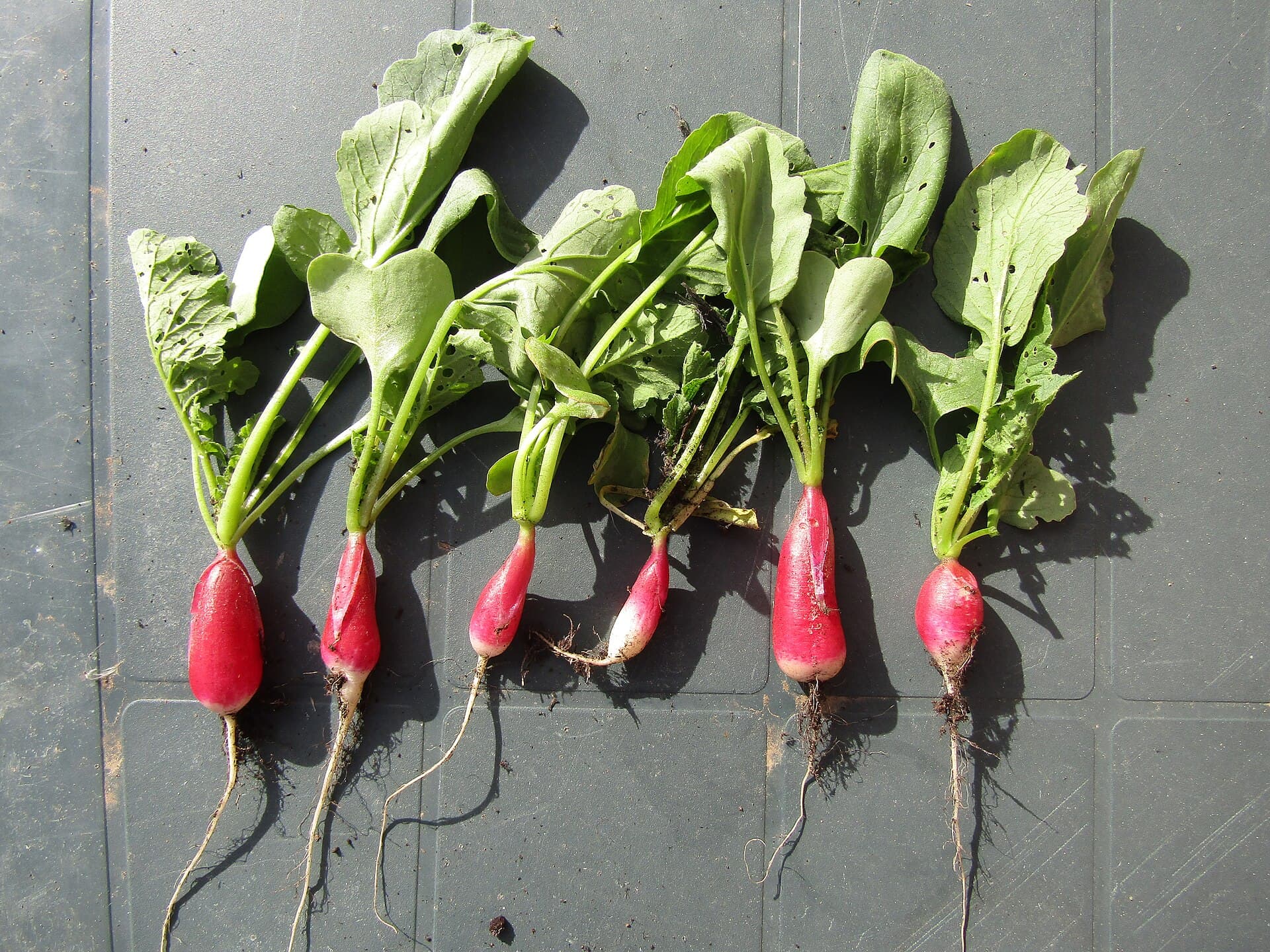
Growing guide
How to grow radishes
The fastest crop in the garden, and the one most often ruined by kindness. All top and no root has three distinct causes, and crowding is only the first of them.
Raphanus sativus · Brassicaceae, with cabbage, kale, turnip and mustard
Above: Kolforn · CC BY-SA 4.0

easy. Genuinely the easiest thing here, and the fastest, three or four weeks from sowing to eating. The only real skill is restraint: thin them, and stop sowing when summer arrives.
At a glance
- Family
- Brassicaceae (cabbage family)
- Life cycle
- Annual
- Hardiness
- Hardy, tolerates real frost
- Sowing method
- Direct sow only
- Germination
- 3–7 days. Among the fastest there is
- Soil
- Loose, stone-free, not freshly manured
- Sun
- Full sun in spring, part shade in summer
- Days to maturity
- 22–30 for spring types
- Spacing
- 2″ apart in rows 10″ apart
- Biggest single risk
- Sowing in summer heat
When to sow, where you actually live
Every other guide prints a month, and a month is only true somewhere. What transfers between locations is the offset: radish go in about 4 weeks before the last spring frost, wherever that falls for you. Give us a ZIP and we will count it from your own NOAA weather station.
Current spacing: 2″ apart in rows 10″ apart, sown 0.5″ deep. Roughly 22–30 days to a first picking, though variety moves that more than any general figure admits.
Get your sowing dates →All leaves and no root: the three causes
This is the radish complaint, and it has three separate causes. Most guides name one.
The first is crowding. Radish seed is large enough to handle and small enough to over-sow, and a crowded row makes leaves competing for light instead of roots. They need about two inches each, which looks absurdly generous when the seedlings are up and is not. Thin at the seedling stage, within a week or so of emergence, and eat the thinnings.
The second is heat. Radish is a cool-season crop, and above about 75°F it stops making a root and runs to flower instead. A summer sowing produces exactly the tall leafy plant people describe, no matter how well thinned. This is why the crop belongs to spring and autumn, and why sowing every fortnight from midsummer is wasted seed.
The third is nitrogen. Ground freshly manured or heavily fed produces lush foliage at the expense of the root, in a crop where the root is the point. Radishes want ordinary, unenriched soil, and they are one of very few things that genuinely do better in ground you have not improved.
So the fix is: thin properly, sow in cool weather, and do not feed them.
- Crowding, heat and nitrogen each produce leaves instead of roots.
- Two inches apart. It looks like too much room and it is not.
- Do not feed them and do not sow into freshly manured ground.
Sowing little and often
Direct sow only, a radish is a root and it will not transplant.
Sow half an inch deep, about an inch apart, in rows ten inches apart, and thin to two inches. Our figures sit close to the 1912 hand-cultivation column, which gives rows twelve to eighteen inches apart at eight to twelve plants to the foot.
Sow a short row every ten days or two weeks from early spring, and stop when the weather warms. A radish row that all matures at once gives you far more radishes in one week than anybody wants, and they do not hold in the ground.
Start about four weeks before your last frost, they tolerate real cold, and resume in late summer for an autumn crop, which is often better than the spring one because the plants size up as the weather cools rather than as it heats.
The old trick of sowing radish along a row of slow-germinating carrots or parsnips is worth doing. The radishes come up in days and mark the row, and they are pulled and gone before the carrots need the space.
- Sow short rows every ten days, and stop when it warms up.
- Autumn sowings are often better than spring ones.
- Sow them along carrot rows as markers, up in days, gone in weeks.
Pull them young
A radish has a narrow window. Left in the ground past its size it turns woody, hollow, unpleasantly hot, and eventually splits.
Check by scraping soil from the shoulder of one rather than pulling at random. Spring types are best at about an inch across, and there is nothing to gain by waiting.
Heat and drought both make them hotter. A radish grown fast in cool moist soil is mild and crisp; the same variety grown slowly in dry summer soil is fierce. If yours are too pungent, the answer is a cooler sowing date and steadier water, not a different variety.
Do not throw the tops away. Radish leaves are edible, peppery, and good cooked like any other brassica green, which is worth knowing given how much leaf the crop makes.
And if a few bolt, let them. The seed pods that follow are crisp, hot and excellent raw, and some varieties are grown for the pods alone.
- Pull at about an inch across. Waiting gains nothing and loses texture.
- Excess heat in the flavour means heat or drought in the growing.
- The leaves are good cooked, and the green seed pods are good raw.
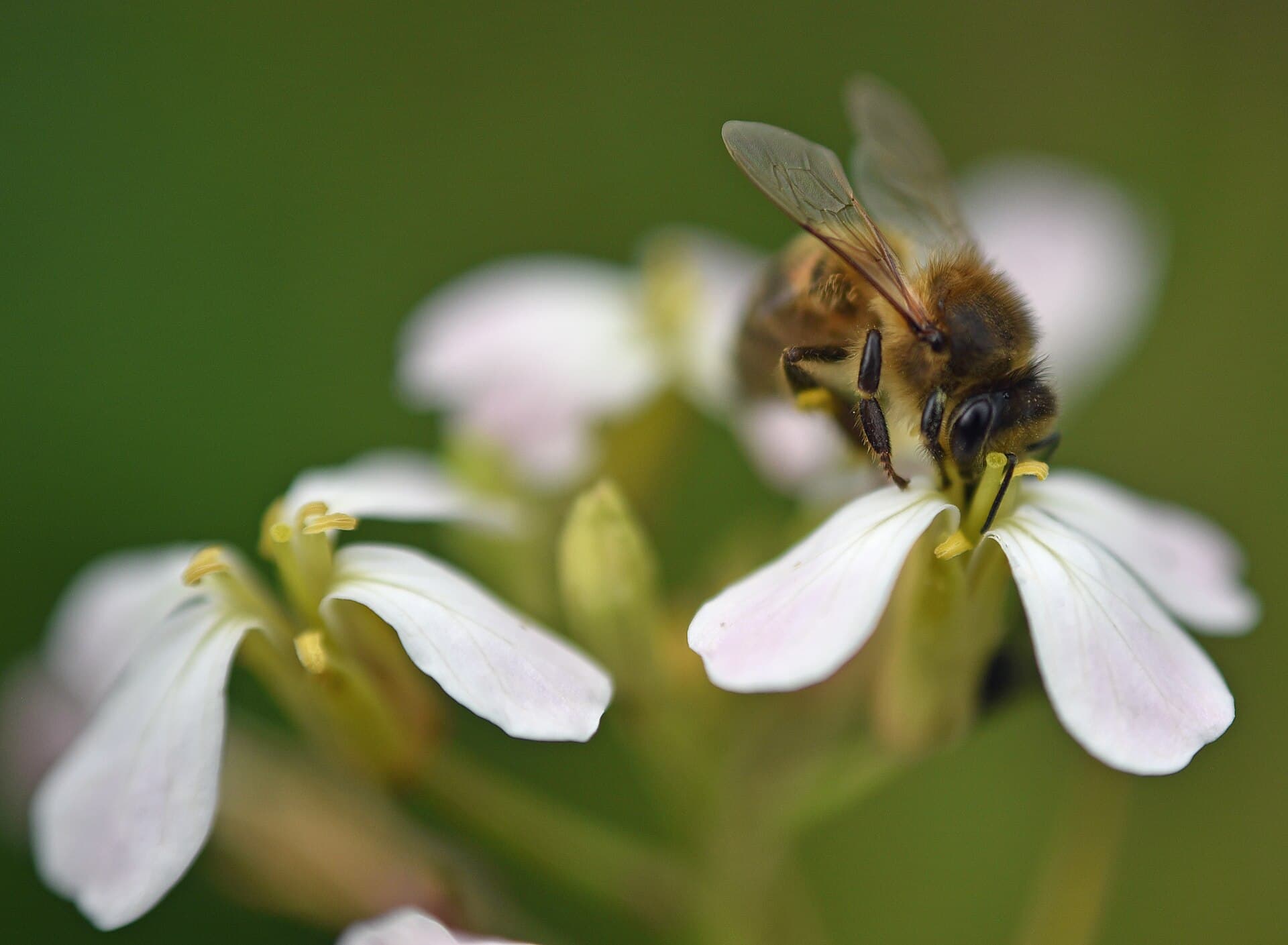
A radish nobody pulled. Letting a few run gives you the crisp green seed pods, and if you are saving seed, this photograph is also the problem: an insect moving between flowers is exactly how your variety crosses with the neighbour's.
Conall · CC BY 2.0
_-_Flickr_-_conall....jpg)
Flea beetle, and the root maggot
Flea beetle is the one you will see: tiny black beetles that jump when disturbed and pepper the leaves with small round holes, exactly as in the photograph at the top of this page. On most brassicas that is a real problem. On radish it usually is not, the crop is so fast that the plant outgrows the damage, and the part you eat is underground. Heavy attack on seedlings can check them, and floating row cover from sowing prevents it entirely.
Cabbage root fly is the one that matters, because its maggots tunnel the root itself. The damage is invisible until you pull a radish full of brown channels. Fine mesh from the day of sowing is the effective control, along with rotation away from where brassicas grew.
Slugs take seedlings in a wet spring, which in a maritime climate is most springs.
Rotation deserves a note that beginner guides skip: radish is a brassica. It belongs in the same rotation group as cabbage, kale, broccoli and turnip, and following one with the other concentrates exactly the pests both share. It is easy to forget because radish looks nothing like a cabbage.
Sources
- Flea beetle holes look worse than they are, the crop outruns them.
- Root maggot tunnels the root itself, and mesh from day one is the fix.
- Radish is a brassica. Rotate it with cabbage and kale, not with carrots.
The winter radishes nobody grows
Everything above is about the small fast spring radish. There is a second group, and it is a genuinely different crop.
Winter radishes, Black Spanish, daikon, the large Chinese sorts, are sown in mid to late summer, take two or three months, grow to the size of a parsnip, and store for months in damp sand or in the ground under mulch. They are milder and denser than spring radishes and are used cooked, pickled and grated as much as raw.
Burr treats them as their own category in 1863, splitting his twenty-eight varieties into spring-and-summer and autumn-and-winter groups. Eight of his are winter types. They quietly left American gardens over the following century and never left Asian ones, which is why a daikon is easier to buy than to find on a seed rack.
They are worth trying for a practical reason as well as a historical one: sown in late summer, they occupy the gap after an early crop comes out, and they are one of very few things that will give you a substantial root harvest from an August sowing.
Daikon is also grown as a soil crop, a deep-rooting cover that punches through compaction and then rots in place over winter, which is the tidiest use of a vegetable most people never eat.
- Winter radishes are a different crop: sown late, big, and they store.
- Eight of Burr's twenty-eight were winter types. Most have left our seed racks.
- Sown in August, daikon also works as a deep-rooting cover crop.
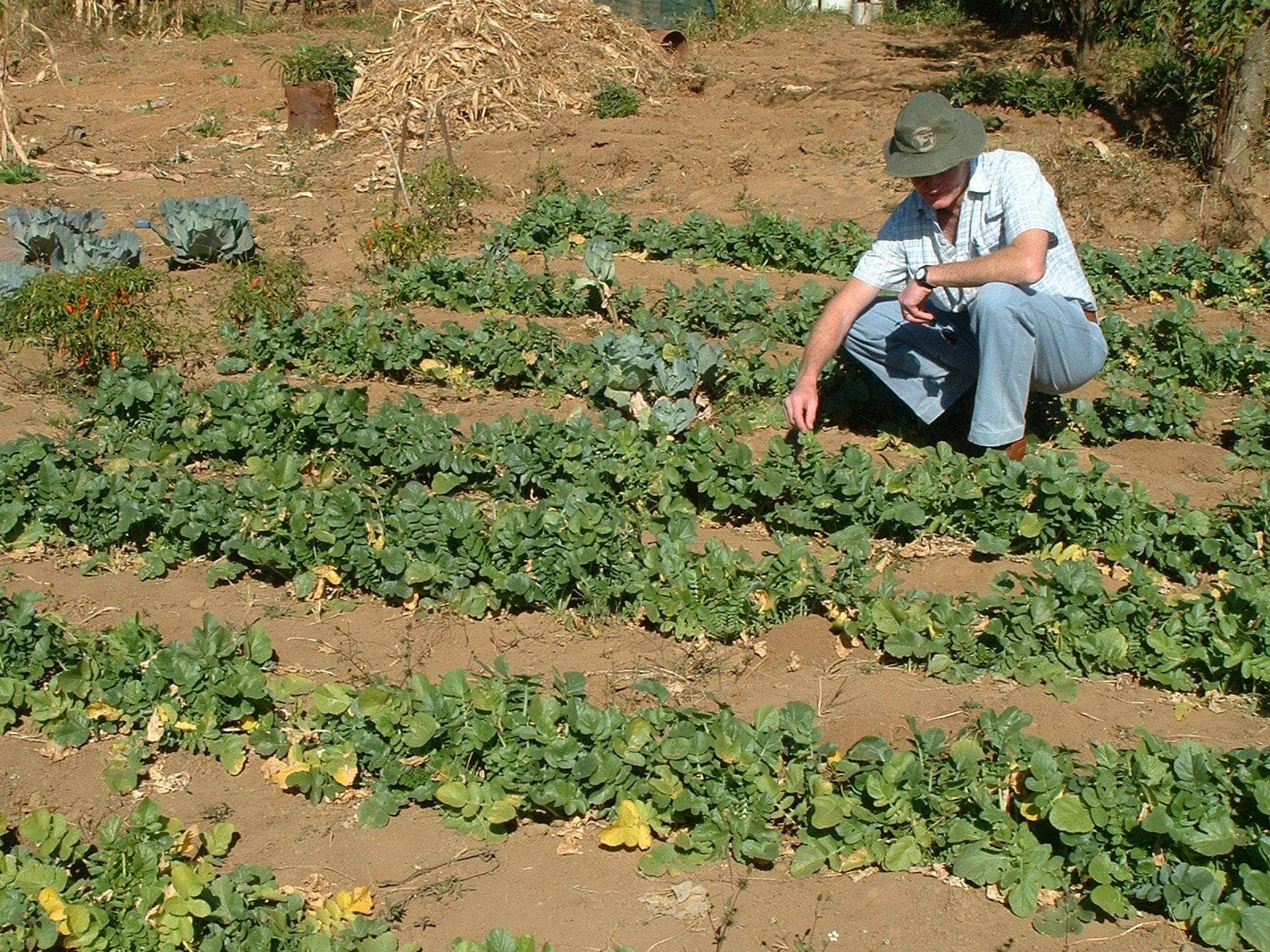
Daikon in rows, with a grower for scale, a different crop from the salad radish at the top of this page. Note the dry sandy ground: this is the drought-tolerant winter crop, and the deep root that breaks up compaction is entirely out of sight here.
KwaZulu-Natal Midlands
Alandmanson · CC BY 4.0

How this crop used to be spaced
A single spacing figure reads as a fact about the plant. It is not, it is a judgement about your cultivation method and your water, and two books on our shelf disagree with our figure and with each other for reasons worth knowing.
- 1912, worked by hand
- Rows 12 to 18 in., plants 8 to 12 to ft., sown 1/2 to 1 in.deep. That is the hand-cultivation column, the same table's horse column is far wider, because a horse and cultivator had to walk between the rows, and quoting that one is how old manuals got their reputation for wasting ground. We reproduce the table in full.
Which type to grow
Grouped by what each is for rather than by catalogue order, because the useful question is which one suits your ground.
Round red spring radishes
Globe, an inch acrossBest for: Speed
Cherry Belle and its relatives, the default radish, three to four weeks, and the right thing for a first sowing or a child's row. Burr's Early Scarlet Turnip-rooted is the same plant under an older name.
French Breakfast radishes
Elongated, red with a white tipBest for: Flavour, and the classic look
Milder than the round reds and prettier, which is the type in the photograph at the top of this page. Slightly less forgiving of being left in the ground too long.
White and icicle radishes
Long, tapering, whiteBest for: Mildness and a longer season
Generally milder and slower to turn hot than the reds, and better able to stand a little warmth. Burr's Long White and White Turnip-rooted are the ancestors.
Winter radishes
Very large, round or long, black-skinned or whiteBest for: Storage, and an August sowing
Black Spanish and the Chinese types. Sown midsummer, harvested in autumn, stored for months. A genuinely different crop from a spring radish, and the part of Burr's list that has most nearly disappeared from Western gardens.
Daikon
Very long, white, mildBest for: Cooking, pickling, and breaking up compacted soil
The winter radish that stayed common in Asia while the European ones faded. Doubles as a cover crop: it drills through a pan, then dies and rots in place over winter.
What went wrong
Listed by what you can see, not by what the plant has, you arrive here holding the evidence and without the vocabulary. Where the answer is that nothing can be done this year, it says so.
Big leafy plants with no root
Fixable nowWhy: Crowding, warm weather, or too much nitrogen, often more than one at once.
What to do: Thin to two inches within a week of emergence. Sow in cool weather rather than summer, and use unenriched ground. Radish is one of the few crops that does worse in improved soil.
Roots woody, hollow or unpleasantly hot
Fixable nowWhy: Left in the ground too long, or grown slowly in heat and drought.
What to do: Pull at about an inch across. Sow earlier or later in the year, and keep the water steady, a fast radish is a mild one.
Roots split
Fixable nowWhy: Heavy watering or rain after a dry spell, or simply over-maturity.
What to do: Use split roots immediately. Water evenly and pull the row younger.
Small round holes all over the leaves
Fixable nowWhy: Flea beetle.
What to do: Usually ignorable, the crop grows faster than the damage and you eat the root. If seedlings are being checked, cover with fleece from the day of sowing.
Brown tunnels through the root
Next seasonWhy: Cabbage root fly maggots.
What to do: Cover with fine mesh from sowing, and rotate away from ground that grew brassicas, remember radish is one.
Plant runs straight to a flower stem
Fixable nowWhy: Bolting, from heat or long days.
What to do: Let a few go and eat the green seed pods, which are crisp and peppery. Move sowings to spring and autumn.
Patchy germination
Fixable nowWhy: Crusted soil surface, or seed sown too deep.
What to do: Radish is one of the fastest germinators there is, so patchiness usually means the seedbed capped after rain. Sow half an inch deep into a fine surface and keep it damp.
28 kinds, in 1863
Twenty-eight in 1863, and Burr organises them exactly as a grower would rather than alphabetically: spring and summer radishes first, then autumn and winter ones. That second group of eight, Black Spanish, Long Black Winter, and three Chinese sorts, is the interesting half. Those are the large storage radishes, and they have very nearly vanished from Western seed racks while remaining entirely ordinary in Asia. The daikon in a supermarket is a survivor of a category his book treats as unremarkable.
Early Black · Early Long Purple · Early Purple Turnip-rooted · Early Scarlet Turnip-rooted · Early White Turnip-rooted · Gray Olive-shaped · Gray Turnip-rooted · Long Purple · Long Salmon · Long Scarlet · Olive-shaped Scarlet · Purple Turnip-rooted · Scarlet Turnip-rooted · Small, Early, Yellow Turnip-rooted · White, Crooked · White Turnip-rooted · Yellow Turnip-rooted · Long White · Long White Purple-top · New London Particular · Oblong Brown · Black Spanish · Large Purple Winter · Long Black Winter · Long-leaved White Chinese · Purple Chinese · Rose-colored Chinese · Winter White Spanish
Our reading of twenty-two tomatoes →What’s in radish
Per 100 grams raw, from USDA FoodData Central. The range is what USDA actually measured across its samples — it is usually wide, and your own crop sits somewhere in it rather than on the headline number.
| Nutrient | Per 100 g | % daily | Range measured |
|---|---|---|---|
| Vitamin C | 14.8 mg | 16% | 3.8–25.1 (n=16) |
| Folate | 25 µg | 6% | 7–64 (n=19) |
| Fibre | 1.6 g | 6% | 0.7–2.7 (n=8) |
| Potassium | 233 mg | 5% | 177–308 (n=25) |
| Magnesium | 10 mg | 2% | 7–14 (n=25) |
| Calcium | 25 mg | 2% | 15–35 (n=26) |
| Iron | 0.34 mg | 2% | 0.15–0.8 (n=24) |
| Protein | 0.68 g | 1% | 0.3–1.51 (n=19) |
| Vitamin K | 1.3 µg | 1% | 0.5–3.1 (n=7) |
| Vitamin A | 0 µg | 0% | , |
| Water | 95.27 g | , | 93.1–96.95 (n=21) |
| Energy | 16 kcal | , | , |
Source: USDA FoodData Central, “Radishes, raw” (SR Legacy, published 4/1/2019). Percentages are of the FDA adult Daily Value, a labelling reference rather than a personal requirement. Raw values; boiling leaches water-soluble vitamins and some carotene, so a cooked serving is not the same figure.
What the wartime archive says about radish
3 passages from the USDA’s 1943–46 victory garden material, with our note on whether each still holds. Pulled from the annotations themselves rather than listed here by hand.
- What not to dryStill holds
Home drying doesn't suit lettuce, melons, cucumbers, radishes. Asparagus can be dried, but is not so good as most dried vegetables.
Oven drying the surplus
- Winter radishes are a different cropStill holds
One of the members of our club who has gardened for years is always recommending winter radishes... But be sure you ask for winter radish seeds when you buy them because they are different from spring radishes.
Working the garden year · August 16, 1944
- A row cover, in 1943Still holds
Small seedlings may be protected from insects by covering them with an inverted glass jar or by completely covering them with a light paper or muslin hood. Such hoods are usually about 8 inches in diameter and are supported by wire or woode…
Pests and diseases · “Insect Control in the Victory Garden”, 1943
Saving your own seed
Easier than most outcrossing crops, for one structural reason: radish is an annual. It flowers and sets seed in the same season, so there is no winter storage or replanting step of the kind beetroot and carrot demand.
The method is to stop eating. Leave a few of your best plants, chosen for root shape and for being slow to bolt, not just for having bolted first, and let them run. They grow tall, flower white or pale lilac, and set fat pods.
Let the pods dry to brown and brittle on the plant, then crush them to release the seed. The pods are tough compared with most vegetable seed heads, so expect to work at it.
The real constraint is isolation. Radish is insect-pollinated and crosses freely with every other radish variety and with wild radish where it grows, so half a mile is the honest figure and twenty to forty plants the sensible population. Growing one variety at a time is the practical answer for most gardens.
Seed keeps four to five years, so one good plant supplies you for a long time.
Farm rooted clothing · Est. 2005
The guides are free. The shop is the business.
Sun & Rain Works is a small apparel outfit in Eugene, Oregon, with agricultural roots and a slow path toward farming. The radish guide you just read comes from the same place as the shirts.
More growing guides
We're working through the vegetables one at a time, with dates counted from your own frost station and the old books read properly. Occasional notes from Eugene, Oregon, an art business with agricultural roots, working its way toward farming.
We'll email you to confirm before sending anything. After that, occasional seasonal notes from Sun & Rain Works, we won't share your address, and every email has an unsubscribe link.
Growing advice here is current horticultural practice, drafted with AI assistance and checked against the sources this page names. Where it quotes a book, the book is named and linked. Where practice is genuinely contested, or local enough that we would be guessing, the text says so, your county extension service beats any national guide, including this one, on pest timing.
The photographs are not AI-generated. Every one is our own work, public domain, or licensed, and carries its author and licence beneath it.