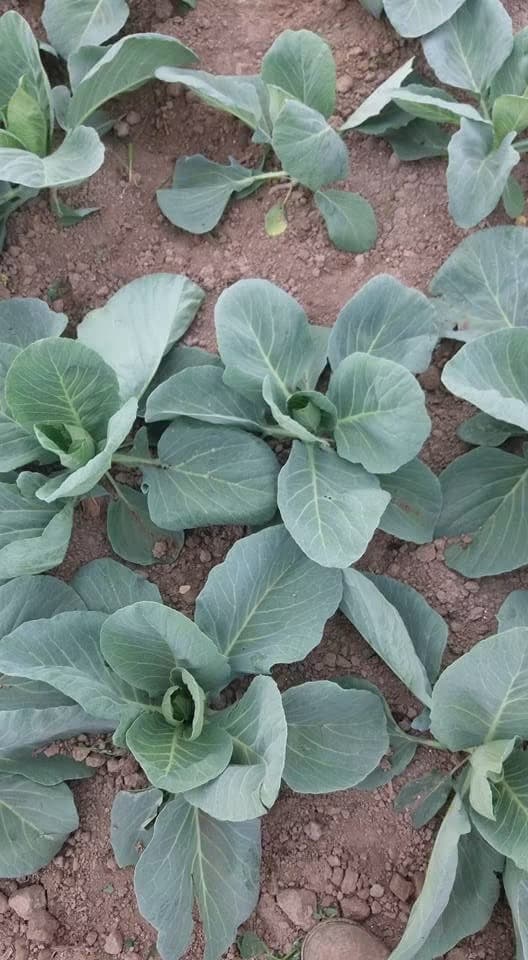
Growing guide
How to grow cabbage
One of the oldest cultivated vegetables and one of the most forgiving, provided you get three things right: room, firm ground, and a rotation you actually stick to.
Brassica oleracea var. capitata · Brassicaceae, with kale, broccoli, cauliflower and Brussels sprouts
Above: Sun & Rain Works · © Sun & Rain Works
moderate. Undemanding to grow and easy to grow badly. Nothing about the plant is delicate; the difficulty is that it wants more room than seems reasonable, and that the cabbage-family pests are relentless.
At a glance
- Family
- Brassicaceae (cabbage family)
- Life cycle
- Biennial, grown as an annual
- Hardiness
- Hardy, savoys take hard frost
- Sowing method
- Start and transplant; direct sowing works too
- Germination
- 5–10 days in warm soil
- Soil
- Rich, firm and limed. Heavy feeder
- Sun
- Full sun
- Days to maturity
- 65–90 from transplant, by type
- Best season
- Spring and autumn; savoys stand through winter
- Biggest single risk
- Clubroot, which is permanent
When to sow, where you actually live
Every other guide prints a month, and a month is only true somewhere. What transfers between locations is the offset: cabbage go in about 2 weeks before the last spring frost, wherever that falls for you. Give us a ZIP and we will count it from your own NOAA weather station.
Current spacing: 15″ apart in rows 24″ apart, sown 0.25″ deep. Roughly 65–90 days to a first picking, though variety moves that more than any general figure admits.
Get your sowing dates →Spacing is a decision about head size
The most common cabbage disappointment is a row of small hard heads, and it is almost always a spacing problem. A cabbage builds its head out of what its leaves capture, so a plant with more room makes a bigger head, the relationship is that direct, and it means spacing is not a rule to follow but a choice about what you want.
Our calendar gives cabbage fifteen inches in the row with twenty-four between, which produces a good household-sized head. The 1912 table, hand-cultivation column, gives twelve to eighteen inches in rows twenty-four to thirty inches apart, near enough the same answer, a century earlier. Solomon, growing without irrigation, separates early savoys by about thirty inches and gives the big late ones four feet, or sixteen square feet each.
If you want small heads for a small household, plant closer deliberately and harvest younger. What does not work is planting close by accident and hoping.
The other half of the spacing question is firmness. Brassicas want ground that has settled, not ground freshly forked into a fluffy tilth, a loose-planted cabbage rocks in the wind, chafes its stem, and sulks. Firm each transplant in hard enough that a tugged leaf tears rather than the plant lifting.
- More room means a bigger head. Spacing is a choice, not a rule.
- 15–18 inches apart gives a household head; four feet gives a giant.
- Firm ground and firm planting. A rocking brassica never thrives.
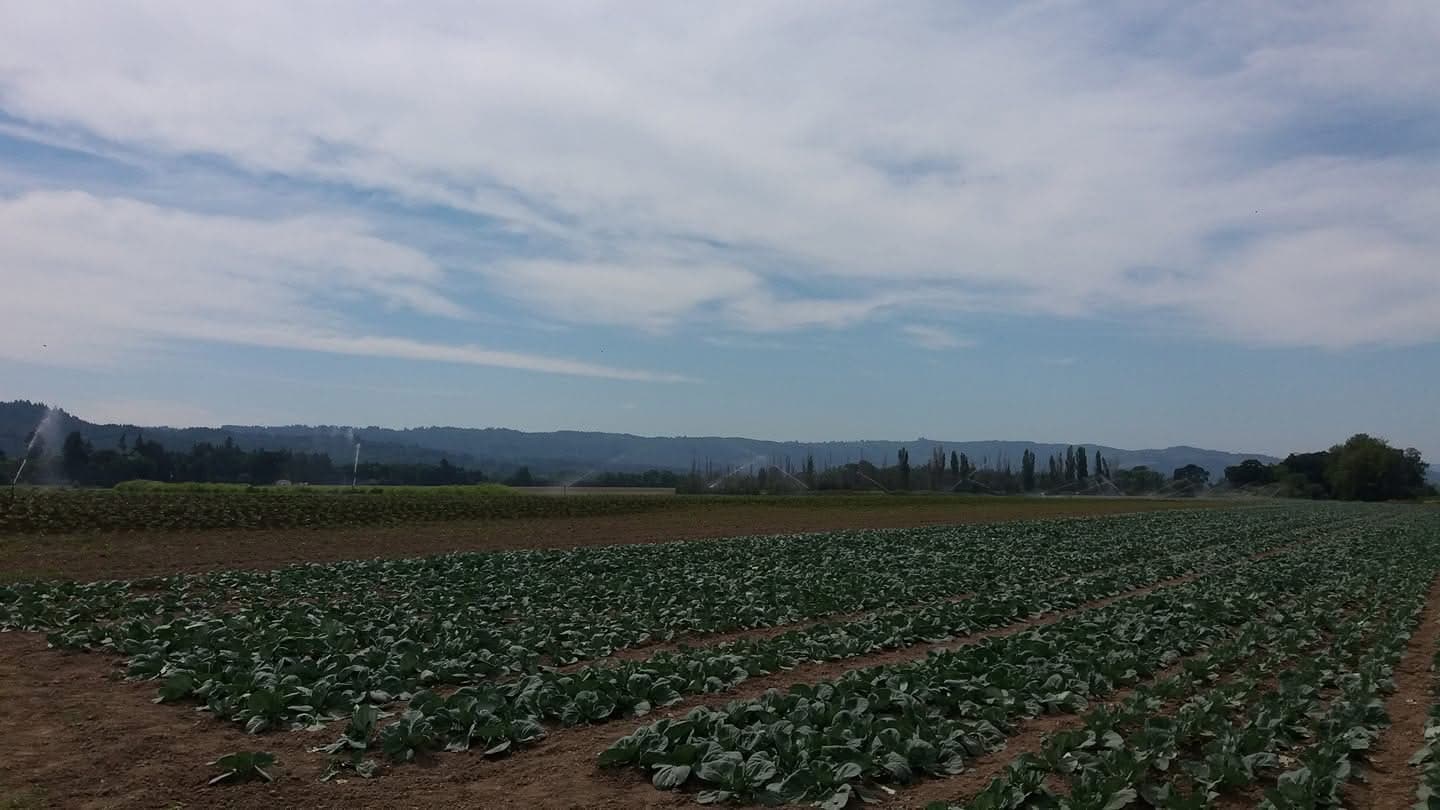
Frame one of five: the block newly planted and irrigated. At this stage the spacing looks absurdly generous, that impression is exactly what makes people crowd their own cabbages, and it is wrong.
Sauvie Island, Oregon
Sun & Rain Works · © Sun & Rain Works
Rich, and limed
Cabbage is a heavy feeder and it occupies its ground for a long time, so the fertility has to be there before you plant. Compost or well-rotted manure dug in ahead of the crop, plus a nitrogen-leaning feed once the plants are away, is the whole regime.
Lime matters more than the feeding does. The cabbage family prefers soil near neutral, and acidic soil, the maritime Northwest's default, both weakens the crop and encourages clubroot, which is the one cabbage problem you genuinely cannot undo. A soil test is the single most useful thing to know about a brassica bed and it need only be done once every few years.
Where clubroot is already suspected, the regional handbook is more specific than near neutral, and worth following exactly: lime to bring the soil above pH 7, in the range 7.3 to 7.5, put it on the year before the crop rather than at planting, and mix it thoroughly through the soil instead of scattering it on the surface. That is a higher target than the plant itself needs. It is aimed at the disease rather than the cabbage.
Water steadily rather than heavily. Cabbage is not especially thirsty, but it is very sensitive to the pattern: a plant that dries out, forms a firm head, and then gets a soaking will split, because the inside starts growing again and the outside cannot stretch. That is the mechanism behind almost every split cabbage.
Sources
- Feed before planting; a hungry cabbage makes a small head and stops.
- Test and lime. Acid soil is where clubroot thrives.
- Against clubroot the target is pH 7.3 to 7.5, limed a year ahead.
- Steady water. Drought then deluge is what splits a head.
Weeding, and why it matters more than it looks
A young cabbage is a small plant sitting in a large amount of open ground, and that open ground grows weeds faster than it grows cabbage. Weeds compete for exactly the nitrogen and moisture the crop needs during the weeks it is building the frame that will later build the head, so weeding early is not tidiness, it is yield.
The two photographs below are the same block a short time apart, and they make the case better than any argument. In the first, weed pressure is building between plants still too small to shade the ground. In the second the weeds have been cleared by hand and left lying between the rows, which is worth noticing: pulled weeds left on the surface in dry weather dry out, die, and return their moisture and nutrients to the bed rather than being carted away.
Once the plants are large enough for their leaves to close over the soil, they suppress weeds themselves and the job is largely done. Everything before that point is the work.
- Weeds cost yield during the frame-building weeks, not later.
- Hand-pulled weeds left lying in dry weather die and feed the bed.
- Once leaves close over the soil, the crop weeds itself.
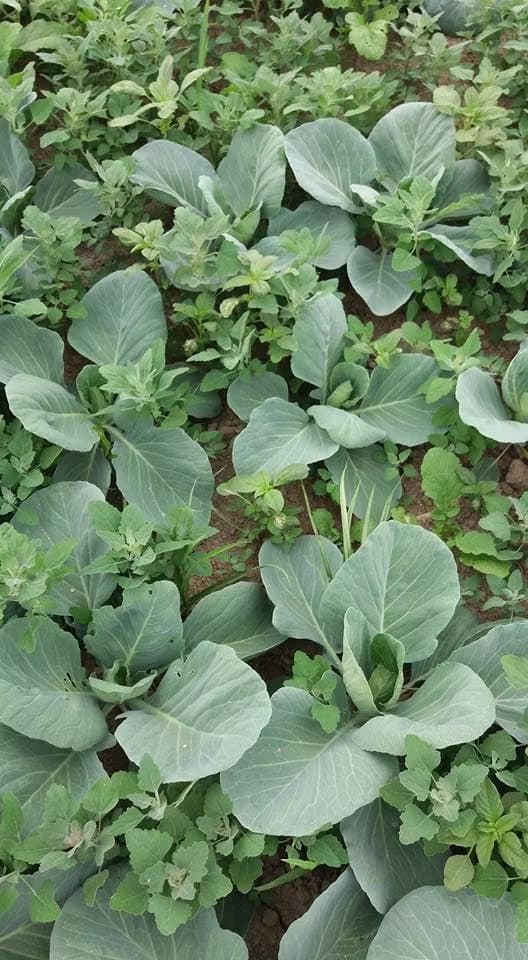
Frame three: weed pressure building between young cabbage. The crop is not yet big enough to shade its own ground, which is precisely the window in which weeds cost you head size.
Sauvie Island, Oregon
Sun & Rain Works · © Sun & Rain Works
The cabbage-family pests, in order of nuisance
Cabbage white caterpillars are the visible problem: they shred leaves and then work into the head, where they are very difficult to get out. Fine insect mesh over hoops from the day of planting prevents the butterfly laying at all, and is far more effective than anything done afterwards. Where they get in, hand-picking works on a small planting and Bacillus thuringiensis on a large one, though with Bt the timing decides whether it works at all: it is very effective on young caterpillars and much weaker once they are large, so it is a spray for the week the first holes appear rather than the week you get round to it. The strain to look for is kurstaki, sold as Btk, and some formulations of it are OMRI listed for certified organic growing.
Cabbage root fly maggots attack the stem base and can kill a young transplant outright. A collar of card or roofing felt laid flat on the soil around each stem stops the fly laying where it needs to, costs nothing, and is one of the highest-return five minutes in the vegetable garden. Floating row cover does the same job across a whole bed and the regional handbook rates it highly, with one catch worth knowing before you depend on it: over ground that carried an infested brassica crop last season, the cover seals the overwintering flies in with the plants rather than keeping them out. On that ground, rotate first and cover second.
Cabbage aphids form dense grey colonies in the growing point and between the outer leaves. Catch them early; once they are inside a forming head you have lost that plant.
Slugs take young transplants, particularly in a wet spring, and mostly stop being a problem once the plant has half a dozen leaves.
And clubroot, which is in a category of its own because it is permanent. It distorts the roots, wilts the plant in sun, and once in a bed it stays for many years. There is no cure. The management is liming to the target in the soil section above, the longest rotation you can manage, raising plants in large pots so they go out big enough to outrun early infection, and, most importantly, never importing soil or brassica transplants from an infected garden.
Sources
- PNW Insect Management Handbook, Broccoli, Brussels sprout, cabbage, cauliflower, Imported cabbageworm
- PNW Insect Management Handbook, Broccoli, Brussels sprout, cabbage, cauliflower, Cabbage maggot
- PNW Insect Management Handbook, Broccoli, Brussels sprout, cabbage, cauliflower, Aphid
- PNW Plant Disease Management Handbook, Cabbage and Cauliflower, Clubroot
- Mesh from planting day is the single most effective measure.
- Bt is for small caterpillars. On large ones it mostly does not work.
- A card collar around each stem stops cabbage root fly for nothing.
- Clubroot is permanent. Lime, rotate, and never import soil or plants.
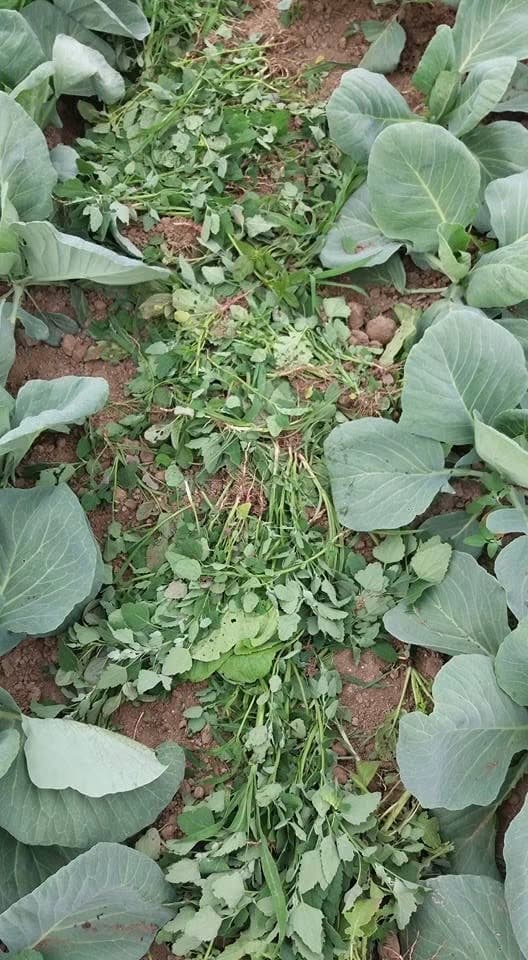
Frame four: the same rows cleared. The pulled weeds have been left where they fell rather than removed, in dry weather they wilt and break down in place, which is both less work and better for the bed.
Sauvie Island, Oregon
Sun & Rain Works · © Sun & Rain Works
Cutting, splitting, and the second crop most people miss
Cut when the head feels solid to a firm squeeze. A head left past that point in wet or fast-growing weather will split, and a split head does not store and rots quickly in the field.
If you can see splitting coming, a firm head, and rain forecast after a dry spell, you can buy time by breaking some of the roots. Take hold of the plant and give it a sharp quarter-turn, or push a spade down on one side. It sounds brutal and it works: less water reaches the head, and growth slows enough to hold it for another week or two.
The trick most gardeners never learn: leave the stump in the ground. Cut the head off cleanly, leave the stalk and its outer leaves, and score a shallow cross in the top of the cut stump. Within a few weeks it will push out a cluster of small secondary heads, not a second full cabbage, but a genuinely useful crop of loose greens from a plant you had finished with.
For storage, cut with a few outer leaves left on, keep it cold and humid, and check regularly. Dense winter varieties and red cabbages keep for months in the right conditions; loose summer types keep for days.
- Cut when solid. Past that, rain splits the head.
- A sharp quarter-turn breaks roots and buys a week or two.
- Score the cut stump and it makes a second crop of small greens.
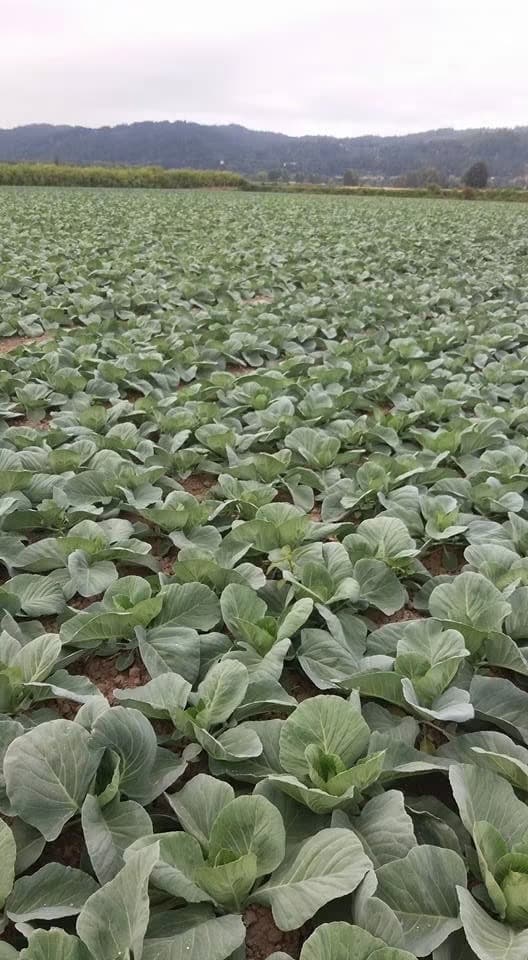
The block at scale, under the overcast that makes cabbage growing straightforward here. Cool, damp and slow is exactly what this crop wants, which is why the maritime Northwest grows it so well and why the autumn crop is usually the better one.
Sauvie Island, Oregon
Sun & Rain Works · © Sun & Rain Works
How this crop used to be spaced
A single spacing figure reads as a fact about the plant. It is not, it is a judgement about your cultivation method and your water, and two books on our shelf disagree with our figure and with each other for reasons worth knowing.
- 1912, worked by hand
- Rows 24 to 30 in., plants 12 to 18 in., sown 1/2 in.deep. That is the hand-cultivation column, the same table's horse column is far wider, because a horse and cultivator had to walk between the rows, and quoting that one is how old manuals got their reputation for wasting ground. We reproduce the table in full.
- Through a rainless summer, unwatered
- Early savoy types about 30 inches apart; later, larger ones given 4 feet, or 16 square feet each. Solomon's advice is as much varietal as spatial, he tells dry gardeners to give up on the tender supermarket cabbage entirely and grow savoys, which stand the summer on far less support. Our notes on the book.
Which type to grow
Grouped by what each is for rather than by catalogue order, because the useful question is which one suits your ground.
Early summer cabbage
Pointed or small round headsBest for: The first cut of the year
Fast, small and not for storing. Sown early under cover and set out as soon as the ground allows, they give a head while everything else is still growing. Eat them promptly, they split readily and keep badly.
Savoy
Crinkled, deeply puckered leavesBest for: Winter standing, and the best eating
The hardiest and, to most palates, the best. Solomon is emphatic that dry gardeners should give up on the tender supermarket cabbage and grow savoys, which stand a summer on far less support and a winter on none.
Late storage / Danish cabbage
Dense, heavy, flattened or roundBest for: Keeping through winter
Slow, large and worth the ground they occupy if you have somewhere cold to keep them. These are the drumheads and flat Dutch types that dominate Burr's 1863 list, which tells you how central winter storage once was.
Red cabbage
Dense, deep purple headsBest for: Pickling, salads and long keeping
Slower than green types and among the best keepers. Burr describes just four red varieties and notes they were used mainly as salad or for pickling, the same two uses that dominate now.
Chinese cabbage and pak choi
Upright, loose or barrel-shapedBest for: Fast autumn crops
A different species with different habits, much faster, much more prone to bolting from a spring sowing, and best treated as an autumn crop. Burr gives Pe-Tsai and Pak-Chöi their own entries, so their presence in American gardens is older than most people assume.
What went wrong
Listed by what you can see, not by what the plant has, you arrive here holding the evidence and without the vocabulary. Where the answer is that nothing can be done this year, it says so.
Head splits open
Fixable nowWhy: A firm head grew again suddenly after rain following a dry spell. The inside expanded faster than the outside could stretch.
What to do: Use split heads at once; they will not store. On the rest, give the plant a sharp quarter-turn to break some roots, and even out watering.
Small, hard heads on healthy-looking plants
Next seasonWhy: Crowding, or hunger. A cabbage builds its head from what its leaves gather.
What to do: Nothing recovers this year. Next season, plant further apart than feels reasonable and feed before planting rather than after.
Plant grows big leaves but never forms a head
Fixable nowWhy: Too much nitrogen late on, heat during heading, or a variety being grown in the wrong season.
What to do: Eat the leaves, they are perfectly good greens. Next time, feed early rather than late and shift the crop so it hearts in cool weather.
Plant wilts in sunshine, roots swollen and distorted
Next seasonWhy: Clubroot. Soil-borne and effectively permanent once present.
What to do: Remove and destroy the plants, never compost them. Lime the ground towards neutral, rotate brassicas as far and as long as you can, raise future plants in large pots so they go out big, and never move soil or transplants from that bed.
Young transplant collapses at the stem base
Fixable nowWhy: Cabbage root fly maggots, feeding at the root collar.
What to do: Too late for that plant. Fit a card or felt collar flat on the soil around every remaining stem, and around every transplant from now on, it costs nothing and works.
Ragged leaves and caterpillars in the head
Fixable nowWhy: Cabbage white butterfly larvae.
What to do: Pick them off; Bacillus thuringiensis for a heavy attack. Soak cut heads in salted water to float out what you missed. Next season, mesh over hoops from planting day.
Dense grey-white colonies in the growing point
Fixable nowWhy: Cabbage aphids.
What to do: Blast them off with water while they are still on the outer leaves. Once they are inside a forming head that plant is finished, cut your losses and check the others weekly.
Plant leans and rocks, stem chafed at soil level
Fixable nowWhy: Planted into loose ground, or not firmed, then worked by the wind.
What to do: Firm it back in and draw soil up the stem. Next time plant into settled ground and firm hard enough that a tugged leaf tears.
36 kinds, in 1863
Thirty-six cabbages in 1863, and the names tell you what the crop was for: Drumhead, Flat Dutch, Winnigstadt, Pomeranian, Large Late Drumhead, dense, heavy, long-keeping heads for a household that needed vegetables in February. Only four are red. Savoys, cauliflower, broccoli, kale, Brussels sprouts and colewort each get their own chapter in the same book, so the cabbage family as a whole runs far longer than this one list.
Atkins's Matchless · Barnes's Early · Bergen Drumhead · Champion of America · Early Battersea · Early Cornish · Early Drumhead · Early Dutch Twist · Early Hope · Early Low Dutch · Early Nonpareil · Early Sugar-loaf · Early Wakefield · Early York · East Ham · Green Glazed · Large Late Drumhead · Large York · Large Ox-heart · Marblehead Mammoth Drumhead · Mason · Pomeranian · Premium Flat Dutch · St. Denis · Shilling's Queen · Small Ox-heart · Stone-Mason · Sutton's Dwarf Comb · Vanack · Vaugirard Cabbage · Waite's New Dwarf · Winnigstadt · Early Dwarf Red · Large Red Dutch · Superfine Black · Utrecht Red
Our reading of twenty-two tomatoes →Related crops
Worked out from the botany rather than from a hand-written list, so it stays correct as the library grows.
- The same species
The same species, Brassica oleracea, bred in a different direction, so they cross freely, and seed saved near one another will not come true.
- The same family
Also Brassicaceae. Shares much of this crop's pest and disease pressure and belongs in the same rotation group.
What’s in cabbage
Per 100 grams raw, from USDA FoodData Central. The range is what USDA actually measured across its samples — it is usually wide, and your own crop sits somewhere in it rather than on the headline number.
| Nutrient | Per 100 g | % daily | Range measured |
|---|---|---|---|
| Vitamin K | 59.4 µg | 50% | 41.6–82.9 (n=8) |
| Vitamin C | 40.34 mg | 45% | 34.8–56.3 (n=8) |
| Potassium | 207.1 mg | 4% | 184–267 (n=8) |
| Magnesium | 13.86 mg | 3% | 9.7–18.4 (n=8) |
| Calcium | 41.84 mg | 3% | 23.1–64.1 (n=8) |
| Protein | 0.96125 g | 2% | 0.5–1.5625 |
| Iron | 0.06625 mg | 0% | 0–0.27 (n=8) |
| Water | 91.87 g | , | 90.08–93.1 (n=8) |
Source: USDA FoodData Central, “Cabbage, green, raw” (Foundation, published 10/28/2022). Percentages are of the FDA adult Daily Value, a labelling reference rather than a personal requirement. Raw values; boiling leaches water-soluble vitamins and some carotene, so a cooked serving is not the same figure.
What the wartime archive says about cabbage
12 passages from the USDA’s 1943–46 victory garden material, with our note on whether each still holds. Pulled from the annotations themselves rather than listed here by hand.
- The Department says don't save seedMostly holds
Unfortunately, no. Horticulturists of the Department of Agriculture say it might be a good plan if it would work — but it won't, especially for those vegetables you named: carrots, beets, cabbage, kale, onions and turnips. Those vegetables,…
The Question Box · August 5, 1943
- Tar-paper disksStill holds
A 3-inch tar-paper disk — cut to the center so that it will fit snugly — if placed flat on the ground and fitted around each newly set plant, will afford protection.
Victory Garden Insect Guide
- Why they had to start their ownOf its time
Other years northern gardeners have bought early tomato plants — or cabbage, pepper or onion plants that were grown in the South and shipped north. This year with labor and shipping short, you may not be able to buy these southern-grown pla…
Planning and starting · March 17, 1943
- Why your seed comes from OregonStill holds
Before the war, most seed of cabbage, kale and related crops came from Europe, where black rot and black leg are common. Now this seed is grown in the Pacific Northwest where these diseases do not occur, and so it is free from them. Beans a…
Pests and diseases · “Prevent Vegetable Diseases”, 1944
- Resistance, namedStill holds
Seed catalogs indicate the resistance of a variety after the name. Example: “Marglobe (wilt resistant).” If that is not done, the resistance is usually mentioned in the description of the variety.
Pests and diseases · “Prevent Vegetable Diseases”, 1944
- The cutworm collar, to specificationStill holds
Use for this collar a piece of lightweight cardboard about the size and stiffness of the penny postcard. The opening in the rolled paper should be about four times the size of the main stem of the plant, to permit the entrance of air and li…
Pests and diseases · “Insect Control in the Victory Garden”, 1943
- A row cover, in 1943Still holds
Small seedlings may be protected from insects by covering them with an inverted glass jar or by completely covering them with a light paper or muslin hood. Such hoods are usually about 8 inches in diameter and are supported by wire or woode…
Pests and diseases · “Insect Control in the Victory Garden”, 1943
- Hand picking, started earlyStill holds
Hand picking of the larger beetles, bugs, and caterpillars, if done consistently, will often give satisfactory control and eliminate the need for applying insecticides. This practice is most effective if started early enough to catch the fi…
Pests and diseases · “Insect Control in the Victory Garden”, 1943
- The false economy of saving seedMostly holds
It's false economy for gardeners to save seed of many vegetables from this year's garden to plant next year. Producing high grade vegetable seed is one of the most difficult jobs in the agricultural field. Experts at it work under controlle…
When things go wrong · August 2, 1945
- Don't cut it up earlyStill holds
Just remember when you're using cabbage — or any fresh vegetables or fruits — the vitamins escape rapidly once you cut or shred them, so don't prepare them too far ahead of mealtime.
Saving the crop · September 22, 1943
- Half-grown cabbage takes the frostStill holds
What can you do if you have a lot of late cabbage, that's only half grown, when frost hits the garden? Well, the garden specialists say that if cabbage is only half grown, it can stand quite a lot of freezing. It's the mature heads that can…
Saving the crop · October 4, 1944
- How to tell a cutworm from a rabbitStill holds
HEZEKIAH: Rabbits wouldn't be likely to just cut a plant off and leave it there. They'd eat it. JIM: But why on earth would a cutworm be so ornery as to — HEZEKIAH: That's where a cutworm hides — during the daytime. In fact, he's been hidin…
Consumer Time · April 24, 1943
Saving your own seed
Difficult, and worth being honest about rather than encouraging. Cabbage is a biennial, so it makes its head in year one and flowers in year two, which means overwintering plants and giving up the harvest you grew them for.
It is also awkward mechanically: a solid head does not let a flower stalk through. Growers cut a shallow cross in the top of the head in spring so the stem can emerge, which works but is fiddly.
The real obstacle is crossing. Cabbage, kale, broccoli, cauliflower, Brussels sprouts, kohlrabi and collards are all Brassica oleracea and all cross freely with each other, and with anything a neighbour has left to bolt. Growing one brassica for seed in a given year is the only reliable answer at garden scale.
And it is strongly self-incompatible, so a small saving population inbreeds badly. Twenty plants is the sensible minimum and eighty is better, which for most gardens settles the question. Buy cabbage seed and save your effort for the self-pollinating crops, where the same effort actually keeps a variety alive.
Farm rooted clothing · Est. 2005
The guides are free. The shop is the business.
Sun & Rain Works is a small apparel outfit in Eugene, Oregon, with agricultural roots and a slow path toward farming. The cabbage guide you just read comes from the same place as the shirts.
More growing guides
We're working through the vegetables one at a time, with dates counted from your own frost station and the old books read properly. Occasional notes from Eugene, Oregon, an art business with agricultural roots, working its way toward farming.
We'll email you to confirm before sending anything. After that, occasional seasonal notes from Sun & Rain Works, we won't share your address, and every email has an unsubscribe link.
Growing advice here is current horticultural practice, drafted with AI assistance and checked against the sources this page names. Where it quotes a book, the book is named and linked. Where practice is genuinely contested, or local enough that we would be guessing, the text says so, your county extension service beats any national guide, including this one, on pest timing.
The photographs are not AI-generated. Every one is our own work, public domain, or licensed, and carries its author and licence beneath it.