Growing guide
How to grow kale
Sown in summer, ignored through the drought, and then picked all winter while everything else is bare ground. No other vegetable gives so much for so little attention.
Brassica oleracea var. sabellica and acephala · Brassicaceae, with cabbage, broccoli, cauliflower and Brussels sprouts
Above: Rasbak · CC BY-SA 3.0

easy. About as forgiving as a vegetable gets, hardy, drought-tolerant for a brassica, and productive from one sowing for the better part of a year. The pests are the only real work.
At a glance
- Family
- Brassicaceae (cabbage family)
- Life cycle
- Biennial, grown as an annual
- Hardiness
- Very hardy, improves after frost
- Sowing method
- Direct sow or transplant; both fine
- Germination
- 5–10 days
- Soil
- Firm, limed, moderately fertile
- Sun
- Full sun; tolerates part shade in summer
- Days to maturity
- 55–75, and pickable long before
- Best sowing
- Late spring to midsummer, for winter
- Biggest single risk
- Aphids in the growing point
When to sow, where you actually live
Every other guide prints a month, and a month is only true somewhere. What transfers between locations is the offset: kale go in about 4 weeks before the last spring frost, wherever that falls for you. Give us a ZIP and we will count it from your own NOAA weather station.
Current spacing: 12″ apart in rows 24″ apart, sown 0.5″ deep. Roughly 55–75 days to a first picking, though variety moves that more than any general figure admits.
Get your sowing dates →Sow for winter, not for summer
Kale will grow perfectly well from a spring sowing and give you leaves all summer, and almost nobody should do that. It is at its worst in warm weather, tougher, more bitter, and a magnet for every cabbage-family pest at the point in the year when they are most active, and at its best after frost, when there is nothing else to pick.
So the useful sowing is late spring to midsummer, timed so the plants reach a decent size before growth slows in autumn. From there they stand, and you pick through the cold months.
Frost genuinely improves it, and the mechanism is the same one behind sweet parsnips and post-frost carrots: cold triggers the plant to convert stored starch into sugars, which work as antifreeze in the leaf. You taste the result. A kale leaf in November and the same leaf in August are different vegetables.
In a mild maritime winter the plants simply stand in the ground and are picked as needed, which makes kale the closest thing to a free winter vegetable there is.
- Sow late spring to midsummer for a winter crop. Spring sowings are the worst kale.
- Frost converts starch to sugar, this is real, not folklore.
- In a mild winter the plants stand in the ground and you pick as needed.
The cabbage-family crop that copes without water
Solomon ranks the brassicas by how well they dry-garden and puts kale at the head of the list, above late Brussels sprouts, late savoy cabbage, rutabaga and kohlrabi, and well above ordinary cabbage, cauliflower and Italian broccoli. His explanation is that the further this family has been bred from the wild cabbage, the more it has lost the ability to forage, and kale has been bred the least.
The practical consequence is a genuine option in a rainless summer: give the plants real room, Solomon says four feet, grown like broccoli, and they will sit stunted and gnarly through the drought without dying, then grow explosively as soon as the autumn rains return. A side-dressing of fertiliser in late September turns that recovery into a very large plant by November.
Our own calendar gives kale twelve inches in the row with twenty-four between, which assumes you will water. The 1912 table's hand-cultivation column says eighteen to twenty-four inches each way. The three figures are not in conflict, they are three different answers to the question of how much water the plant will get.
- The most drought-adapted brassica, because it is closest to wild cabbage.
- Given four feet, it survives an unwatered summer stunted and recovers fully.
- Feed when the autumn rains return and the recovery is dramatic.
Firm ground, and room
Everything true of the cabbage family is true here. Kale wants ground that has settled rather than freshly forked, soil that is not acid, and firm planting, a loose-set brassica rocks in the wind, chafes its stem and sulks.
It is a big plant and a tall one. A full-grown curly kale is a couple of feet across and, in a mild winter, will keep going into a second season and get taller still. Plant it where a two-foot plant in November will not shade something that needs the light.
Feeding is moderate rather than heavy. Kale is less hungry than cabbage or broccoli because you are harvesting leaves progressively rather than asking it to build one large structure. Too much nitrogen produces soft growth that aphids find first and frost damages more easily.
- Firm ground, firm planting, limed soil, the whole family wants this.
- Give it more room than the seedling suggests; it is a big plant.
- Feed moderately. Soft growth attracts aphids and damages in frost.

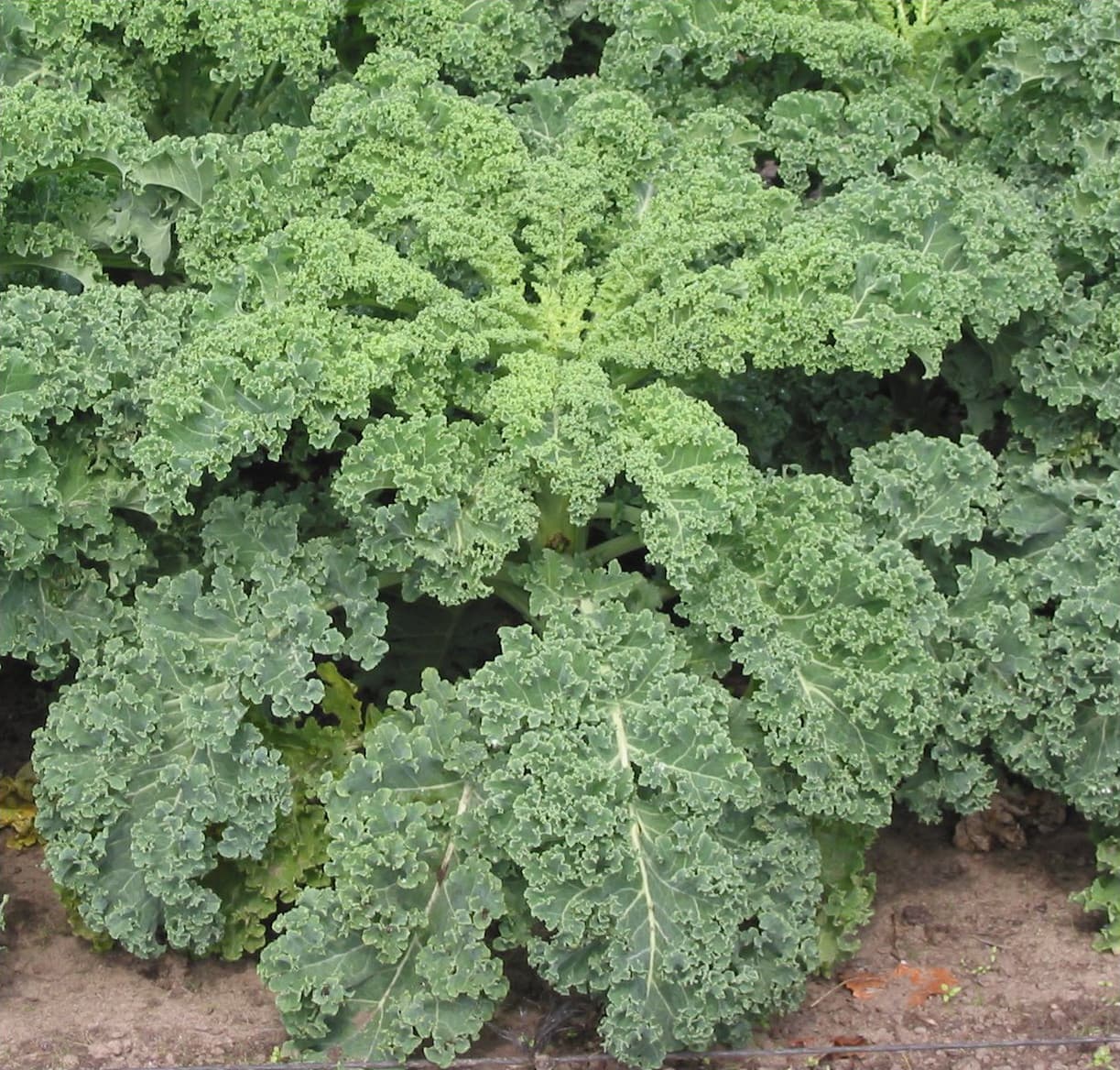
Kale at field spacing. Worth noticing how much ground each plant occupies, this is a crop people habitually plant too close because the seedlings are small and the mature plant is not.
Andy Li · CC0

Pick from the bottom, and never take the top
Kale grows from a single point at the top of its stem and produces leaves outward and downward from there. So the way to harvest it is to take the older, lower leaves and leave the growing point alone, do that and one plant keeps producing for months.
Take no more than about a third of the leaves at once. Strip a plant bare and it takes weeks to recover; take a few leaves a week and it barely notices.
The lowest leaves yellow and go tough as the plant grows on. Take those off whenever you see them, whether or not you want them, leaving them encourages slugs and holds moisture against the stem.
In spring, an overwintered plant will start to bolt and send up a flower stalk. Do not pull it immediately: the flowering shoots are excellent eating at the bud stage, essentially a sprouting broccoli, and a plant will give a fortnight of them before the stems get woody.
- Pick lower leaves, never the growing point at the top.
- A third at a time. Stripping a plant costs weeks of growth.
- In spring, eat the flowering shoots, they are as good as sprouting broccoli.
Aphids and caterpillars
The two that matter are cabbage aphids and cabbage white caterpillars, and between them they account for nearly all kale damage.
Cabbage aphids are the more serious because of where they sit. Grey-white colonies pack into the crinkles of curly varieties and down into the growing point, where washing them out is close to impossible, a badly infested plant is effectively finished. Check the growing point and the undersides of young leaves weekly through late summer, blast early colonies off with water, and leave the ladybirds and hoverflies alone to do the rest. Flat-leaved types like cavolo nero are markedly easier to clean than curly ones, which is a real argument for growing them.
Caterpillars shred leaves, as the photograph below shows, but rarely kill a plant. Fine mesh over hoops from planting day is the reliable prevention; hand-picking works on a few plants and Bacillus thuringiensis on more. Kale's saving grace is that it grows through the damage, a plant that looks ruined in August is usually fine by October.
Whitefly rise in clouds when you brush the plants and look alarming. On kale they are mostly a nuisance rather than a threat.
And clubroot, which applies to every brassica: soil-borne, permanent once present, managed by liming towards neutral and by the longest rotation you can manage.
Sources
- Aphids in the growing point are the real threat; caterpillars mostly are not.
- Flat-leaved types are far easier to clean than curly ones.
- Kale grows through damage that would finish a cabbage.
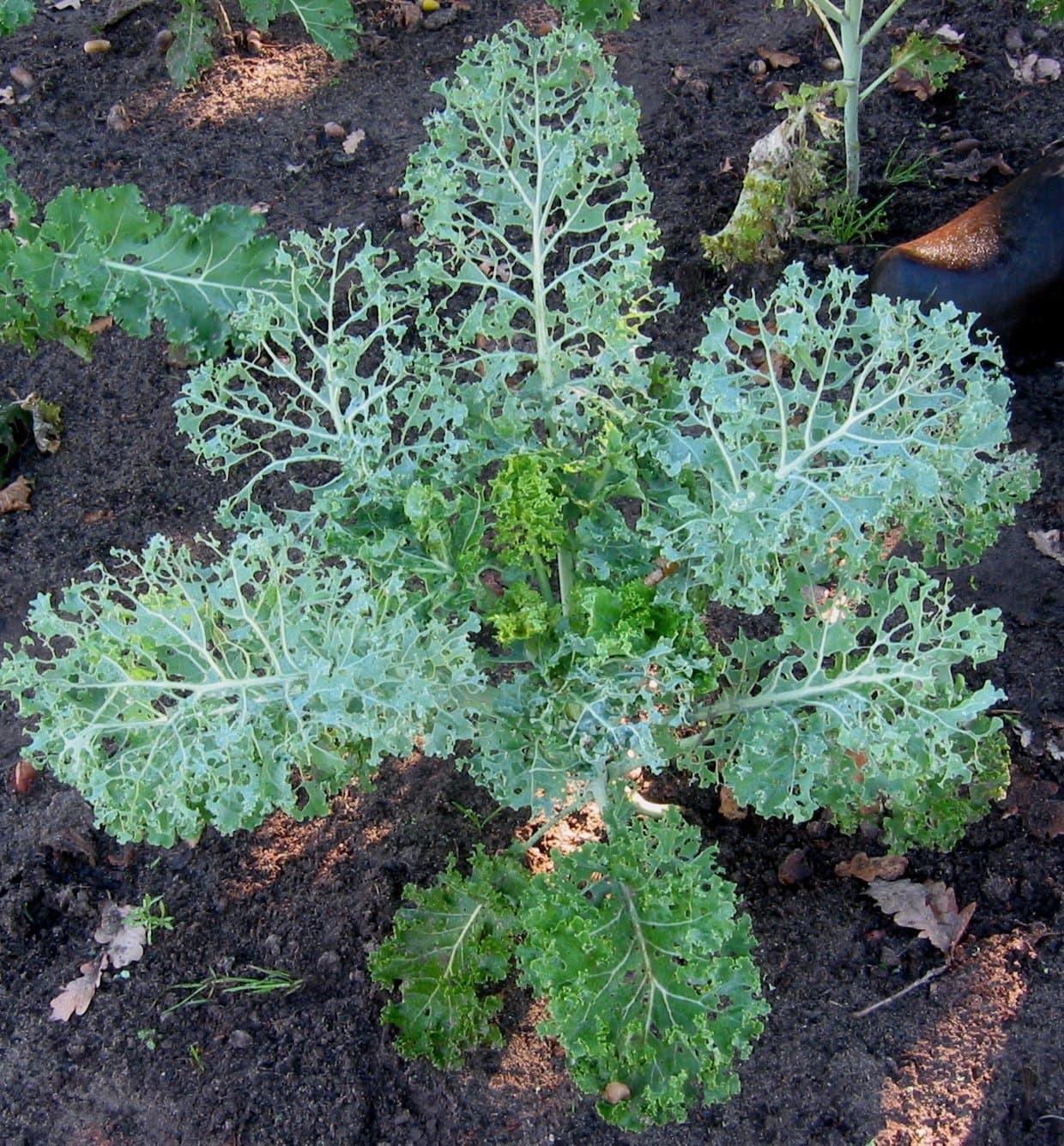
Caterpillar damage at its worst, and worth showing precisely because this plant is not dead. Kale grows through this kind of damage in a way cabbage or cauliflower cannot, which is a large part of why it is the easy one.
Rasbak · CC BY-SA 3.0

How this crop used to be spaced
A single spacing figure reads as a fact about the plant. It is not, it is a judgement about your cultivation method and your water, and two books on our shelf disagree with our figure and with each other for reasons worth knowing.
- 1912, worked by hand
- Rows 18 to 24 in., plants 18 to 24 in., sown 1/2 in.deep. That is the hand-cultivation column, the same table's horse column is far wider, because a horse and cultivator had to walk between the rows, and quoting that one is how old manuals got their reputation for wasting ground. We reproduce the table in full.
- Through a rainless summer, unwatered
- Grow like broccoli, spaced 4 feet apart. Unwatered the plants sit stunted through summer and then run away as soon as the autumn rains return. Solomon treats kale as the crop the whole dry garden is built around, and gives it room accordingly. Our notes on the book.
Which type to grow
Grouped by what each is for rather than by catalogue order, because the useful question is which one suits your ground.
Curly kale
Tightly frilled, dense blue-green leavesBest for: Hardiness and yield
The hardiest and heaviest-cropping type, and the one Burr means by Dwarf Green Curled Borecole. The frills that make it attractive also make it the hardest to get aphids out of.
Cavolo nero / Tuscan
Long, narrow, blistered dark leavesBest for: Flavour, and easy cleaning
Flat enough to wash properly, which matters more than it sounds. Burr lists it as Palm Kale, so the fashionable Italian kale of the last two decades was in an American catalogue in 1863.
Red and purple kale
Curly or flat, red-veined to deep purpleBest for: Colour, and a little extra cold-hardiness
Redbor and its relatives colour up more strongly after frost, which is the same sugar chemistry that improves the flavour made visible. Burr's Purple Borecole and Variegated Borecole are the ancestors.
Collards
Large, flat, smooth cabbage-like leavesBest for: Heat tolerance
The same species and effectively a non-heading cabbage. More tolerant of summer heat than curly kale, which is why it dominates in the American South. Burr gives Colewort, or Collards, its own entry.
Perennial and tree kales
Woody-stemmed, very tall, propagated by cuttingsBest for: Growing once and picking for years
Daubenton's and the walking-stick types persist for several years and are grown from cuttings rather than seed. Burr lists Daubenton's Creeping Borecole and Woburn Perennial Kale, so this is an old idea rather than a new one.
What went wrong
Listed by what you can see, not by what the plant has, you arrive here holding the evidence and without the vocabulary. Where the answer is that nothing can be done this year, it says so.
Dense grey-white colonies in the crinkled leaves and growing point
Fixable nowWhy: Cabbage aphids, which shelter deep in the leaf structure.
What to do: Blast early colonies off with water. Once they are packed into the growing point that plant is effectively finished, remove it rather than letting it seed the rest. Grow a flat-leaved type next time if this recurs.
Leaves shredded to lace
Fixable nowWhy: Cabbage white caterpillars.
What to do: Pick them off; the plant will grow through it. Kale recovers from damage that would end a cabbage. Mesh over hoops from planting day prevents it entirely next season.
Plant stops producing new leaves
Next seasonWhy: The growing point was picked out, or the plant was stripped bare.
What to do: If the top is gone, the plant is finished, kale grows from that single point. Take lower leaves only, and never more than a third at once.
Tall bare stem with a tuft of leaves on top
Fixable nowWhy: Normal ageing, accelerated by picking too high up the plant.
What to do: Still perfectly productive. Earth up around the stem for stability, or start a fresh sowing, a kale plant's best year is its first.
Flower stalk in spring
Fixable nowWhy: The plant is biennial and has reached its second season.
What to do: Not a problem, eat the flowering shoots at bud stage, which are excellent. Pull the plant when the stems go woody.
Soft floppy growth, worse frost damage than expected
Next seasonWhy: Too much nitrogen, usually from feeding late in the season.
What to do: Feed earlier and more moderately next time. Kale is a light feeder compared with cabbage or broccoli.
Plant wilts in sun, roots swollen and distorted
Next seasonWhy: Clubroot, soil-borne and permanent once present.
What to do: Remove and destroy; never compost. Lime towards neutral, rotate brassicas as far and as long as possible, and raise plants in large pots so they go out big enough to outrun early infection.
19 kinds, in 1863
Nineteen, filed under the older English name, Burr's heading is Borecole, or Kale. Read the list and kale's actual history is plain: Cow-cabbage, Field Cabbage, Thousand-headed Borecole and the marrow-stem types were grown to feed livestock through winter. Kale's recent career as a fashionable salad green is a very thin layer on a long history as the plant that fed animals and poor households when nothing else stood. That history is exactly why it is so hardy. Palm Kale in this list is cavolo nero, sold now at a considerable markup.
Buda Kale, or Borecole · Cabbaging Kale, or Borecole · Cock's-comb Kale · Cow-cabbage · Daubenton's Creeping Borecole · Dwarf Green Curled Borecole · Field Cabbage · Flanders Kale · Green Marrow-stem Borecole · Lannilis Borecole · Neapolitan Borecole · Palm Kale · Purple Borecole · Red Marrow-stem Borecole · Tall Green Curled · Thousand-headed Borecole · Variegated Borecole · Variegated Cock's-comb Kale · Woburn Perennial Kale
Our reading of twenty-two tomatoes →Related crops
Worked out from the botany rather than from a hand-written list, so it stays correct as the library grows.
- The same species
The same species, Brassica oleracea, bred in a different direction, so they cross freely, and seed saved near one another will not come true.
- The same family
Also Brassicaceae. Shares much of this crop's pest and disease pressure and belongs in the same rotation group.
What’s in kale
Per 100 grams raw, from USDA FoodData Central. The range is what USDA actually measured across its samples — it is usually wide, and your own crop sits somewhere in it rather than on the headline number.
| Nutrient | Per 100 g | % daily | Range measured |
|---|---|---|---|
| Vitamin K | 390 µg | 325% | 369–422 (n=3) |
| Vitamin C | 93.4 mg | 104% | 84.4–104 (n=5) |
| Vitamin A | 241 µg | 27% | , |
| Calcium | 254 mg | 20% | 203–281 (n=5) |
| Folate | 62 µg | 16% | 53–72 (n=3) |
| Fibre | 4.1 g | 15% | 4–4.2 (n=2) |
| Iron | 1.6 mg | 9% | 0.77–3.61 (n=5) |
| Magnesium | 32.7 mg | 8% | 28.4–45.8 (n=5) |
| Potassium | 348 mg | 7% | 301–389 (n=5) |
| Protein | 2.92 g | 6% | 2.25–3.81 |
| Water | 89.6 g | , | 88.8–90.2 (n=5) |
| Energy | 35 kcal | , | , |
Source: USDA FoodData Central, “Kale, raw” (Foundation, published 4/1/2019). Percentages are of the FDA adult Daily Value, a labelling reference rather than a personal requirement. Raw values; boiling leaches water-soluble vitamins and some carotene, so a cooked serving is not the same figure.
What the wartime archive says about kale
4 passages from the USDA’s 1943–46 victory garden material, with our note on whether each still holds. Pulled from the annotations themselves rather than listed here by hand.
- The Department says don't save seedMostly holds
Unfortunately, no. Horticulturists of the Department of Agriculture say it might be a good plan if it would work — but it won't, especially for those vegetables you named: carrots, beets, cabbage, kale, onions and turnips. Those vegetables,…
The Question Box · August 5, 1943
- Cut and come againStill holds
We know of another gardener who set aside a small space for this purpose last summer and by clipping off the large leaves was able to supply three people with mustard greens at least once a week for nearly three months.
Planning and starting · May 10, 1944
- Why your seed comes from OregonStill holds
Before the war, most seed of cabbage, kale and related crops came from Europe, where black rot and black leg are common. Now this seed is grown in the Pacific Northwest where these diseases do not occur, and so it is free from them. Beans a…
Pests and diseases · “Prevent Vegetable Diseases”, 1944
- One serving of kaleMostly holds
Food specialists say one serving of turnip greens or kale will give us all the vitamin A we need for an entire day, and about a third of the vitamin C and calcium we need, and a fifth of the riboflavin and iron.
Saving the crop · September 22, 1943
Saving your own seed
Hard, for the same reasons as every other Brassica oleracea. Kale, cabbage, broccoli, cauliflower, Brussels sprouts, kohlrabi and collards are one species and cross freely with each other and with anything a neighbour has left to bolt.
It is also biennial, so seed means keeping plants through a second winter, though in a mild maritime climate that is genuinely easy, and kale is the brassica most likely to survive to flower without any help.
The population requirement is the real obstacle. Kale is strongly self-incompatible, so twenty plants is a minimum and eighty is better; saving from two or three good plants produces visibly weaker seedlings within a couple of generations.
If you want to try one brassica for seed, kale is the sensible choice, it overwinters most reliably and flowers most freely. Just grow only that one brassica for seed that year, and accept that your neighbours' bolted purple sprouting is outside your control.
Farm rooted clothing · Est. 2005
The guides are free. The shop is the business.
Sun & Rain Works is a small apparel outfit in Eugene, Oregon, with agricultural roots and a slow path toward farming. The kale guide you just read comes from the same place as the shirts.
More growing guides
We're working through the vegetables one at a time, with dates counted from your own frost station and the old books read properly. Occasional notes from Eugene, Oregon, an art business with agricultural roots, working its way toward farming.
We'll email you to confirm before sending anything. After that, occasional seasonal notes from Sun & Rain Works, we won't share your address, and every email has an unsubscribe link.
Growing advice here is current horticultural practice, drafted with AI assistance and checked against the sources this page names. Where it quotes a book, the book is named and linked. Where practice is genuinely contested, or local enough that we would be guessing, the text says so, your county extension service beats any national guide, including this one, on pest timing.
The photographs are not AI-generated. Every one is our own work, public domain, or licensed, and carries its author and licence beneath it.